Most conversations about legal operations automation focus on contract management. CLM platforms, AI-assisted review, automated approvals. These get the attention. Meanwhile, one of the most operationally intensive functions in any enterprise legal team gets almost no coverage: legal notice management.
For Indian enterprises, this gap is particularly costly. Legal notices are not a peripheral activity. They sit at the intersection of compliance, litigation, and contract obligations. A single missed notice, whether a cheque bounce demand under Section 138, a statutory notice under Section 80 CPC, or a regulatory communication from a government body, can trigger litigation or result in an ex parte order. And yet, most legal teams in India are still managing notices through email threads, spreadsheets, and manual follow-ups.
This blog looks at why notice management automation deserves more attention, what manual processes actually cost, and how automation changes the way enterprise legal teams operate.
What Legal Notice Management Actually Involves
Legal notice management covers the full lifecycle of formal legal communications sent and received by an organisation. This includes:
- Outgoing notices: Demand letters, cheque bounce notices under Section 138 of the Negotiable Instruments Act, SARFAESI notices, employment-related notices, breach of contract communications, and legal actions against vendors, customers, or counterparties.
- Incoming notices: Regulatory notices from government bodies, notices from counterparties initiating disputes, tax demand notices, statutory compliance communications, and court summons.
- Internal routing and response: Assigning incoming notices to the right team, tracking response deadlines, escalating where needed, and maintaining records of actions taken.
At low volumes, this is manageable. At enterprise scale, where a large organisation may receive and send hundreds of notices per month across business units, geographies, and regulatory domains, manual management breaks down quickly.
The Cost of Managing Notices Manually
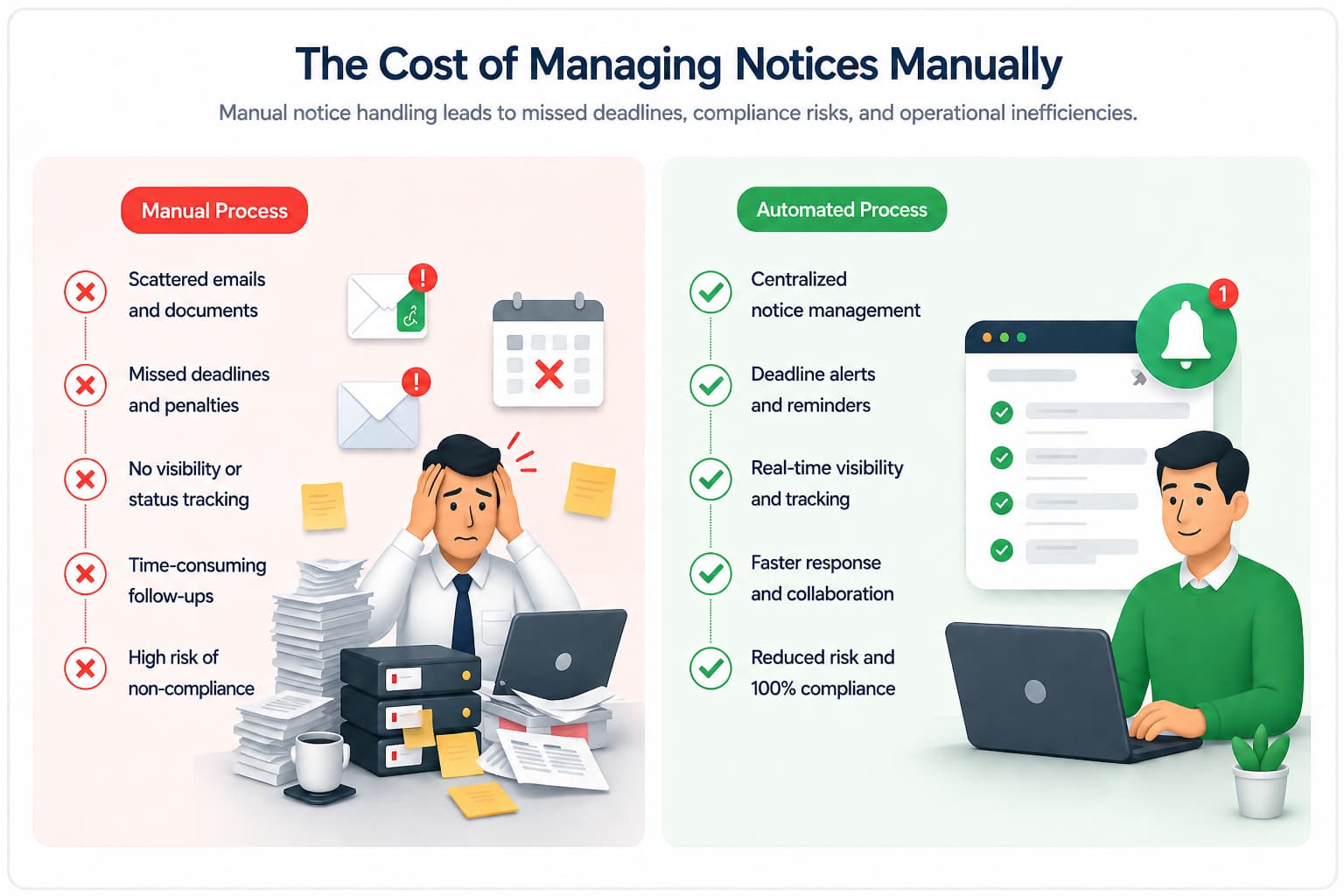
When notices are tracked manually, several things go wrong consistently.
Deadlines get missed. Legal notices carry statutory response timelines. A Section 138 notice requires a response within 15 days. A Section 80 CPC notice requires two months before a suit can be filed. When these deadlines are tracked through spreadsheets or individual memory, the risk of missing them is high. A missed deadline can mean losing the right to respond, facing an ex parte order, or being held in default.
There is no single source of truth. Notices arrive across email accounts, physical courier, registered post, and sometimes through court filings. Without a centralised system, no one person or team has a complete picture of the organisation’s notice portfolio at any point in time.
Routing is inconsistent. An incoming notice needs to reach the right person quickly. In many enterprises, this depends on who happens to be copied on the email or who the courier happens to reach first. Without defined workflows, notices sit unassigned and unacted upon.
Audit trails are incomplete. When a dispute escalates to litigation, the legal team needs to demonstrate what was sent, when it was sent, how it was delivered, and what response was given. Manual systems make this reconstruction difficult and unreliable.
Bulk notice operations are slow. For enterprises in banking, financial services, or collections, sending large volumes of demand notices is a regular activity. Preparing each notice manually, coordinating dispatch through physical and digital channels, and tracking delivery status individually is time-consuming and error-prone.
The underlying problem with manual notice management is that the process is only as reliable as the individual managing it. When accountability is not embedded in a system, it becomes personality-dependent and unpredictable.
What Notice Management Automation Does Differently
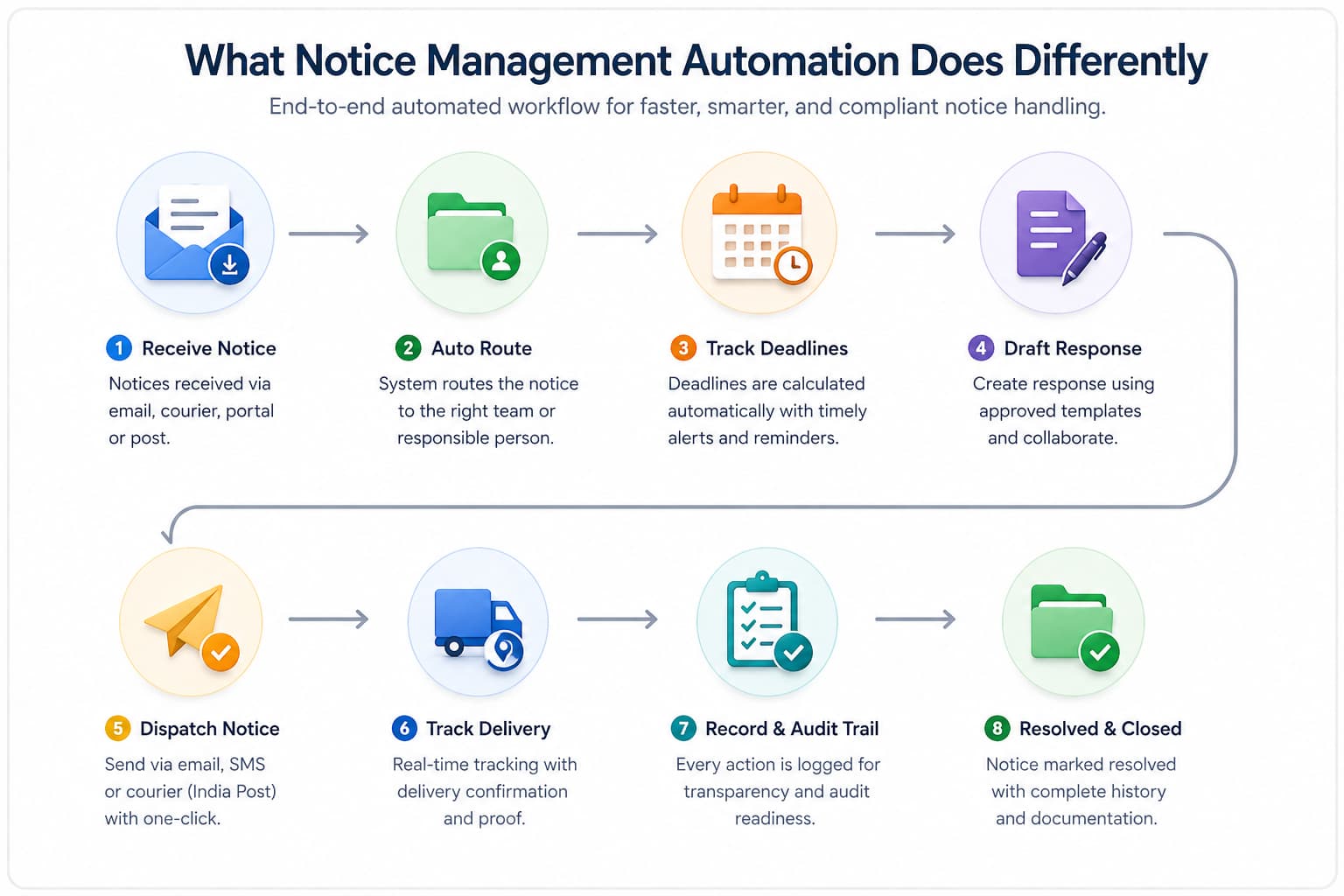
Automation does not simply speed up existing manual steps. It restructures how notice management works, replacing ad hoc processes with defined workflows.
Centralised notice lifecycle management
Every notice, incoming and outgoing, is tracked in a single system from creation or receipt through to resolution. The status of each notice is visible in real time: whether it has been drafted, sent, delivered, responded to, or escalated. Legal teams stop managing notices through email and start managing them through a dashboard.
Template-driven drafting for outgoing notices
Standard notice types, including demand letters, cheque bounce notices, employment communications, and breach of contract notices, follow defined formats. Automation platforms maintain approved templates for each notice type, allowing teams to generate accurate, legally compliant notices in minutes. For organisations sending bulk notices, the time saving is real. What might take a paralegal two days of drafting and formatting can be completed in a fraction of that time.
Automated deadline tracking and alerts
Once a notice is logged, the system calculates response deadlines automatically based on the notice type and applicable statute. Automated alerts go to the responsible team member and to escalation contacts at defined intervals before the deadline. No manual calendar entries, no reminders lost in overflowing inboxes.
Multi-channel dispatch and delivery tracking
Automated notice management platforms support dispatch through email, SMS, and physical courier channels, including India Post. Delivery status is tracked and recorded automatically, creating a verifiable audit trail. For notices where proof of delivery is legally important, this documentation is essential.
Structured incoming notice routing
When a notice arrives, the system routes it to the right team or individual based on predefined rules covering notice type, business unit, geography, or subject matter. Approval workflows ensure that response communications are reviewed before dispatch. Escalation rules trigger alerts if a notice approaches its deadline without being actioned.
The Connection Between Notice Management, CLM, and Litigation
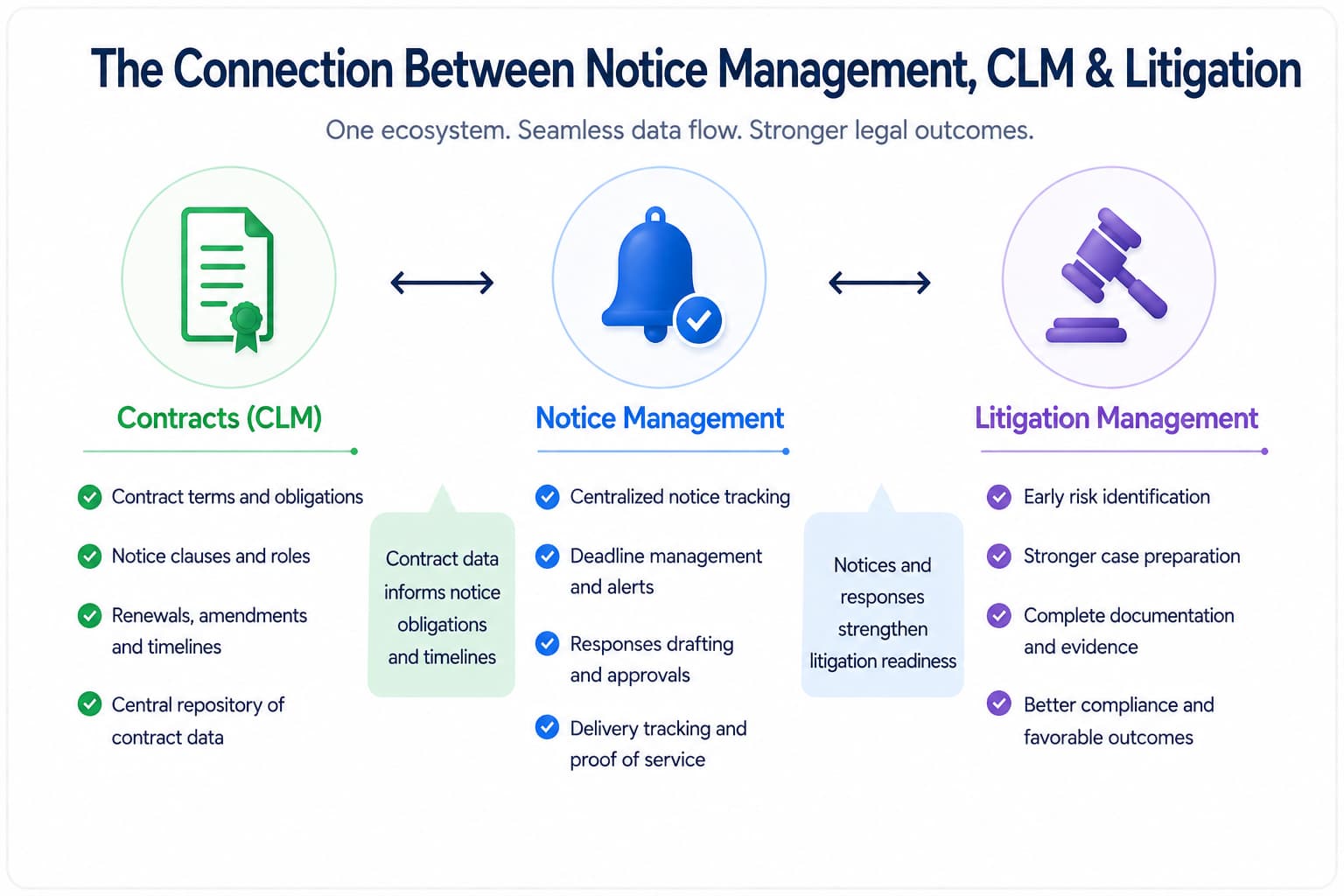
This is where the real operational efficiency lies, and it is the angle that most legal ops content misses entirely.
Legal notices do not exist in isolation. Most of them are tied to contracts or to ongoing or potential litigation.
A demand notice is typically triggered by a contractual breach: a vendor who has not delivered, a customer who has not paid, a counterparty who has violated an agreement term. If the notice management system is disconnected from the contract repository, the legal team has to cross-reference manually. They pull the contract, check the relevant clause, determine the appropriate notice format, confirm the governing jurisdiction. This is duplicated effort that adds time and introduces the risk of inconsistency.
When notice management is integrated with contract lifecycle management, the link is automatic. The platform knows which contract the notice relates to, what the relevant clause says, what remedies are available, and what the notice requirements are. The notice is drafted and dispatched with that context already built in.
Similarly, many notices are either precursors to litigation or responses to it. A Section 80 CPC notice is a mandatory pre-litigation step. A SARFAESI notice initiates a secured asset recovery process. When notice management is integrated with litigation tracking, the transition from notice to case is structured and documented. The legal team can track the entire history from the original dispute, through the notice exchange, into litigation, in one place.
This integration is what separates a notice management module from a notice management system. A standalone module handles notices in isolation. An integrated system treats notices as part of a connected legal operations picture, where contracts, notices, and cases inform each other.
What Legal Teams in India Specifically Need
The Indian legal environment adds complexity that generic legal ops platforms do not always address.
India’s regulatory framework generates a high volume of statutory notices. Tax demand notices, GST compliance communications, and notices from regulatory bodies such as SEBI, RBI, and IRDAI all require timely, accurate responses with documented audit trails. The regulatory framework itself changes frequently through notifications, circulars, amendments, and judicial interpretations, which means the notice management system needs to support updates to templates and workflows as requirements change.
Indian enterprises also operate across a large number of forums and jurisdictions. A large corporate may receive notices from district courts, high courts, tribunals, consumer forums, and regulatory bodies simultaneously, across multiple states. Without a centralised system that can classify and route notices by forum, the management burden is disproportionate to the size of the legal team.
Physical dispatch remains relevant in India in a way it is not in many other markets. Registered post and courier are still legally important channels for many notice types. A notice management system for Indian enterprises needs to support physical dispatch, including India Post integration, alongside digital channels, and needs to track delivery across both.
What to Look for in a Notice Management System
For legal teams evaluating notice management tools, the following capabilities matter most.
Centralised lifecycle tracking. The platform should track every notice from creation or receipt through to final resolution, with full status visibility at all times.
Template library for Indian notice types. Standard formats for Section 138 notices, Section 80 CPC notices, SARFAESI communications, employment notices, and other common Indian legal notice types should be available and customisable.
Multi-channel dispatch with delivery tracking. Both digital and physical channels should be supported, with automated delivery confirmation and audit logs.
Automated deadline management. The system should calculate statutory response deadlines automatically and send alerts to responsible team members and escalation contacts.
Integration with CLM and litigation management. Notice management should not function as a standalone module. Integration with the contract repository and litigation tracking platform ensures that notice activity is linked to the contracts and cases it relates to.
Bulk notice capabilities. For organisations sending large volumes of demand notices, bulk generation and dispatch should be supported without sacrificing accuracy or audit trail quality.
Role-based access and approval workflows. Sensitive notice communications should go through defined approval steps before dispatch, with access controls that restrict who can view and act on notices by type, business unit, or geography.
Legistify’s notice management module is built with these requirements in mind, with integration into its contract and litigation management capabilities so that notice activity is tracked in the context of broader legal operations.
Conclusion
Legal notice management is not a minor administrative function. For enterprises operating in India’s regulatory environment, it is a high-stakes, high-volume activity that has a direct bearing on litigation exposure, compliance standing, and contractual relationships.
The organisations that treat notice management as a structured, automated process with defined workflows, automated deadlines, multi-channel dispatch, and full audit trails operate with a clear advantage over those that rely on manual tracking. They miss fewer deadlines, respond faster, maintain cleaner records, and spend less legal team time on work that does not require legal judgment.
The connection between notice management, CLM, and litigation tracking is where the operational edge comes from. When these three functions work together in an integrated system rather than in separate spreadsheets and inboxes, the legal team has visibility and control that manual processes cannot deliver.