Every finance leader has had some version of this conversation. Legal is over budget, again, and the explanation involves complexity, unexpected developments, and a matter that ran longer than anticipated. It is delivered with confidence. But there is no data behind it, no early warning that it was coming, and no clear account of where the money actually went. This is the recurring friction point between legal and finance, and it is intensifying in 2026: outside counsel rates rose an average of 9.6% in 2025 alone, with senior partners at some elite firms now billing $2,000 to $4,000 an hour, while 90% of all legal spend still flows through standard hourly arrangements largely unchanged since before the billable hour became the burden it now represents.
This guide covers what legal spend management actually is, why 2026 is a genuine inflection point for how CFOs and legal operations teams are addressing it together, and the concrete components of a program that moves outside counsel spend from a defended budget line to a governed, forecastable one.
Why This Conversation Is Different in 2026
The tension between legal and finance is not new, but the data underlying it has changed in ways that make continuing to manage legal spend informally a harder position to defend. Despite 89% of GCs rating their relationship with their CFO as excellent, 77% have reported experiencing tension with their CFO in some way, and that tension usually comes down to one specific thing: legal and finance are not looking at the same numbers at the same time.
Almost 45% of Chief Legal Officers planned to increase outside counsel spend in 2025, a 17-percentage-point jump from the prior year. Departments that cannot demonstrate exactly where that additional spend is going, and whether it is priced correctly relative to market, cannot defend it to their CFO or negotiate it intelligently with their own law firms. That shift, from opinion to evidence, is where genuine rate negotiation leverage actually comes from, and it is exactly the capability most legal departments still lack.
Legal Spend Management: What It Actually Covers
Legal spend management is how corporate legal departments take control of outside counsel costs: tracking budgets by matter and practice area, enforcing billing guidelines, analysing firm performance, and generating the financial reporting that General Counsel and CFOs both need to demonstrate return on investment. For most in-house teams, outside counsel fees are the largest and least predictable line item in the legal budget, and legal spend management software exists specifically to change that.
By capturing historical spend data at the matter, firm, practice area, and individual timekeeper level, legal spend management systems give legal operations the inputs needed to build realistic budgets and genuinely accurate forecasts. Instead of estimating next year’s outside counsel spend based on simply extrapolating last year’s total, departments can model spend by matter type, adjust systematically for rate changes, and flag matters likely to run over budget before they actually do, rather than discovering the overrun only when the final invoice arrives.
The Five Connected Components of a Mature Program
Outside counsel rate governance. This is the starting point: negotiating rates, publishing and actively enforcing billing guidelines, building a preferred provider panel, and reviewing every rate renewal request against real market data rather than accepting the increase a firm proposes at face value. Panel consolidation reflects this discipline in action: the median number of law firms used by companies has declined from 14 to 10 over the past year, as departments concentrate spend with fewer, higher-performing relationships rather than spreading it thinly across a large, loosely managed panel.
E-billing enforcement. Structured e-billing review flags invoices that violate published guidelines, whether through unauthorised timekeepers, block billing that obscures what was actually done, or fees for work that was never pre-approved, before those invoices are paid rather than after. This single discipline is consistently cited as one of the highest-leverage components of a legal spend management program, precisely because outside counsel bills for work that is authorised, and the authorisation decisions, scope approvals, and budget sign-offs are internal legal operations decisions, not something a firm’s own invoice can be trusted to self-police.
Matter-level budgeting. Setting a budget at the individual matter level, not just an annual departmental total, is what converts financial management from retrospective reporting into proactive control. Without matter budgets, a legal department only discovers it is over budget after the fact; with them, spend against budget is visible in real time, and escalation can happen while a matter is still in progress rather than after the final invoice has already landed.
Firm performance analytics. Legal spend should be tracked against the strategic importance and actual outcome of the work being done by each external firm, not just the dollar amount billed. This is what allows a legal operations leader to identify which firms consistently deliver strong outcomes at reasonable cost, and which firms are simply expensive without a corresponding difference in the results they produce.
Financial reporting that finance actually trusts. The output of a mature legal spend management program is not just internal legal dashboards; it is reporting that a CFO can read and act on directly, using the same definitions, the same time periods, and the same level of granularity finance applies to every other cost centre in the business.
The KPIs CFOs Actually Want to See
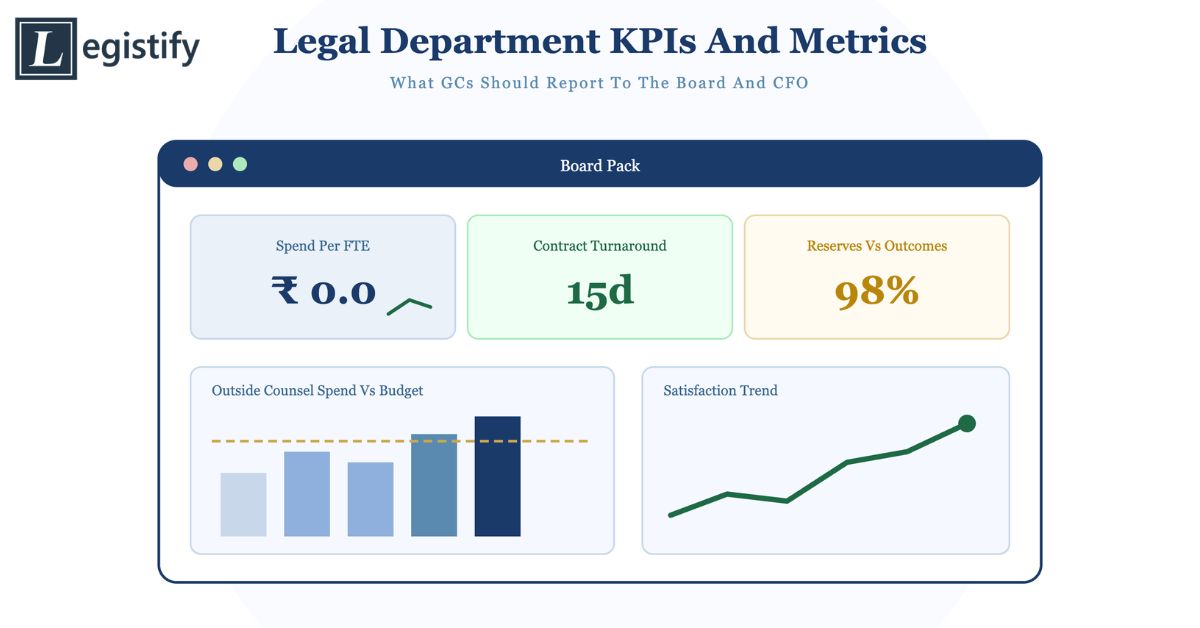
Legal departments are cost centres, and a CFO’s first question is consistently “how much, and how does that compare to peers.” The metrics that answer this question directly, rather than measuring activity that does not translate into a cost or value conclusion, are worth prioritising specifically.
Outside counsel spend per company FTE. The denominator here is total company headcount, not legal team headcount, because the question the CFO is actually answering is what legal is costing the business per employee, not how busy the legal team itself is.
Outside counsel spend as a percentage of revenue. This normalises spend against the size of the business, allowing genuinely meaningful comparison against industry benchmarks and against the organisation’s own historical trend, rather than a raw dollar figure that means little in isolation.
Matter mix between outside and inside resources. Tracking what proportion of legal work is being handled externally versus internally reveals whether the organisation is systematically over-relying on outside counsel for work that in-house capacity, properly resourced, could handle more cost-effectively.
E-billing rejection rate. This serves as a useful proxy for how seriously the department actually enforces its own published billing guidelines, since a rejection rate near zero on a large invoice volume often signals guidelines that exist on paper but are not genuinely being applied.
A useful discipline when building or refreshing a legal spend dashboard is ruthless pruning: many legal department dashboards accumulate an extra row every time a new function is created, compliance, privacy, ethics, without anyone going back to remove metrics that no longer earn their place. A dashboard that measures legal team activity rather than legal team value is one a sharp CFO can identify at a glance, and it undermines the credibility of the reporting function even where some of the underlying numbers are genuinely useful.
From Compliance-Mode to Strategic-Mode
The 2026 spend management priority for leading legal operations teams is upgrading from what might be called compliance-mode, simply enforcing billing guidelines after the fact, to strategic-mode: predicting spend before it occurs, optimising panel allocation based on actual performance data, and tying outside counsel selection directly to matter outcome data rather than to habit or historical relationship alone.
This shift is becoming possible because the underlying data finally exists. Matter management systems have accumulated years of billing data, outcome data, and matter complexity parameters, and AI integration has made the analytical tools needed to extract genuinely predictive value from that historical data far more accessible than they were even two or three years ago. The organisational will to actually use outside counsel performance data to make panel decisions, rather than defaulting to the same relationships out of inertia, is increasing precisely because CFO pressure on legal spend continues to intensify.
Why Legal Spend Is Not Simply a Finance Cost-Control Problem
In organisations without a dedicated legal operations function, outside counsel spend frequently lands directly on the CFO’s desk, and the CFO approves invoices and manages legal spend the way they would manage any other vendor relationship, through straightforward cost control. That approach is not wrong; it is simply the wrong tool for this specific problem. A CFO can cut a budget. What a CFO generally cannot do, without legal operations expertise sitting alongside them, is look at a specific invoice and determine whether a matter was overstaffed, whether the billed rate was actually appropriate for the seniority and complexity of the work performed, or whether the matter’s scope quietly expanded beyond what was originally authorised. Those are attorney-level judgments, which is precisely why legal spend management is fundamentally a legal operations problem wearing finance’s clothing, not a pure finance problem that simply happens to touch legal.
Building Measurement Before Building Budgets
The single highest-leverage investment a legal operations function can make right now is not a new technology platform. It is the baseline data collection and measurement infrastructure that will allow the organisation to demonstrate the value of every subsequent technology or process investment made afterward. Without this foundation, a legal technology budget will always be vulnerable to CFO scrutiny, and will always default to defending sunk costs rather than making a forward-looking, evidence-based case for continued or expanded investment.
A practical, often overlooked step here is demanding vendor data rights in contracts, specifically with outside counsel and with any legal technology vendor, so that historical spend, matter, and performance data remains genuinely accessible and portable to the organisation over time, rather than becoming locked inside a specific firm’s or vendor’s own systems in a format the legal department cannot easily extract and analyse independently.
What This Looks Like for Indian Enterprise Legal Teams
For Indian enterprises, the same underlying discipline applies, with a specific local dimension: panel management across Indian advocates and law firms operating under stage-linked or milestone billing (common in Indian litigation) alongside international firm engagements typically billed hourly requires a spend management approach that can meaningfully compare cost and performance across genuinely different billing models, not just track hourly totals uniformly. Litigation-heavy Indian enterprises specifically benefit from connecting spend data to case outcomes and case duration, since the panel advocate who wins matters faster at a slightly higher hourly rate frequently delivers better total value than the lower-cost advocate whose matters run considerably longer.
Legistify’s platform supports this connected view for Indian enterprise legal teams, linking litigation management, external counsel billing, and matter outcome data in a single system, so that panel performance, cost, and case duration can be assessed together, rather than legal spend sitting in a disconnected finance system with no visibility into which matters, and which advocates, actually drove the underlying cost.
Conclusion
Legal spend management in 2026 is moving from an occasional, defensive budget conversation into a genuinely structured discipline, driven by rising outside counsel rates, increasing CFO scrutiny, and, for the first time, the data infrastructure needed to actually answer the questions finance is asking. The departments succeeding at this are not the ones with the toughest individual rate negotiators; they are the ones with structured billing guidelines, active e-billing enforcement, a deliberately consolidated preferred panel, and matter-level budget discipline, all backed by data both legal and finance can look at together and actually agree on.