E-signatures are legally binding in India. The Information Technology Act, 2000 (IT Act) explicitly provides that electronic signatures are legally equivalent to handwritten signatures for the purposes of contract formation and authentication. The legal framework governing electronic signatures in India has been in place for over two decades, and the body of case law and regulatory guidance around it has grown substantially in that time.
But the answer to “are e-signatures legally binding” is not a simple yes or no. The legal validity of an electronic signature depends on the type of electronic signature used, whether the relevant requirements of the IT Act are met, and whether the document in question is one that the law requires to be executed in a specific form. Understanding these distinctions is practical for anyone signing or receiving electronically signed documents in India.
The Legal Framework: IT Act, 2000
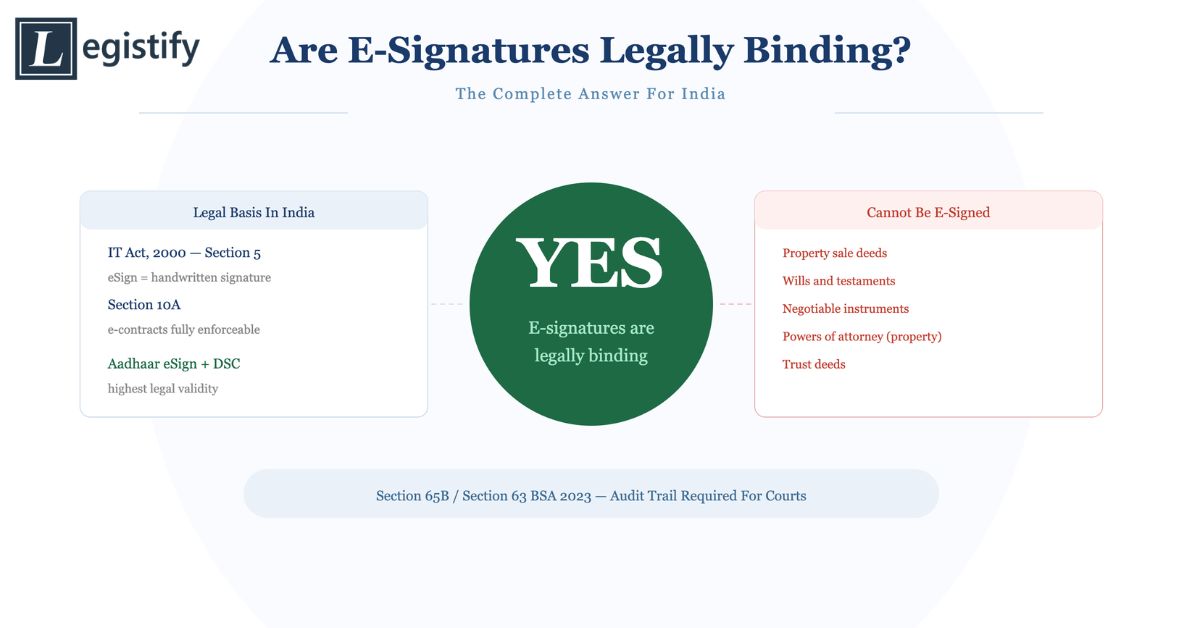
Section 5 of the Information Technology Act, 2000 is the foundational provision. It provides that where any law requires that information or any other matter shall be authenticated by affixing the signature of any person, such requirement shall be deemed to have been satisfied if such information or matter is authenticated by means of a digital signature affixed in such manner as may be prescribed by the Central Government.
Section 10A, inserted by the 2008 amendment to the IT Act, further provides that contracts formed through electronic means are valid and enforceable. A contract cannot be denied legal effect, validity, or enforceability solely because it is formed electronically.
The Second Schedule to the IT Act prescribes the electronic signature or electronic authentication techniques recognised by the law. The two main forms recognised are:
Digital Signatures based on public key infrastructure, issued by licensed Certifying Authorities under the IT Act. A Digital Signature Certificate (DSC) issued by a licensed CA constitutes a digital signature for the purposes of the IT Act.
Aadhaar eSign, which allows individuals to sign documents using their Aadhaar number and authentication through OTP or biometrics. Aadhaar eSign is provided through licensed Electronic Signature Service Providers authorised under the eSign (Third Party) Application Service Provider Guidelines.
Both of these forms are specifically recognised by the IT Act and produce electronic signatures that are legally equivalent to handwritten signatures.
What Makes an Electronic Signature Valid Under Indian Law
For an electronic signature to be legally valid under the IT Act, it must satisfy the requirements of Section 3A of the Act:
It must be unique to the person signing. The electronic signature must be linked to the signatory in a way that uniquely identifies them.
It must be capable of identifying the signatory. The signature must be capable of establishing the identity of the person who applied it.
It must be created in a manner that is under the sole control of the signatory. At the time of signing, only the signatory must have access to the signature creation data.
It must be linked to the electronic record in a manner that any subsequent alteration to the record is detectable. After the signature is applied, any change to the document must be detectable through the signature verification process.
These requirements are fully satisfied by DSC-based signatures and Aadhaar eSign. A basic electronic signature, such as a typed name, a scanned signature image, or a click-to-accept confirmation, does not inherently satisfy all of these requirements and has weaker legal standing than a DSC or Aadhaar eSign.
Types of Electronic Signatures in India and Their Legal Standing
Digital Signature Certificate (DSC). Issued by licensed Certifying Authorities under the IT Act, a DSC uses public key cryptography to create a signature that uniquely identifies the signatory, is unforgeable without access to the private key, and detects any post-signing alterations to the document. A DSC is the most legally robust form of electronic signature in India. It is mandatory for company filings with the Ministry of Corporate Affairs, income tax returns above certain thresholds, customs filings, and several other regulatory applications.
Aadhaar eSign. Authentication through Aadhaar-linked OTP or biometrics, provided by a licensed eSign Service Provider. Aadhaar eSign is widely used in financial services, insurance, and digital lending for consumer-facing agreements. It satisfies the IT Act requirements and is legally equivalent to a handwritten signature. It is particularly practical because it does not require the signatory to obtain and manage a DSC.
Basic electronic signature. A typed name, a scanned signature image, a click-to-agree, or a signature drawn using a mouse or finger. These forms are electronic signatures in the broad sense but do not satisfy the specific authentication requirements of the IT Act that apply to recognised electronic signatures. They may be legally valid for certain purposes under the general law of contracts (since the Indian Contract Act does not require signatures to be handwritten or authenticated in any particular way), but their evidentiary weight in a dispute is significantly lower than a DSC or Aadhaar eSign.
Documents That Cannot Be E-Signed in India
Despite the broad legal recognition of electronic signatures in India, certain categories of documents are explicitly excluded from the IT Act’s scope. Section 1(4) and the First Schedule to the IT Act exclude the following from the Act’s provisions:
Negotiable instruments other than cheques, including bills of exchange and promissory notes. These must be executed in physical form.
Powers of attorney that involve the granting of authority to deal with immovable property. These typically require registration, which implies physical execution.
Trust deeds under the Indian Trusts Act.
Wills and any other testamentary documents.
Contracts for the sale or conveyance of immovable property or any interest in immovable property. Sale deeds, gift deeds, and mortgage deeds must be executed physically and registered under the Registration Act, 1908.
For these categories of documents, wet ink signatures on physical documents remain mandatory. An electronic signature applied to a document in one of these categories does not produce a legally valid execution.
Sector-Specific Requirements
Beyond the IT Act’s general framework, specific regulatory bodies have issued guidance or requirements on electronic signatures in their sectors.
RBI Digital Lending Directions. The RBI’s Digital Lending Directions (May 2025) require that loan kits and Key Fact Statements be digitally signed and electronically transmitted to borrowers. These provisions effectively mandate electronic signature workflows for digital lenders.
IRDAI. Insurance documents including policy documents and proposal forms are accepted in electronic form. IRDAI has issued guidelines on electronic insurance and e-policies that recognise electronic execution.
SEBI. SEBI allows electronic signatures for certain regulatory filings and disclosures by listed entities and market intermediaries.
Companies Act, 2013. Company filings with the Ministry of Corporate Affairs must be digitally signed by the relevant signatories using DSCs. This is a mandatory requirement, not an optional convenience.
Evidentiary Framework: Section 65B and Section 63 BSA
For an electronically signed document to be admissible as evidence in Indian court proceedings, it must comply with the framework under Section 65B of the Indian Evidence Act (now Section 63 of the Bharatiya Sakshya Adhiniyam, 2023, which replaced the Evidence Act with effect from 1 July 2024).
Under this framework, an electronic record produced as secondary evidence must be accompanied by a certificate from a person in a responsible official position certifying that the electronic record was produced by a computer in regular use, that the computer was functioning properly during the relevant period, and that the information in the record was fed into the computer in the ordinary course of activities.
For electronically signed documents, this means maintaining a complete audit trail of the signing process: who signed, when, by what method, what authentication was used, and that the system was functioning correctly. E-signature platforms that produce a detailed audit trail of each signing event support Section 65B compliance significantly better than informal electronic signing methods.
Practical Conclusion for Indian Enterprises
For most commercial agreements between corporate entities in India, electronic signatures using Aadhaar eSign or DSC are fully legally binding and represent best practice. They satisfy the IT Act requirements, produce a clear audit trail, and are accepted by courts and regulators.
Legistify eSign (legistify.com/sign-doc) provides all three signature modes — Digital (OTP), Aadhaar eSign, and DSC Token — for free, with no account required. Upload a PDF of up to 10MB, add up to two signatories, and get a document signed in under two minutes with a court-admissible audit trail and full IT Act 2000 and BSA 2023 compliance.
Here is how to get started:
Step 1 — Upload your PDF. Go to legistify.com/sign-doc and upload the document. No sign-up or credit card needed.
Step 2 — Add signatories and choose signature type. Add up to two signatories by name and email. Select Digital (OTP-verified) for standard agreements, Aadhaar eSign for the highest legal enforceability, or DSC Token for regulatory-grade execution.
Step 3 — Place the signature field. Drag the field to the correct position on the document.
Step 4 — Send. Each signatory gets a secure signing link by email. Track completion with your unique document tracking code. Download the executed document with a tamper-evident, court-admissible audit trail once signing is complete.
For consumer-facing agreements, Aadhaar eSign is particularly practical because most Indian citizens with Aadhaar numbers can sign without obtaining a DSC. For regulatory filings and formal corporate documents, DSC signing is often mandatory.
The documents that cannot be electronically signed, including property transfers, wills, and negotiable instruments, require physical execution. For all other commercial documents, electronic signatures are legally binding and increasingly the standard for enterprise contracting in India.