DocuSign remains the most widely recognised e-signature platform, and for straightforward signature capture, it continues to do that job well. But for legal teams handling NDAs, vendor agreements, MSAs, and employment contracts, signing is just one part of a much longer process, and DocuSign’s core product does not fully support the rest of that process. DocuSign does not offer a clause library, automated approval routing, obligation tracking, or renewal alerts as native capability; it mainly serves as a signing tool, which means legal teams handle the remaining steps through email and spreadsheets outside the platform.
This gap, everything before and after the signature, is the primary reason legal teams evaluate DocuSign alternatives in 2026. This guide covers eight platforms worth considering, from full contract lifecycle management suites to more specialised tools, along with what specifically to evaluate before switching.
What DocuSign Does Well, and Where the Gap Actually Is
DocuSign continues to be genuinely competitive for enterprise teams with complex compliance needs, large budgets, and a broad integration ecosystem already built around it. For organisations whose primary need is reliable, compliant signature capture at scale, DocuSign’s established trust and partner network remain real advantages.
The gap that drives most legal teams to look elsewhere is specifically the absence of workflow automation, integrations tailored to legal review, contract reporting, and collaborative negotiation tooling. Legal teams still draft agreements in Word, negotiate through email threads, chase approvals in Slack, and store final signed PDFs in shared drives with limited searchability or reporting. DocuSign’s pricing model is also mainly per-user licensing, which becomes expensive quickly as more departments beyond legal (sales, procurement, HR) need access, and the automation and workflow features that legal teams actually want typically require an upgrade to DocuSign’s higher-priced IAM plans.
1. Legistify
Legistify is a full contract lifecycle management platform that goes well beyond what DocuSign offers, covering everything DocuSign leaves as a gap: drafting from approved templates, a built-in clause library, automated approval routing, obligation tracking, and renewal alerts, alongside a native e-signature capability that supports Digital (OTP), Aadhaar eSign, and DSC Token signing in one workflow. For Indian enterprises specifically, Legistify addresses requirements that no global CLM platform, including every other alternative on this list, handles natively: multi-state stamp duty assessment built directly into the execution workflow, DPDPA-compliant data processing agreements and obligation tracking, India Post registered dispatch integration for notice management, and clause libraries covering RBI, SEBI, and IRDAI regulatory requirements.
Where DocuSign requires legal teams to manage drafting in Word, negotiation over email, and renewal tracking on a separate spreadsheet, Legistify unifies the entire lifecycle, from intake through signature to post-signature obligation management, in a single connected system, with litigation and notice management modules that share data with the contract record rather than sitting in a disconnected tool.
For teams that want to start with signing specifically before adopting the full CLM, Legistify eSign is a free, no-sign-up tool supporting Digital (OTP), Aadhaar eSign, and DSC Token signing on PDFs up to 10MB with up to two signatories, producing a court-admissible audit trail compliant with the IT Act, 2000 and BSA 2023.
Best for: Enterprise legal teams that need full CLM functionality with native Indian compliance built in from the start, not adapted after the fact. Why it leads this list: It is the only platform here that combines complete contract lifecycle coverage with India-specific signature and compliance infrastructure as core functionality rather than a workaround.
2. SpotDraft
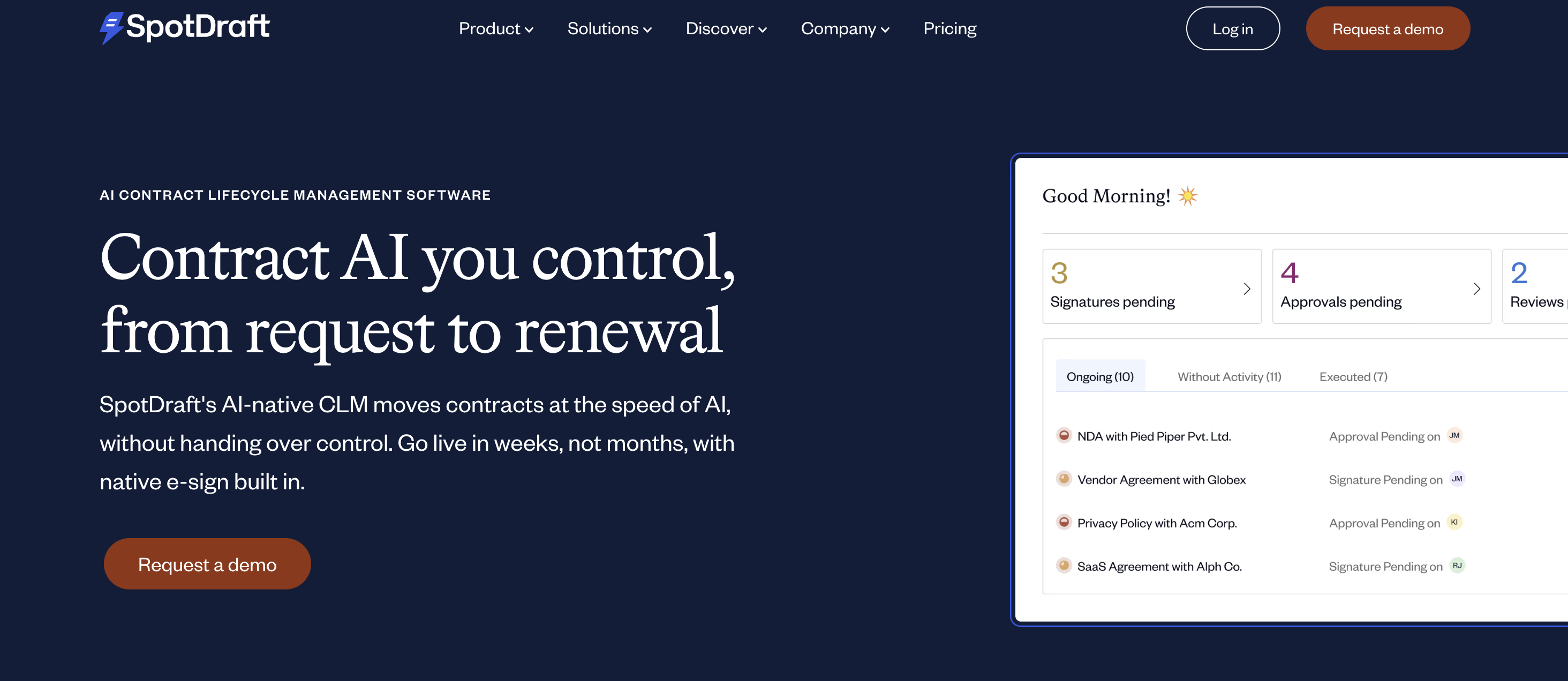
SpotDraft is a complete contract lifecycle management platform built specifically for in-house legal teams who want to work efficiently and stay organised across the full contract lifecycle, not just the signature step. It covers drafting, negotiation, approval routing, execution, and post-signature obligation tracking within a single platform.
Best for: In-house legal teams that want an end-to-end CLM built specifically around legal team workflows rather than a general business tool.
3. Ironclad
Ironclad is a leading enterprise CLM platform, named a Leader in the Gartner Magic Quadrant for CLM, built for legal operations teams that want to measure and optimise their entire contracting process, not just capture signatures. Its analytics show exactly where contracts get stuck in multi-step approval workflows and how long each stage takes on average.
Best for: Larger legal operations teams that want deep process analytics alongside contract execution, and are prepared for enterprise-level pricing and implementation scope.
4. Juro
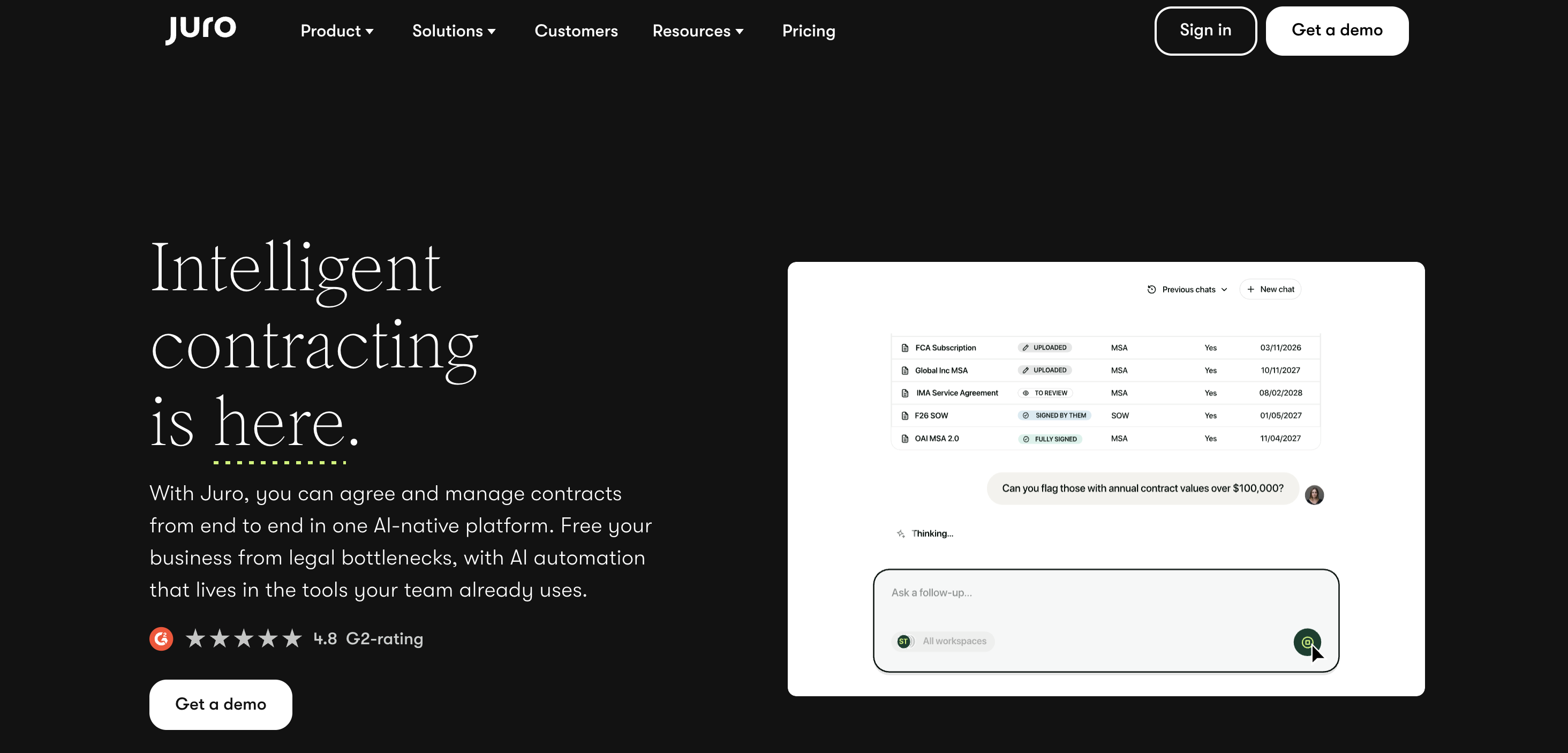
Juro positions itself as intelligent contract automation, enabling legal, HR, procurement, sales, and finance teams to create, agree, execute, and manage contracts significantly faster than manual, DocuSign-plus-email processes. It is particularly strong for organisations where sales teams need to self-serve on standard contract types without waiting on legal for every routine agreement.
Best for: Cross-functional teams (legal, sales, HR, procurement) that need fast self-serve contracting on standard agreement types.
5. LinkSquares
LinkSquares combines AI-powered contract analysis with lifecycle management, positioning itself specifically around extracting insight from an organisation’s existing contract repository as much as managing new contract creation and execution.
Best for: Legal teams with a large existing contract repository who want strong AI-driven analysis of historical agreements alongside forward-looking lifecycle management.
6. Luminance
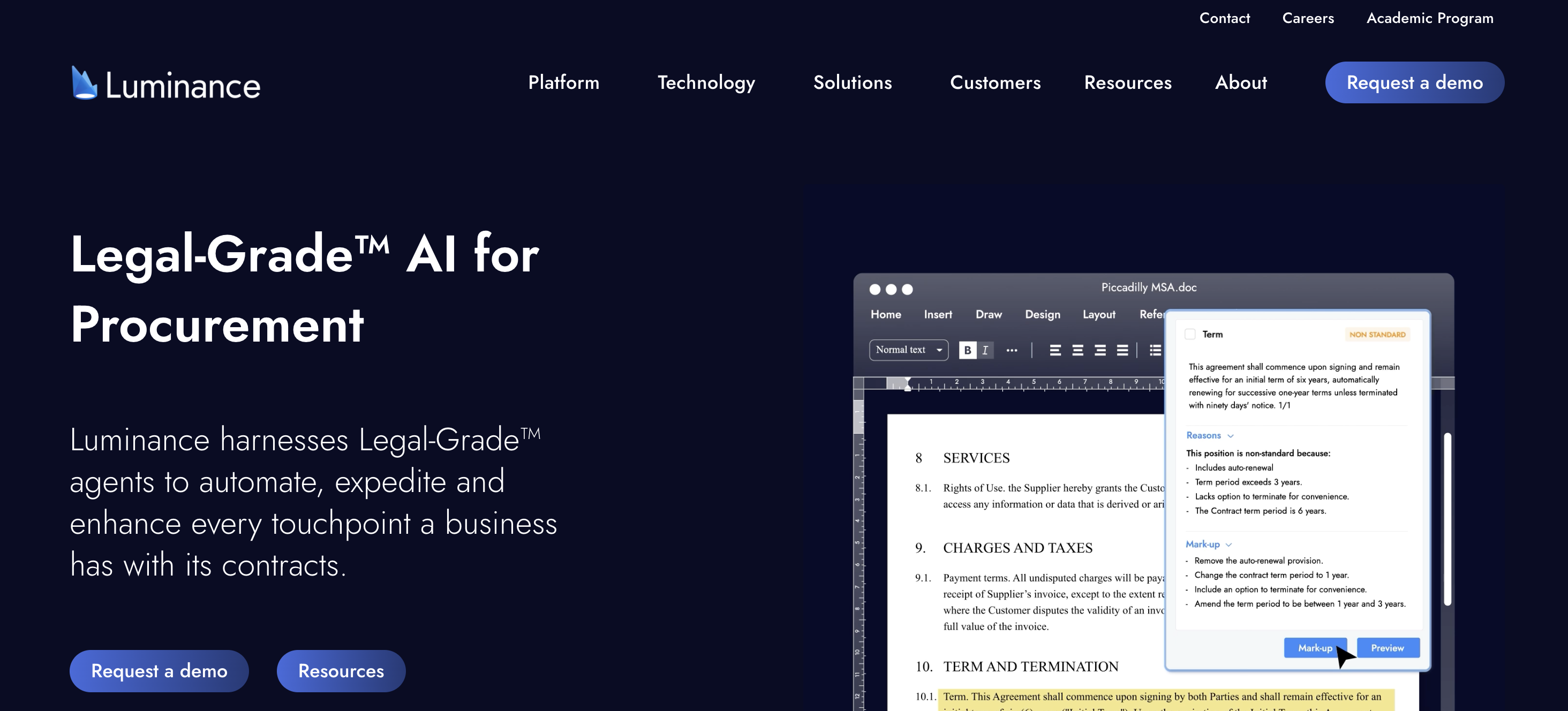
Luminance applies AI specifically to contract review and analysis, with strength in due diligence-style review across large contract volumes, drawing on its origins in AI-powered document review for M&A and litigation contexts.
Best for: Legal teams that need deep AI-assisted review capability, particularly for due diligence-style analysis of large volumes of existing contracts.
7. Sirion
Sirion is an AI-native, end-to-end CLM platform that unifies contract authoring, negotiation, execution, and post-signature performance management, with particular strength in enterprise governance, procurement visibility, and Salesforce and ERP integration for large, complex organisations.
Best for: Large enterprises with complex compliance, risk, and ERP integration requirements that need contract data operationalised across legal, procurement, and finance simultaneously.
8. Conga
Conga Contracts is a Salesforce-native CLM platform designed to support quote-to-cash processes directly within the CRM. Its deep Salesforce object alignment enables contract creation, negotiation, and execution without the sales team ever leaving the Salesforce interface, with strong alignment to CPQ and billing workflows.
Best for: Revenue teams standardising contract processes within a Salesforce-driven quote-to-cash workflow, where embedding contracting directly in the CRM matters more than a standalone legal-first interface.
Comparison at a Glance
| Platform |
Core Strength |
Best Suited For |
| Legistify |
Full CLM + India-specific compliance built in |
Indian enterprise legal teams needing native Aadhaar eSign, DSC, stamp duty, and DPDPA support |
| SpotDraft |
Full CLM built for in-house legal |
In-house legal teams wanting an end-to-end platform |
| Ironclad |
Process analytics and optimisation |
Legal ops teams measuring approval bottlenecks |
| Juro |
Fast, cross-functional self-serve contracting |
Sales, HR, procurement teams alongside legal |
| LinkSquares |
AI analysis of existing contract repository |
Teams with large historical contract volumes |
| Luminance |
Deep AI-assisted review, due diligence style |
Large-volume contract review and analysis |
| Sirion |
Enterprise governance and ERP integration |
Large, complex enterprises with procurement/finance ties |
| Conga |
Salesforce-native quote-to-cash |
Revenue teams standardising within Salesforce |
What to Evaluate Before Switching from DocuSign
Confirm what you actually need beyond signing. If your core pain point is genuinely just signature capture at higher volume or lower cost, a simpler, cheaper e-signature-only tool may be sufficient rather than a full CLM migration. If the pain point is the surrounding process (drafting, negotiation, approval, renewal tracking), a full CLM platform is the more appropriate comparison category.
Check integration depth with your existing systems. Whether your priority is Salesforce (Conga, Sirion), general cross-functional adoption (Juro), or India-specific systems (Legistify), verify the specific integration depth rather than assuming broad “integrates with everything” marketing claims translate into the specific connection you need.
Understand the pricing model’s scaling behaviour. DocuSign’s per-user pricing becomes expensive as more departments need access; confirm whether the alternative you are evaluating scales similarly, or offers a flat-rate or usage-based model that better fits your expected growth in users and departments.
Verify security, compliance, and regional requirements specifically. For Indian enterprises, this means explicitly checking Aadhaar eSign and DSC support, DPDPA compliance, and multi-state stamp duty handling, none of which most global CLM platforms address natively, regardless of how strong their other capabilities are.
Plan for migration of the existing contract repository. Ask any vendor you are seriously considering how they handle bulk ingestion and metadata extraction from your existing signed contracts, since most legal teams switching from a signature-only tool like DocuSign have a substantial historical repository that needs to be brought into the new platform, not just new contracts going forward.
Conclusion
DocuSign remains a strong choice for organisations whose primary need is compliant signature capture at scale within a broad, established integration ecosystem. But for legal teams that need clause libraries, automated approval routing, obligation tracking, and renewal alerts as part of their core workflow, rather than handled manually outside the platform, a purpose-built CLM alternative typically delivers significantly more value, and Legistify leads that group by combining complete lifecycle coverage with India-specific compliance built in natively rather than bolted on. The right choice among the eight platforms above still depends on your specific priority: process analytics (Ironclad), cross-functional self-serve speed (Juro), Salesforce-native embedding (Conga), enterprise governance at scale (Sirion), or full lifecycle coverage with native Indian regulatory compliance (Legistify).