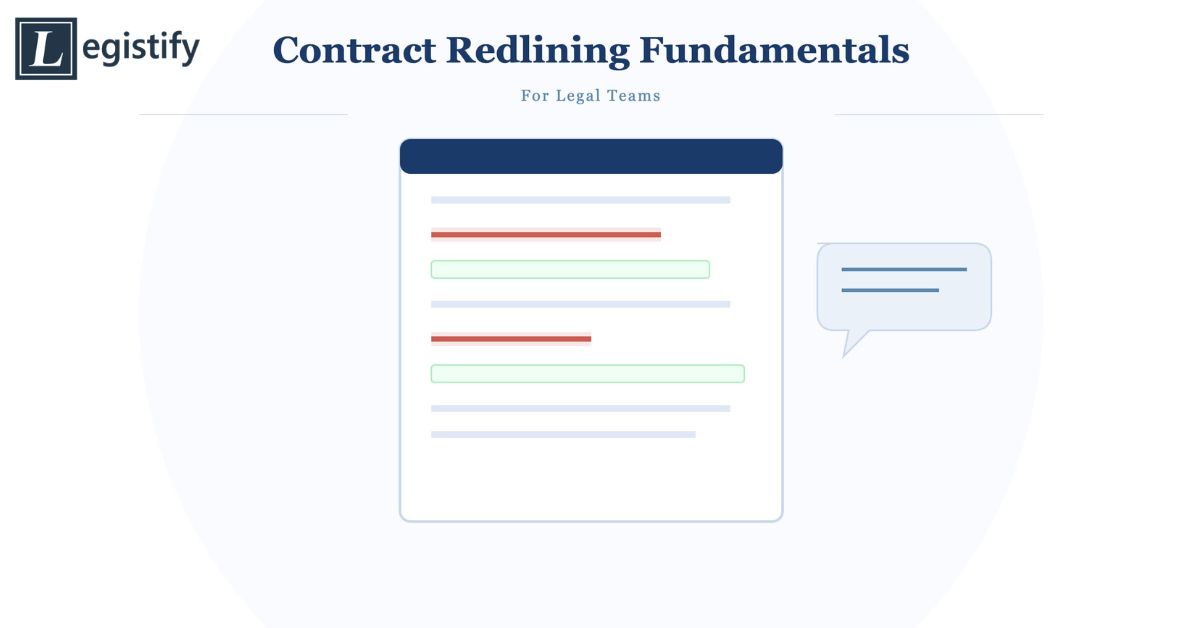
Contract redlining is the tracked-edit process that settles a negotiation in writing. It is called redlining because, in the paper era, proposed changes were marked in red ink on a physical printout; today it is done almost entirely through tracked changes and comment threads in Word or a dedicated contract platform, but the underlying function is identical. Each side edits the document, explains material revisions in comments, and exchanges versions back and forth until the language works for both parties.
According to a 2023 World Commerce & Contracting study, poor contract management costs organisations an average of 9% of annual revenue, and a significant share of that waste originates specifically in the negotiation and redlining phase, where miscommunication, lost edits, and unclear version history compound into delays that stretch what should be a days-long process into weeks or months. This guide covers the fundamentals every legal team needs to get right, and where the process most commonly breaks down.
What Contract Redlining Actually Is
Redlining is the process of marking proposed changes to a contract so that both parties can see exactly what was added, removed, or reworded, rather than having to compare two clean documents side by side and guess at what changed. One side sends a draft; the other reviews it, marks up their proposed changes with tracked edits and margin comments explaining the reasoning where needed, and sends it back. This back-and-forth continues, sometimes across several rounds, until both sides converge on language they can each accept.
It is worth being precise about where redlining sits within the broader negotiation process, since the terms are sometimes used loosely. Redlining specifically refers to marking up the document itself. Review is the earlier stage of reading and assessing a contract against internal standards before any edits are proposed. Negotiation is the broader conversation, sometimes happening over redlines, sometimes over calls or meetings, that resolves the substantive disagreements the redlines surface. Good redlining supports negotiation; it is not a substitute for the actual conversation about why a party wants a particular change.
Why Redlining Quality Varies So Much Between Teams
Strong redlining and sloppy redlining produce very different negotiation experiences, and the difference usually comes down to discipline rather than tooling alone. Good redlining is fast, clear, and easy to follow: every change is visible, every material revision is explained, and everyone involved can tell at a glance what changed between this version and the last. Sloppy redlining is slow, confusing, and genuinely expensive, because every untraceable edit or unexplained change forces another round of clarifying questions, adding days to a negotiation that clean redlining would have closed in a single exchange.
The Fundamentals Every Legal Team Should Apply
Start from a pre-approved template, not a blank page
Using a well-drafted, pre-approved template as the starting point for every negotiation saves the team from reinventing standard language on every single deal. A solid template already includes the organisation’s standard terms, tested legal language, and consistent formatting, which means redlining effort concentrates on the clauses that actually matter for that specific deal, pricing, timelines, service terms, rather than being wasted on redrafting boilerplate that should already be settled.
Define negotiable versus non-negotiable terms before the redlining starts
Establishing, ideally within a documented negotiation playbook, which terms are genuinely open to negotiation and which are fixed organisational positions gives the person doing the redlining clear parameters to work within. Without this, redlining becomes a case-by-case judgment call on every clause, which is both slower and more prone to inconsistency across different deals and different reviewers.
Keep every change visible, with tracked changes always on
This sounds obvious, but it is the single most common source of confusion in redlining disputes: a change made without tracked changes turned on, buried inside what looks like an otherwise clean paragraph, that the other side does not notice until much later, if at all. Every proposed edit needs to be visible as an edit, not silently incorporated into the flowing text.
Explain material revisions, don’t just mark them
A tracked change shows what was altered; it does not always explain why. For any revision that is not self-explanatory, particularly language that shifts risk, liability, or a commercial term, a margin comment explaining the reasoning saves the counterparty a round of clarifying questions and speeds up their own internal review of the redline.
Control versions rigorously
Contract redlining is a constant back-and-forth, and it is genuinely easy to lose track of which version is actually the most current, particularly once a negotiation has gone through several rounds across email. A document that gets edited by more than one internal reviewer, then sent externally, then redlined by the counterparty, then further internally revised, needs a clear, consistent version naming and tracking discipline, or the team risks working from, or worse, executing, an outdated draft.
Prioritise the clauses that carry genuine risk
Not every clause deserves equal redlining attention. Reviewers should prioritise the highest-risk provisions, liability caps, indemnification, termination rights, payment terms, spending proportionate time there, rather than treating every paragraph of a lengthy agreement with identical scrutiny. This is both a speed practice and a risk management practice: the clauses most likely to matter in a future dispute are exactly the ones that deserve the most careful attention during negotiation.
Get explicit agreement, not assumed agreement, on proposed changes
Everyone involved in a negotiation, on both sides and across internal stakeholders, should genuinely agree on the changes being proposed before a redline is sent forward. Skipping this internal alignment step often leads to confusion, rework, or, in the worse cases, a loss of trust with the counterparty when an internal stakeholder later objects to a term that had already been represented as agreed.
Refine the playbook as new edge cases surface
A negotiation playbook is not a static document. As redlining across different deals surfaces new edge cases, clause variations the playbook did not anticipate, or market terms that have shifted since the playbook’s positions were last set, the playbook should be updated to reflect this. A position that was reasonable a year ago may no longer match how the organisation currently allocates risk, and a stale playbook produces inconsistent redlining decisions across the team.
Where Manual Redlining Breaks Down
Manual redlining, conducted through email attachments and Word documents passed back and forth, creates a specific, recurring set of operational problems that compound as contract volume grows.
Version sprawl. Multiple copies of a contract circulating across email threads, with no single authoritative source of the current version, is one of the most common and costly failure modes in manual redlining.
Lost or untracked edits. Changes made without tracked changes enabled, or edits that get accidentally accepted or rejected during a file conversion between Word and PDF, silently disappear from the negotiation record.
Formatting breakage. Documents that move between Word, email, and PDF repeatedly accumulate formatting inconsistencies that make the redline itself harder to read and interpret correctly.
No centralised audit trail. When redlining happens across scattered email threads rather than a single workspace, reconstructing exactly what was proposed, by whom, and when, becomes genuinely difficult if a dispute later arises about what the parties actually agreed to during negotiation.
Contract platforms have worked for years to move redlining inside a centralised workspace rather than leaving it scattered across email, and the more mature tools now genuinely deliver on this: a shared negotiation workspace where both sides comment and edit directly, version history that stays tidy and centralised automatically rather than depending on manual file naming discipline, and AI-assisted review that checks incoming redlines against the organisation’s own playbook, flagging deviations and proposing compliant fallback language automatically.
The practical value of this shift is not just convenience. It directly addresses the specific failure modes described above: centralising the negotiation eliminates version sprawl and lost edits by design, and an integrated audit trail means there is no ambiguity later about what was proposed, accepted, or rejected at each stage of the negotiation.
That said, adoption of these centralised platforms is uneven in practice. A negotiation frequently starts inside a shared workspace and then, at some point, someone emails a Word document instead, either because the counterparty is not on the same platform or because habit reasserts itself under time pressure. The discipline of keeping redlining inside a single, structured system, rather than allowing it to fragment back into email the moment friction appears, is as much a change management challenge as a technology one.
Bringing Redlining Into a Connected Contract Workflow
For legal teams managing meaningful contract volume, treating redlining as an isolated activity, disconnected from the template it started from and the executed, signed contract it eventually produces, creates the same kind of visibility gap that plagues manual contract management more generally. When the playbook that governs redlining decisions, the template the negotiation started from, and the final executed document all live in the same connected system, the organisation gets a genuinely complete record: not just what was signed, but how the parties got there, and why specific terms ended up where they did.
Legistify’s contract management platform supports exactly this kind of connected redlining workflow, with AI-assisted review that checks incoming contracts and redlines against the organisation’s own playbook positions, a centralised negotiation workspace that keeps version history intact automatically, and a direct link between the negotiated redline and the final executed contract, so the full negotiation record stays attached to the agreement it produced rather than living separately in an email archive that nobody can search later.
Conclusion
Contract redlining is where negotiations actually get settled in writing, and the difference between fast, clear redlining and slow, confusing redlining comes down to a consistent set of disciplines: starting from a solid template, defining negotiable positions in advance, keeping every change visible and explained, controlling versions rigorously, and prioritising attention on the clauses that carry genuine risk. Manual redlining through scattered email threads is where most of this discipline breaks down at scale, which is why centralised, AI-assisted redlining workflows connected to the organisation’s broader contract system are becoming the standard for legal teams managing meaningful contract volume in 2026.