Contract generation tools have made it faster and more accurate to create legally binding agreements. Agreement generation software helps teams draft contracts digitally, with features like e-signatures, blockchain security, and real-time collaboration. Staying current with the latest tools and approaches in contract management gives organisations a clear operational advantage.
What is Contract Generation?
Contract generation is the process of creating legally binding agreements efficiently and accurately using structured templates, automation, and digital tools. Modern businesses use dynamic clause libraries, CRM-integrated drafting, and smart contracts powered by blockchain technology to complete agreement processes with greater speed and consistency.
The stages involved in generating a contract are:
- Sending a contract request: The content of the contract is decided so that both parties agree on what needs to be included.
- Research: All relevant information is gathered based on the context set for the contract, including a review of applicable legislation to ensure compliance.
- Writing: A contract draft is created using the information gathered, with key clauses added to ensure the document is legally binding.
- Final stages: The written document is checked for correct formatting, then sent for approval. This process continues until the contract is signed.
Contract generation software automates the population of templates with relevant data, enforces standard legal language, and supports collaboration across legal, sales, and procurement teams.
Why Do You Need Contract Generation Software?
Contract generation software saves time, reduces errors, and ensures contracts follow internal and regulatory requirements. It supports collaboration across teams, automates approvals, and gives all parties a clearer understanding of their contractual responsibilities — letting organisations handle contracting more efficiently without adding headcount.
Key Concepts in Contract Generation
Understanding the core principles behind contract generation allows organisations to automate parts of the process and maintain compliance across different contract types:
| Features |
Description |
| Templates as Blueprints |
Ready-made formats with customisable names, dates, and prices. |
| Smart Fill Technology |
Auto-fills fields using CRM; updates with new source data. |
| Conditional Rules |
Adds or removes clauses based on predefined if-then logic. |
| Automated Contract Generation |
Detects issues, flags terms, and suggests compliant alternative language. |
| Electronic Workflow |
Tracks edits, reviews, and signs with legal e-signature capability. |
| Automatic Organisation |
Secure storage, document tagging, and reminders for important dates. |
| Continuous Updates |
Stays legally current, version-controlled, and synced across devices. |
Top Clauses and Terms for Effective Contract Drafting
Key terms used in the contract generation process:
Core Document Terms
These define the foundational elements of a contract.
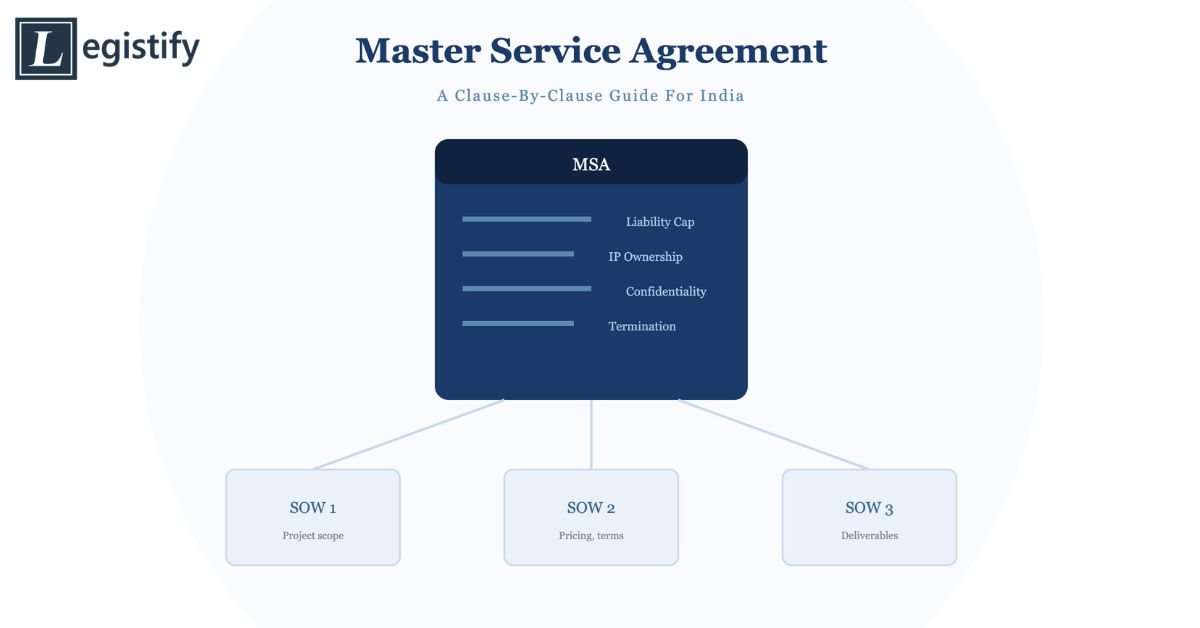
- Master Agreement: The primary contract governing an ongoing business relationship.
- Statement of Work (SOW): Outlines detailed deliverables and timelines.
- Amendment: A formal modification to the original contract terms.
- Exhibit/Attachment: Supplementary documents that support or elaborate on contract content.
Structural Components
These define the framework shaping contract enforceability in an automated contract generation workflow.
- Recitals/Preamble: Background information and context for the agreement.
- Definitions Section: Clarifies precise meanings of capitalised terms.
- Representations & Warranties: Factual assertions by parties regarding facts or conditions.
- Covenants: Ongoing obligations during the contract term agreed upon by the parties.
- Conditions Precedent: Requirements that must be met before the contract becomes enforceable.
Operational Terms
These cover the practical implementation requirements of a contract generation tool.
- Term/Termination: Defines contract length and how and when it may end.
- Service Levels/KPIs: Specifies expected performance targets to ensure consistent service delivery.
- Delivery Milestones: Establishes timeline checkpoints to track progress and ensure accountability.
- Acceptance Criteria: Outlines conditions that must be met to approve deliverables.
- Change Order Process: Provides structured methods to manage and approve contract modifications.
Risk Management Terms
These allocate liability and protection mechanisms in any contract.
- Limitation of Liability: Limits the total amount one party pays if something fails.
- Indemnification: One party compensates another for specific damages or legal losses.
- Force Majeure: Excuses obligations during unforeseeable, external, and uncontrollable events.
- Insurance Requirements: Requires parties to maintain specific insurance coverage throughout the contract.
- Liquidated Damages: Pre-agreed financial compensation for specific contract breaches or performance failures.
Intellectual Property Terms
These regulate knowledge asset ownership within contract generation workflows.
- License Grant: Defines allowed usage scope under specific rights granted by the licensor.
- Ownership Allocation: Specifies who retains rights to intellectual property or developed materials.
- Proprietary Rights: Protects sensitive information and enforces rights over proprietary business content.
Specialised Clauses
These address specific business protections using contract generation software.
- Non-Compete: Restrictions on competitive activities.
- Non-Solicitation: Limits on approaching employees or customers.
- Survival Provisions: Terms that continue after termination.
- Dispute Resolution: Controls conflict management procedures.
Execution Terms
These ensure valid agreement formation in any automated contract generation system.
- Electronic Signatures: Validates contracts executed digitally under applicable electronic signature laws.
- Authority Representations: Confirms each signer has the legal power to bind their party.
- Effective Date: Specifies the exact date contract obligations begin and become enforceable.
- Notice Provisions: Outlines acceptable formats and addresses for sending official communications.
Technologies in Contract Generation
The technology behind contract generation is what drives real change in legal workflows. Here are the key technologies powering modern contract generation:
| Technology |
Description |
| Contract Lifecycle Management (CLM) Software |
Tools to manage the end-to-end contract process. |
| Document Automation Tools |
Automated contract generation using templates and predefined logic. |
| Artificial Intelligence (AI) |
Analyses contract language, suggests clauses, and detects risks using AI-powered automated contract generation. |
| Natural Language Processing (NLP) |
Enables machines to understand and interpret legal language in contracts. |
| E-signature Tools |
Enables the electronic signing of contracts in most contract generation tools. |
| Blockchain |
Provides secure, immutable records of contract execution. |
| Smart Contracts |
Self-executing contracts with terms directly written into code. |
| Cloud Storage |
Centralised access and storage of contract documents. |
| Version Control Systems |
Tracks changes and maintains different versions in the contract generation process. |
| Collaboration Platforms |
Allows real-time editing and stakeholder collaboration. |
| Data Analytics Tools |
Analyses contract data for insights, compliance, and performance. |
| OCR (Optical Character Recognition) |
Converts scanned or image-based contracts into editable digital text within contract generator software. |
| APIs (Application Programming Interfaces) |
Integrates contract tools with CRMs, ERPs, and legal databases. |
What Does the Contract Generation Process Typically Look Like?
Today’s contract generation process combines human judgment with digital tools to produce better, more consistent agreements. Here is how the process moves from discussion to executed contract:
1. Initiation
- The user selects the type of contract (e.g., NDA, sales agreement) via a contract generation tool.
- Answers a few basic questions (names, dates, amounts).
2. Template Selection or Drafting
- A pre-approved template is selected based on contract type.
- The system may auto-fill existing company or customer data.
3. AI-Powered Drafting
- Instantly builds a document using approved templates with accurate details.
- Standard legal protections and necessary clauses are added automatically via contract generation software.
4. Quick Review
- The legal team checks key points in minutes rather than hours.
- Any needed adjustments are made using intuitive editing tools.
5. Negotiation
- All parties review and propose changes in a shared, cloud-based document.
- AI suggests wording to help resolve points faster, a feature of automated contract generation.
- Everyone works on the most recent version through real-time updates.
6. E-Signature & Execution
- Once finalised, the contract is signed electronically with a single click.
- No printing or scanning needed.
- The signed version is saved and securely stored.
Stages of Creating Contracts: The 8-Step Framework
Here is the 8-stage framework used by legal and business teams to implement contract generation effectively:
Requirement Gathering
The first step is to determine why the contract is necessary and define its primary purpose. The main parties and key terms are identified, setting the foundation for the rest of the process.
Template Selection
A pre-approved template is selected from the contract library within the contract generation software platform. Standardised wording ensures consistency, legal compliance, and faster turnaround.
Clause Customisation
Clauses are added, modified, or removed to fit the specific transaction and applicable law. Customisation helps organisations manage risk and meet their distinctive operational needs.
Data Population
All necessary contract details — names, dates, payment information, and deliverables — are included. Automation tools pull this data from integrated systems, reducing errors and speeding up the automated contract generation process.
Review and Collaboration
All relevant parties — legal, procurement, sales, and clients — are given access to the draft for evaluation and comments. Real-time collaboration tools support version control, edit tracking, and transparent negotiation.
Approval Workflow
Each contract goes through step-by-step approvals handled by legal, finance, and management. Automated workflows within agreement generation software ensure internal policies are followed and the right people sign off at the right time.
Execution
Once approved, all involved parties sign the contract. Electronic signatures ensure quick turnaround, eliminate paper-based delays, and maintain audit trails.
Managing and Storing
All executed contracts are securely stored in centralised repositories. Important dates such as renewals and compliance milestones are logged automatically, and possible risks are flagged for ongoing management.
What Are the Benefits of Automating Contract Creation?
Here are the key benefits of using contract generation software:
| Benefits |
Description |
| Efficiency |
Contract generation software automates drafting processes, saving time and effort by eliminating repetitive tasks. |
| Accuracy |
Standardised templates and predefined clauses reduce the risk of errors across all contract types. |
| Compliance |
Built-in checks help organisations comply with legal, regulatory, and internal policies. |
| Risk Reduction |
Automated contract systems identify potentially risky clauses and non-standard terms early in the process. |
| Cost Savings |
Minimising legal review time, automating administrative tasks, and reducing manual errors cuts overall contracting costs. |
| Collaboration |
Modern contract tools enable real-time input, comments, and approvals from multiple users across teams. |
Best Practices in Contract Generation
Effective contract generation ensures accuracy, speed, and legal compliance. Here are the best practices to follow:
| Best Practices |
What to Do |
Why It Matters |
| Use Contract Software |
Start with approved templates in a digital contract platform. |
Speeds up creation and keeps terms compliant. |
| Auto-Populate Details |
Link business tools to auto-fill names, amounts, and dates. |
Cuts down errors and saves manual effort. |
| Build Conditional Logic |
Add smart rules to modify terms based on contract type. |
Ensures accurate and dynamic clauses. |
| Review with AI Help |
Let AI flag gaps or risky wording. |
Improves quality and reduces legal risk. |
| Enable Quick Signing |
Use one-click e-signatures and status tracking. |
Speeds up approval and execution time. |
| Centralise Storage |
Keep contracts in a secure, searchable digital location. |
Prevents loss and helps manage renewals. |
Future Trends in Contract Generation
Contract generation is shifting from isolated task automation towards continuous, AI-driven decision support, and the trend is backed by measurable industry data rather than speculation. Here are the developments genuinely shaping the space:
| Trend |
Impact |
| Generative AI Becoming Standard Practice |
Gartner forecasts that more than 80% of enterprises will have implemented generative AI applications by 2026, shifting contract drafting from a manual process to one that produces complete, compliant first drafts in minutes. |
| Agentic AI in Contract Workflows |
Emerging AI agents are moving beyond simple reminders to autonomously creating tasks, assigning responsibilities, and coordinating multi-party approval processes under human oversight, rather than replacing human sign-off. |
| AI-Assisted Negotiation |
Industry surveys indicate a large majority of legal professionals expect AI to play a growing role in negotiation support, particularly around frequently negotiated terms such as limitation of liability, indemnification, and termination clauses. |
| Contract Intelligence Over Static Repositories |
Contracts are increasingly treated as a source of business intelligence rather than static documents, with AI systems analysing entire portfolios to benchmark vendor performance, forecast renewals, and flag compliance risk earlier. |
| Market Growth in AI Contract Tools |
The global market for AI-based contract management systems is projected to grow at over 20% annually through 2030, reflecting sustained enterprise investment in automation and compliance tooling. |
Legistify’s Contract Creation Software: Automate The Process
Legistify helps legal, procurement, and business teams draft, negotiate, and manage contracts through its AI-powered drafting engine, e-signature integration, and built-in compliance checks. Unlike tools focused on a single area such as simple sales contracts, Legistify provides an AI-based contract lifecycle management (CLM) system trusted by legal, procurement, and enterprise teams, built around the following capabilities:
- AI clause suggestions: recommends relevant clauses based on contract type and risk level.
- End-to-end CLM: manages the full contract lifecycle from drafting through renewal in one platform.
- Advanced legal compliance controls: built-in checks to help keep contracts aligned with regulatory and internal policy requirements.
- Flexible custom approval workflows: configurable routing so the right stakeholders sign off at the right stage.
- Dynamic templates and a built-in clause library: standardised starting points that reduce drafting time and legal risk.
- Customisable CRM integration, including with platforms such as Salesforce, to keep contract data in sync with sales and account records.
- Native eSignature integration: contracts can be signed within the same platform used to draft and manage them.
The platform supports automated contract generation through intelligent drafting, a compliance-first approach, and ready-to-use integrations, making it a comprehensive solution for organisations that require speed, security, and standardisation in a single platform.
| Steps |
What You Do |
| Pick a Template |
- Choose from 100+ ready-made contracts (NDAs, sales, freelancer agreements) using Legistify.
- Answer simple questions to customise.
|
| AI Does the Work |
- Generates automated contracts.
- Checks for errors and missing terms.
- Suggests the right clauses based on contract type and risk.
|
| Sign & Manage |
- Get e-signatures in one click.
- Stores contracts securely.
- Sends renewal reminders automatically.
|
Whether you are a startup or a large enterprise, Legistify keeps your contracts accurate, secure, and managed end to end.