For legal teams, contract lifecycle management is about control: playbook enforcement, risk visibility, and audit trails. For sales teams, CLM is about something else entirely: speed. And in most enterprise sales organisations, the gap between these two priorities is exactly where deals stall, revenue gets delayed, and sales reps end up resenting the very process meant to protect the business.
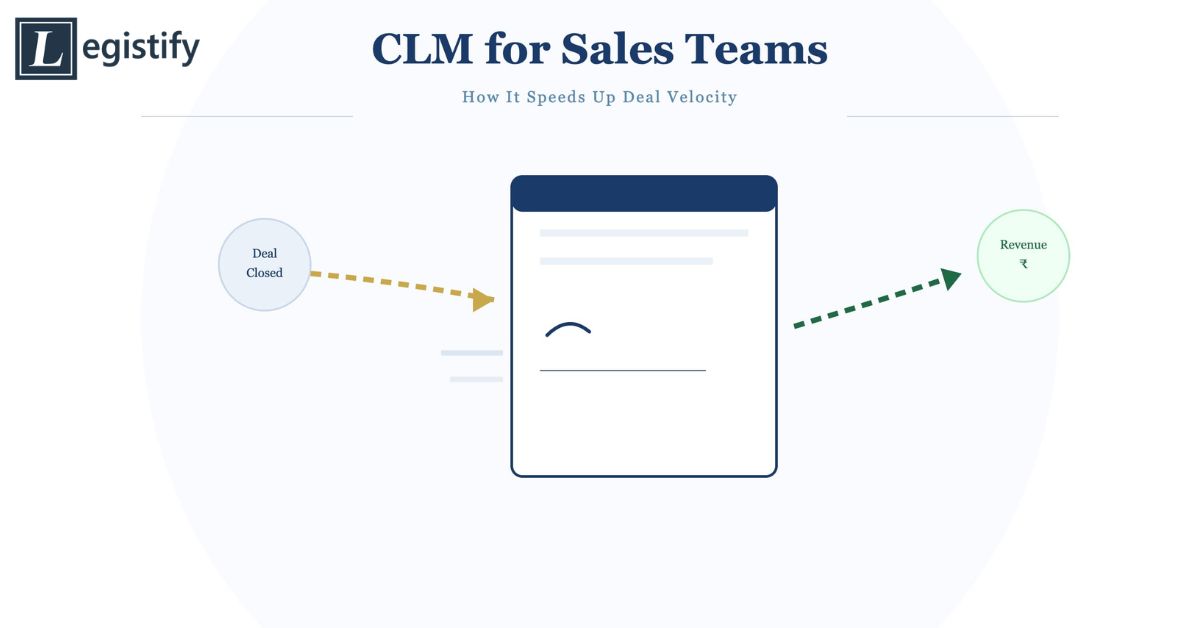
For many businesses, the contract lifecycle is a fragmented, slow process. Contracts get drafted in Word, shared over email, signed through a separate e-signature tool, and eventually tracked, if at all, in a spreadsheet nobody fully trusts. Sales teams feel this fragmentation most acutely, because a deal that has already been verbally agreed and is sitting in the pipeline as “closed-won” is not actually closed until the contract is signed, and every day the contract sits in legal review or bouncing between email threads is a day of delayed revenue recognition and a live risk that the deal falls through entirely.
This blog covers what CLM specifically does for sales teams, how it changes the sales-to-signature process, and what actually determines whether a CLM rollout succeeds or quietly gets routed around.
Why Contracts Are a Sales Bottleneck in the First Place
Sales teams cannot afford delays waiting for legal to draft a contract from scratch on every deal, and yet in organisations without structured CLM, that is precisely what happens for even the most standard agreements. The contract creation process for a standard deal type should be close to instant; instead, it frequently involves a sales rep emailing legal, legal pulling up the last similar contract they can find, manually editing it, and sending it back for the rep to review before it can even go to the customer.
This friction compounds at every subsequent stage. Redlines from the customer’s procurement or legal team arrive by email, get manually incorporated into the document, and require another round of internal legal review before a response goes back out. Approval, particularly for terms that deviate even slightly from standard, often means the rep chasing down whoever has signing authority, sometimes across time zones, with no visibility into where in that approval chain the contract is actually sitting. And once everyone finally agrees, the signature step itself may require yet another tool, with the final signed document landing in an inbox or a shared drive rather than anywhere connected to the CRM record the deal actually lives in.
None of this is a legal capability problem. It is a workflow and connectivity problem, and it is exactly what CLM software is built to solve.
What CLM Actually Changes for Sales Teams
Contracts generated from the CRM, without leaving it
The most direct value CLM delivers to sales is enabling reps to get sales agreements created and agreed without ever leaving their CRM. Rather than switching context to a separate document tool, request a contract, and wait for legal to produce a draft, a properly integrated CLM generates the contract directly from the CRM opportunity record, pre-populated with the deal’s actual terms, pricing, and party details pulled straight from the data already sitting in Salesforce or the equivalent CRM.
This single change removes an entire category of delay and manual re-entry error: the contract’s starting point is already accurate, because it was built from the same data the sales team was already tracking the deal against, not retyped by someone in legal working from an email summary of the terms.
Standard deals move without waiting on legal
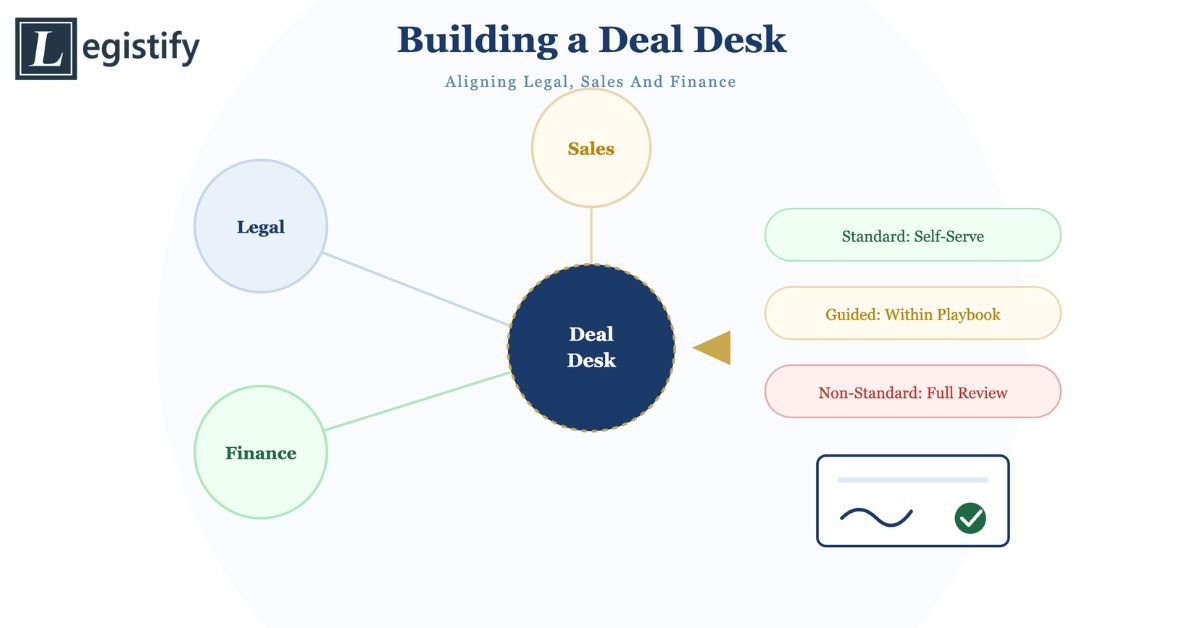
At each stage, CLM software removes manual effort and human error while keeping legal in control of the underlying playbook. For standard agreements that fall within the organisation’s pre-approved terms, this means the contract can be generated, sent, negotiated within defined guardrails, and executed without a lawyer needing to personally review every single instance. Legal’s judgment is embedded in the templates and approval rules once, upfront, rather than re-applied manually to every individual deal that fits the pattern legal has already approved.
This is not legal stepping back from control; it is legal exercising control at the design stage rather than the transaction stage, freeing their attention for the genuinely non-standard deals that actually need individual judgment.
Negotiation stays centralised, not scattered across email
When redlines happen through email attachments, version control degrades almost immediately: multiple copies circulate, edits get lost in file conversions, and reconstructing what changed between drafts becomes a manual, error-prone exercise. A CLM platform keeps negotiation centralised, with clean, automatically maintained version history and every edit tracked, so both the sales rep and legal can see exactly what the customer changed and why, without a side conversation to reconstruct the timeline.
Approval routing that does not require the rep to chase people down
Rather than a rep manually figuring out who needs to sign off on a specific deal term and following up individually, CLM automates approval routing based on the deal’s actual characteristics, value, discount level, non-standard terms, sending it directly to the right approver and providing visibility into exactly where in that chain it currently sits. This alone removes one of the most common sources of sales frustration with the contracting process: not knowing whether a deal is stuck, and if so, where.
Signature and CRM stay connected after execution
Once a contract is signed, the record needs to flow back into the CRM automatically, updating the opportunity status, storing the executed document against the account record, and triggering whatever downstream process, provisioning, billing, customer success handoff, depends on that signature having happened. Without this connection, someone has to manually update the CRM after the fact, which is precisely the kind of administrative task that gets delayed, forgotten, or done inconsistently across a sales team.
Renewal and obligation visibility that supports account growth, not just legal compliance
For sales and account management specifically, CLM’s obligation tracking capability extends beyond legal risk management into commercial opportunity. Automated renewal alerts flag upcoming contract end dates well in advance, giving account managers the lead time to engage proactively on renewal or expansion conversations, rather than discovering a contract has already lapsed or auto-renewed on unfavourable terms after the fact.
Measurable Impact on Deal Velocity
Organisations that connect CLM directly with their sales platform report meaningfully lower legal involvement on standard-term deals, precisely because the contract generation and approval logic is embedded in the system rather than requiring a lawyer’s manual attention on every transaction. This connection between contract status and deal progress gives the full sales team, not just the individual rep, visibility into where every deal actually stands, which supports more accurate forecasting and reduces the anxiety-driven check-ins that eat into both sales and legal team time.
The compounding effect matters here. A reduction of even a few days in average contract cycle time, multiplied across a sales team’s full deal volume over a year, represents a material acceleration in revenue recognition, not just a convenience improvement for individual reps.
What CLM Does Not Eliminate: Legal’s Role in Non-Standard Deals
It is worth being precise about what CLM changes and what it does not. CLM does not remove legal from the sales contracting process; it removes legal from the deals that do not actually need individual legal judgment, so that legal’s attention concentrates on the deals that genuinely do: unusual liability terms, significant custom SLAs, or a deal structure the standard playbook was not built to anticipate.
This distinction matters for how a CLM rollout should be framed internally. Positioning CLM purely as a sales speed tool risks legal resistance, since it can read as sidelining legal’s risk management function. Positioning it accurately, as a way to encode legal’s judgment into the standard-deal workflow so legal’s actual time gets spent on the deals that warrant it, produces a rollout that both sales and legal have genuine reason to support.
Where CLM Rollouts for Sales Actually Succeed or Fail
The technology itself rarely determines whether a sales-facing CLM rollout succeeds. Adoption does. If reps can still email a Word document to a customer and get the deal done faster than routing it through the new system, most reps will do exactly that, regardless of how sophisticated the platform’s underlying capability is.
This means the practical test for any CLM rollout aimed at sales teams is not “does it have the right features,” but “is it genuinely faster and easier for a rep to use the new system than to route around it.” That requires the CRM integration to be genuinely seamless, not a clunky handoff between two disconnected interfaces; it requires standard templates to actually cover the deal types reps handle most often, not just the edge cases legal cared most about configuring; and it requires the approval workflow to be visibly faster than the old email-and-follow-up process, not just theoretically faster on paper.
Conclusion
CLM for sales teams is fundamentally about removing contracts as the friction point between a deal a rep has already won and the revenue that deal actually represents. Done well, it generates standard agreements directly from CRM data, routes non-standard terms to the right approver automatically, keeps negotiation centralised and trackable, and feeds signed contracts back into the CRM without manual re-entry, all while keeping legal’s playbook and judgment embedded in the system rather than removed from it. The organisations that get real value from sales-facing CLM are the ones that treat adoption, not feature completeness, as the actual measure of success.
Legistify’s contract management platform is built with this sales-legal balance specifically in mind, with CRM-connected contract generation for standard deal types, automated approval routing based on deal characteristics, and centralised negotiation and obligation tracking that keeps legal’s playbook enforced without requiring legal to personally touch every standard agreement that moves through the pipeline.