Legal teams today have a lot on their plate. They need to work faster, do more work, and deliver clear results without necessarily hiring additional staff to assist them. This is where legal operations software comes in.
Legal operations software assists legal teams in managing all their work in one place and having a clear understanding of what is happening in their contracts, cases, and compliance matters. Rather than trying to manage spreadsheets and emails, teams can work more efficiently and effectively.
This guide will assist you in learning how to select the best legal operations software and will compare some of the best software available today.
What Is Legal Operations Software?
Legal operations software is a technology that assists the legal department in managing their day-to-day activities more efficiently from a single interface.
It integrates things such as contracts, legal matters, compliance activities, and approvals in a single platform. Rather than using email threads, spreadsheets, and manual reminders, the software performs repetitive tasks and keeps everything organized.
This means that the legal department will have less time spent on administrative activities and more time on critical tasks that will add value to the business.
Why Legal Teams Are Investing in Legal Ops Software
- Keep everything in one place
Contracts, cases, and other legal documents are all in one place. This helps teams easily locate files and collaborate without having to search through emails or random folders.
- Automate everyday legal work
Request intake, approvals, follow-ups, and reminders can all be automated. This reduces manual work and saves a lot of time.
- Work faster and stay accountable
Workflows help teams see who is responsible for what. This helps teams react faster to cases and stay on track without unnecessary delays.
- See where time and money are going
Dashboards and reports provide a clear understanding of workloads, legal spend, and performance in real-time.
- Handle more work without hiring more people
Standardizing processes and increasing efficiency enable legal teams to handle growing workloads without adding more people.
How to Choose the Right Legal Operations Software
Before selecting a legal ops tool, it is essential to consider a few fundamentals to ensure that it ultimately benefits the team and users feel comfortable with the tool.
- Covers the basics
The tool should address fundamental legal work such as contract management, case/matter management, and reporting. This will eliminate the need to work with multiple tools.
- Easy to use
A clean and simple interface is a must. The tool should be friendly to use for both legal professionals and business users.
- Smart automation and AI
Automation and AI should make daily work easier like routing requests, reviewing documents, or pulling insights without making the system complicated.
- Strong security and compliance
Legal data is sensitive. The software must offer strong security, clear access controls, and meet compliance standards to keep information safe.
- Grows with your team and shows value
The right tool should scale as work increases and clearly show returns through time saved, lower costs, and better efficiency.
Best Legal Operations Software in 2026
1. Legistify
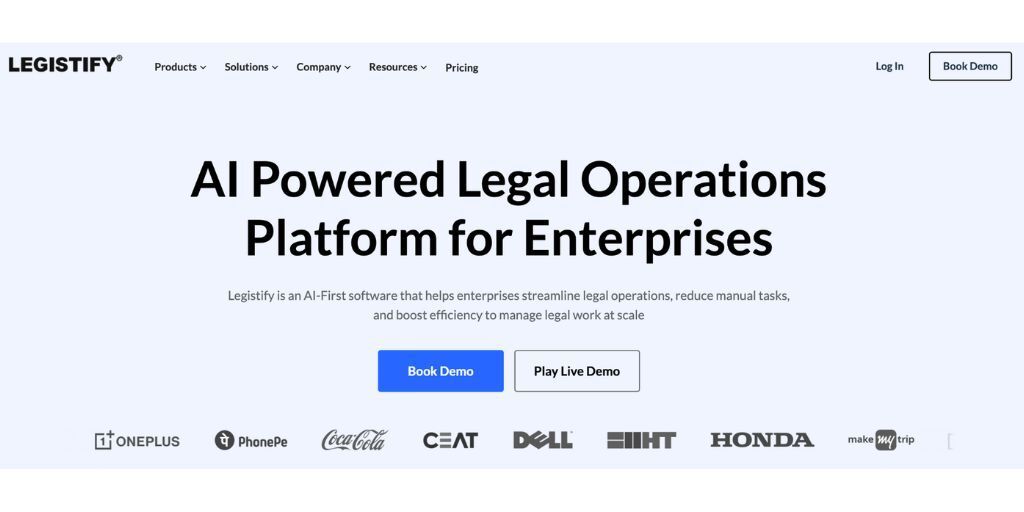
Legistify is a legal operations platform that assists the in-house legal teams in managing their work more easily with the help of AI. Legistify combines contracts, cases, compliance, and IP work into one single system, allowing teams to work faster and stay organized as they grow.
Key features:
- AI-driven contract management from drafting to signing and reporting
- Case and litigation management with alerts and updates
- Legal notice and compliance management in one place
- Document storage and collaboration in one place
- Smart analytics to help teams make better decisions
- Integration with common tools such as Slack, Salesforce, and Google Workspace
Why it stands out:
Legistify’s LegisTrak tool replaces several unconnected tools with one solution. The AI that comes with the solution helps legal teams keep up with their work and transition from reacting to problems to proactively managing them.
Best for:
Enterprises, growing legal teams, and organizations that seek a single solution for contracts, litigation, compliance, and legal insights.
2. SpotDraft
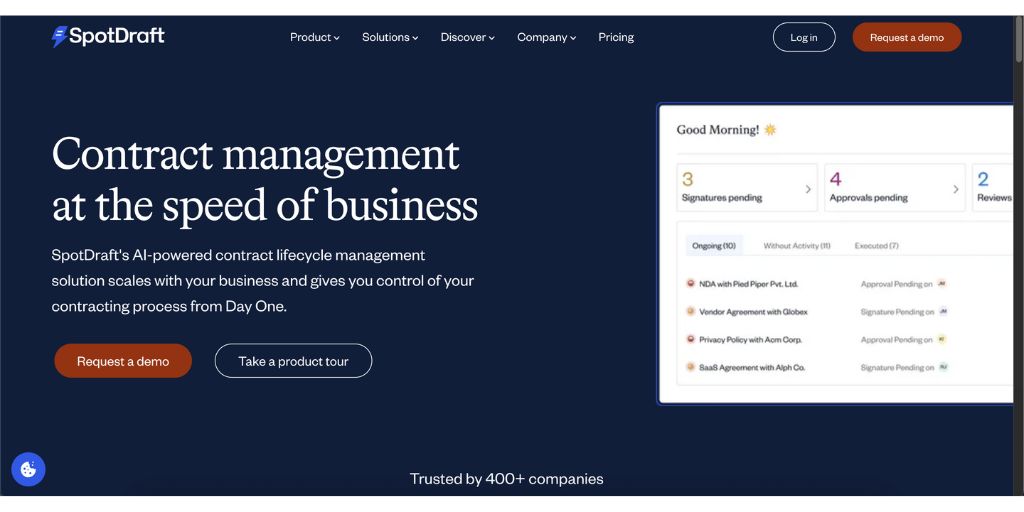
SpotDraft is an AI-based contract management solution that assists legal and business teams in managing contracts more efficiently from contract creation to contract execution.
Key features:
- AI-assisted contract drafting, templates, and approval workflows
- One place to store all contracts with secure access
- Collaboration for contract changes, negotiations, and reviews
- Contract renewal, delay, and timeline reports and insights
- Compliance-ready e-signatures
Why it stands out:
SpotDraft is a smart assistant for contracts. It reduces manual work, accelerates approval, and applies AI to make contract processes faster and more efficient at every stage.
Best for:
In-house legal teams and businesses of all sizes who want better control, visibility, and automation of contract workflows.
3. Clio
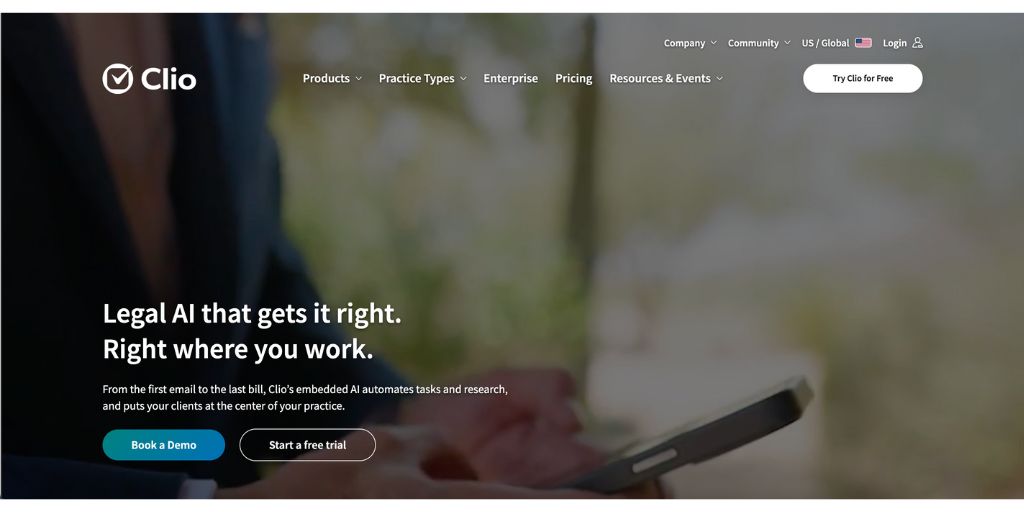
Clio is a cloud-based software that assists law practices in organizing their daily activities from a single interface. It includes everything from client intake and case management to billing, documents, and reporting.
Key features:
- Case and matter management with all client files and deadlines organized in one place
- Time management, billing, and online payments
- Document storage, sharing, and simple automated workflows
- Client intake, CRM, and communication features
- Secure cloud access with connections to 250+ apps
- AI-powered tools for research, insights, and task automation
Why it stands out:
Clio is one of the most recognized and respected legal software solutions globally. It is user-friendly, scalable with the growth of the firm, and integrates all legal activities on a single platform. It is particularly effective in client management and integration.
Best for:
Solo lawyers, small to medium-sized law firms, and expanding law practices seeking an all-in-one cloud-based solution for client, case, billing, and collaboration management.
4. LawVu
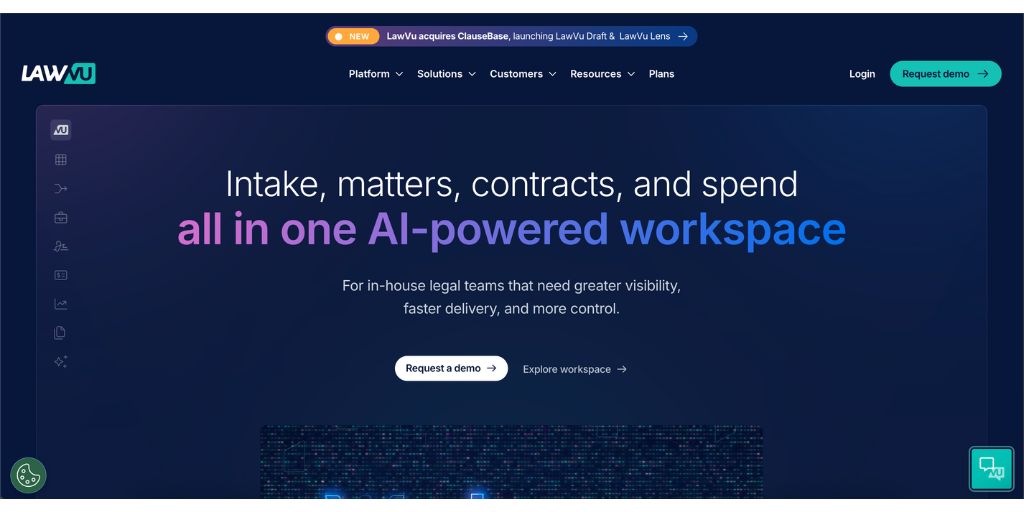
LawVu is a cloud-based legal operations platform designed for in-house legal teams. It provides teams with a single workspace to handle contracts, matters, legal spend, and reports in one place.
Key features:
- Matter management with task management, timelines, and simple-to-read dashboards
- Contract management with AI-powered workflows and self-service capabilities
- Legal spend management, including invoice analysis and external counsel management
- Reporting and analytics to measure performance, trends, and results
- Simple intake portals to capture and manage legal inquiries
- Document storage with search and knowledge-sharing capabilities
Why it stands out:
LawVu brings contracts, matters, and legal spend together in a single, secure system. Its smart automation and insights help legal teams work faster, stay organized, and make better decisions.
Best for:
In-house legal teams and corporate legal departments looking for one complete platform to manage legal work.
5. Streamline AI
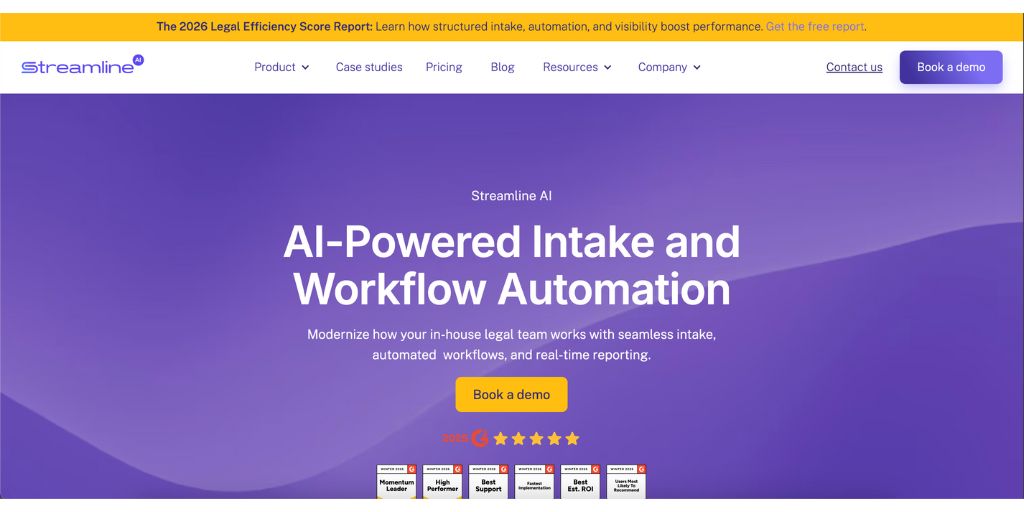
Streamline AI is a solution developed specifically for in-house legal teams to handle legal requests and workflows more efficiently. It assists teams in organizing work, tracking progress, from the initial request to its resolution.
Key features:
- Intelligent legal request intake from email, Slack, Salesforce, and more into one place
- Automated workflow using AI with no-code setup
- Tracking matters and tasks with seamless team collaboration
- Real-time reporting on request volume, workload, and delays
- Integration with existing business tools to ensure smooth request flow
Why it stands out:
Streamline AI is all about solving one of the most frustrating problems for legal teams: disorganized, email-based requests. The tool takes disorganized requests and turns them into organized, easily trackable processes.
Best for:
In-house legal teams that are dealing with a large number of internal requests and want to get faster, more organized, and better insights into how work is being done.
6. Mitratech TeamConnect
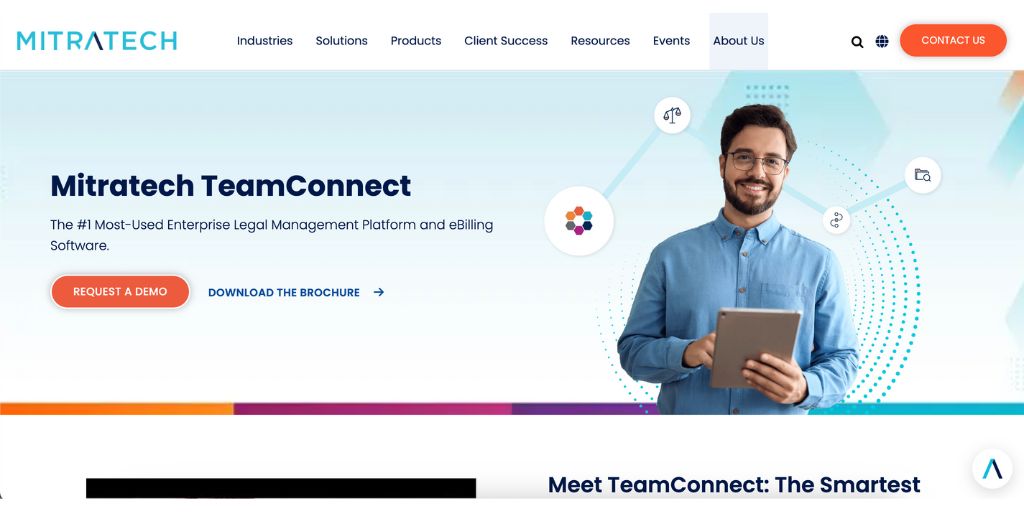
Mitratech TeamConnect is an enterprise legal management solution that assists large legal departments in organizing all their legal work in one place. It is designed to handle matters, manage legal expenses, automate tasks, and provide visibility into the performance of the legal department.
Key features:
- Matter and legal work management with customizable dashboards and templates
- Automated workflows to assign tasks, notify, and manage legal work
- Legal expense management, e-billing, and expense tracking
- Document and contract storage with advanced search functionality across all documents
- Reporting and dashboards to inform data-driven decisions
Why it stands out:
TeamConnect is intended for use in large, complex legal departments. It integrates matter management, spend management, automation, and reporting into a single scalable platform, which helps legal teams standardize processes and gain greater visibility into their operations.
Best for:
Large legal departments and enterprise legal operations teams that handle complex legal matters, high spend, and complex compliance requirements.
7. Xakia
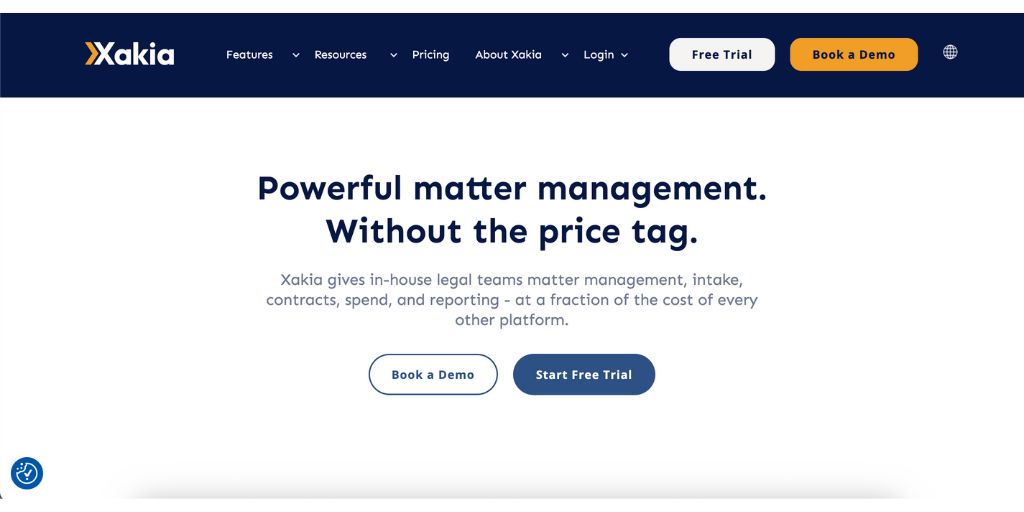
Xakia is a cloud-based legal operations platform designed specifically for in-house legal teams. The platform enables teams to keep all their legal work in one place, simplify admin, and see what’s happening across matters, requests, spend, and reports.
Key features:
- Matter management with task assignment, status updates, and notifications
- Legal request intake and workflow automation to manage incoming work
- Contract management with tracking and history, and the ability to integrate with full contract management systems
- Spend and budget tracking with simple dashboards
- Custom reporting and analytics for better decision-making
- Document storage linked to matters and legal tasks
Why it stands out:
Xakia provides an accessible, affordable, and easy-to-use environment for legal teams. It integrates matter management, intake, expense tracking, and reporting to help teams save time, stay organized, and demonstrate their value to the business.
Best for:
In-house legal teams and corporate legal departments looking for a matter-centric legal operations platform with strong workflows, reporting, and visibility.
8. LeanLaw

LeanLaw is a cloud-based billing and accounting solution designed specifically for law firms. The software assists firms in managing time, billing, and finances in an easy manner without the need for complex systems. The software is most compatible with QuickBooks Online.
Key features:
- Simple time and expense tracking to record billable hours accurately
- Automated billing from time entry to sending invoices and receiving payments from clients
- Trust accounting features to manage client funds properly and remain compliant
- Real-time financial reporting and analysis to view profitability
- Integration with QuickBooks Online to prevent reconciliation problems
- Financial tracking at the matter level to view expenses and revenue accurately
Why it stands out:
LeanLaw is all about simplifying the financial aspect of a law practice. It is ideal for practices that require accurate billing, clean accounting, and easy profitability analysis without adding complexity.
Best for:
Solo lawyers and small to medium-sized law practices seeking robust billing, accounting, and financial management capabilities without the need for full-fledged practice management software.
9. PracticePanther
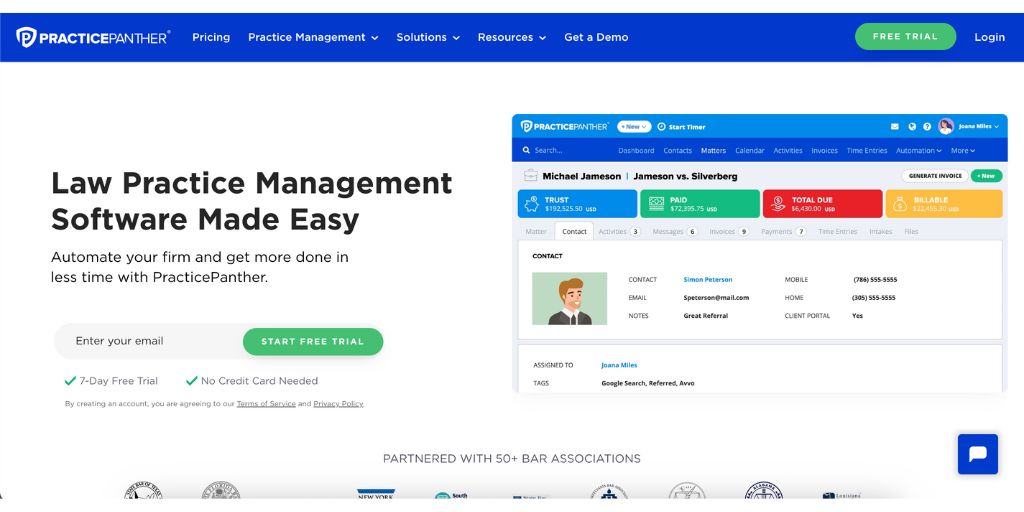
Cloud-based software PracticePanther assists law practices in managing their entire practice through a simple system. It deals with cases, clients, billing, documents, and payments. This ensures that everything is organized and easy to manage.
Key features:
- Case and matter management with secure data and deadline tracking
- Automatic time tracking, billing, and invoice generation with payments
- Document management, e-signatures, and customizable workflows
- Client communication tools and secure client portal
- Calendars, trust accounting, and easy reporting dashboards
- Access from any device, so you can work from anywhere
Why it stands out:
PracticePanther combines everything a law practice needs in one convenient place: cases, billing, communication, and automation. It assists law practices in reducing administrative tasks and spending more time on client matters.
Best for:
Small to mid-sized law firms and lawyers seeking an all-in-one solution for managing their day-to-day operations, billing, and client relations.
10. MyCase
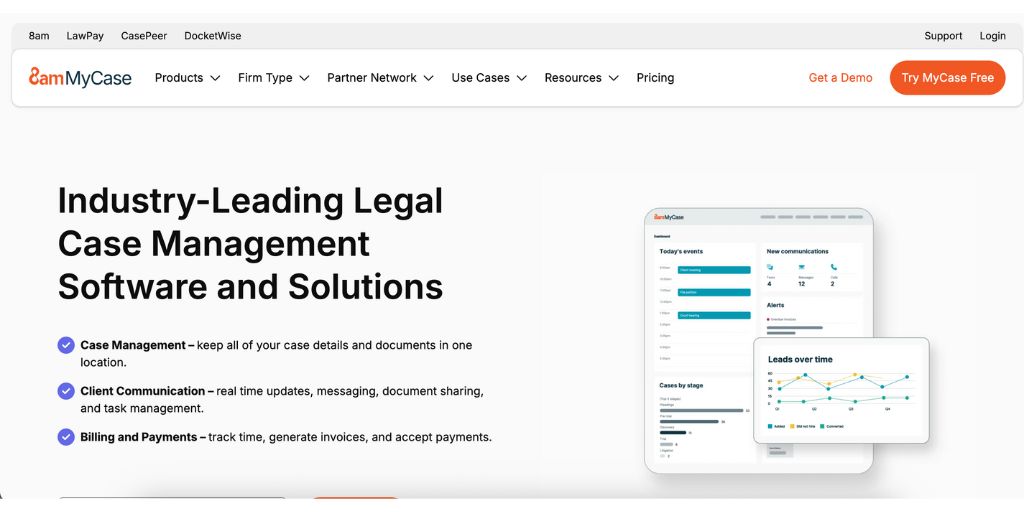
MyCase is a cloud-based practice management software that assists law firms in organizing all their cases in one place. The software integrates case management, communication with clients, billing, and documents in one simple system.
Key features:
- Case and matter management to organize files, deadlines, and documents
- Secure client portal for messaging and document exchange
- Time management, billing, invoicing, and online payments
- Online client intake forms and lead management
- Automated workflows, calendars, and performance reports
Why it stands out:
MyCase helps make running a law practice easier by integrating common tools such as cases, billing, communication, and admin work into one system. This prevents tool overload and keeps teams organized.
Best for:
Solo lawyers and small to mid-sized law practices looking for an easy-to-use, one-stop solution for running their law practice.
Here’s a simple, easy-to-understand comparison to help you see what each tool is best at and who it’s meant for:
| Tool |
What it’s best at |
Best for |
| Legistify |
End-to-end legal operations |
Teams that want one all-in-one platform to manage contracts, cases, compliance, and scale easily |
| SpotDraft |
Contract automation |
Legal teams that handle many contracts and want powerful AI-driven CLM |
| Clio |
Practice & case management |
Law firms that want case management, billing, and client management in one system |
| LawVu |
Unified legal workspace |
In-house legal teams that want matters, contracts, and legal spend in one place |
| Streamline AI |
Intake & workflow automation |
Legal teams that handle many internal requests and want organized workflows |
| Mitratech TeamConnect |
Enterprise legal management |
Large legal departments with complex matters, spend, and compliance requirements |
| Xakia |
Matter & operations management |
Corporate legal teams that want centralised operations with reporting and spend visibility |
| LeanLaw |
Billing & financial management |
Small firms and solo lawyers concerned with billing accuracy, trust accounting, and profits |
| PracticePanther |
Law firm practice management |
Small to mid-sized law firms seeking flexible and cloud-based practice management solutions |
| MyCase |
Client communication & case workflows |
Solo lawyers and small firms concerned with client experience and simple case management |
Conclusion
Legal operations software is designed to help legal teams function better and keep track of their work. Whether your team is mostly contract-related, dealing with many legal requests, or running a full-fledged legal practice, choosing a solution that meets your current requirements is a good idea.
If you are searching for one solution that can scale with your team, Legistify provides a wide range of functionality and flexibility to adapt to today’s rapidly changing legal teams.