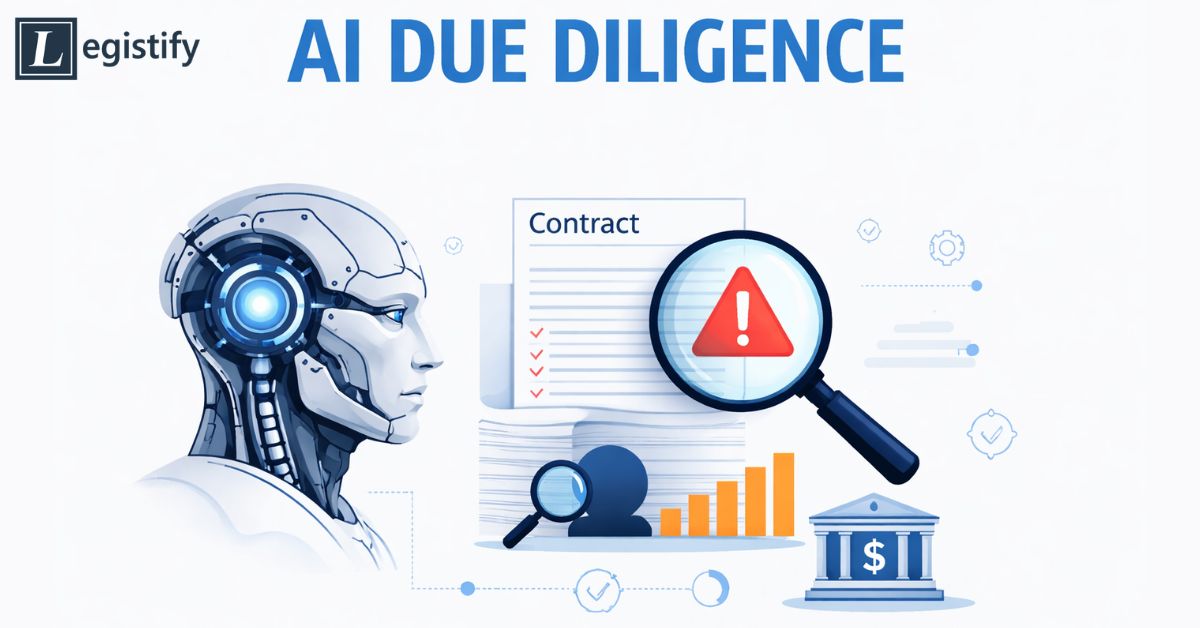
Artificial intelligence is transforming the lives of legal professionals at an unprecedented rate. Law firms as well as in-house legal teams deal with a vast number of contracts, case files, compliance documents, and regulatory information on a daily basis. Reviewing these documents and analysing them is a time-consuming task.
AI for law firms helps in the automation of various legal tasks, including document creation, legal research, contract analysis, and litigation analysis. These platforms help lawyers save time by analysing vast data in a few minutes, allowing them to focus on strategic decision-making, negotiations, and advisory services, as opposed to wasting their time on other tasks.
Why Law Firms Are Adopting AI
The legal sector is increasingly embracing AI to cope with the growing workload. One of the key reasons for this is the growing number of legal documents that organisations need to deal with. These documents, such as contracts and compliance documents, need to be monitored continuously.
AI helps the legal sector deal with the growing workload of documents by analysing them and providing key highlights of the documents. This helps them save a lot of time, as AI can analyse a document in just a matter of seconds.
Another key reason for the growing adoption of AI by the legal sector is the need to reduce operational costs. Dealing with a growing workload of documents can prove to be quite costly, especially for law firms.
Speed is another key benefit of AI for the legal sector. The sector needs to deal with clients who demand timely services. AI helps the sector deal with this by providing key highlights of the relevant laws in just a matter of seconds.
Key Applications of AI in Law Firms
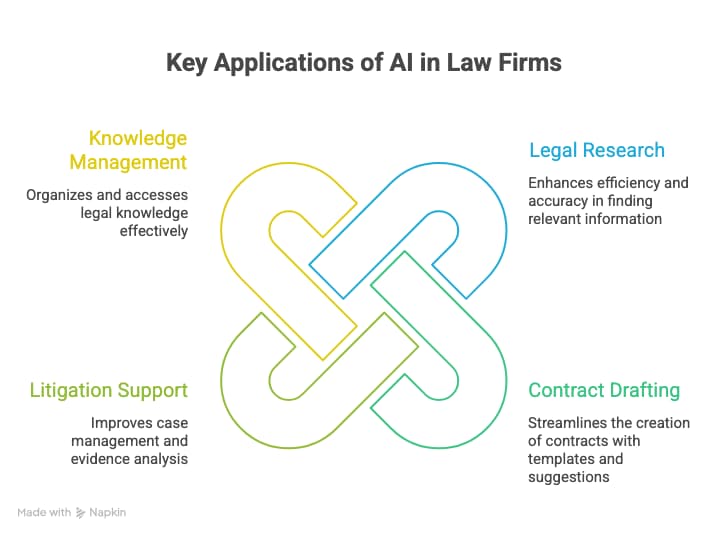
1. AI-Powered Legal Research
Legal research is one of the most labor-intensive processes for a lawyer. AI-powered research tools enable legal professionals to carry out research by querying natural language-based research tools.
Traditionally, a lawyer would need to sift through various sources to obtain relevant information. However, with AI-powered tools, a lawyer can simply pose a question to obtain relevant case precedents.
2. Contract Drafting and Review
Contracts are at the heart of legal operations. Artificial intelligence systems can help lawyers review contracts, pinpoint risky clauses, and even provide alternatives.
Such technology can also evaluate contracts against set standards or clause libraries to maintain uniformity and compliance in contracts.
3. Litigation and eDiscovery
During the litigation process, lawyers may have to go through thousands of documents as part of the discovery process. AI-based tools help in classifying the documents, identifying key evidence, and creating a timeline of events.
This helps lawyers in analysing the data efficiently, allowing them to concentrate on the most relevant information.
4. Knowledge Management
Law firms create a lot of internal knowledge, which may include research data, legal opinions, and documents. AI tools help in organising the information, allowing lawyers to retrieve the information when needed.
1. Legistify
Out of the many AI tools available today, some are designed to support particular legal processes, whereas others are designed to support multiple legal processes within one tool. One such tool is Legistify, which can be used to make the management of contracts and legal operations more efficient.
It is an AI-based tool that can be used to make the management of legal operations and contracts more efficient within an organisation. It can be used to make the management of contracts more efficient by streamlining processes such as contract drafting, clause identification, risks, approvals, and obligations.
Even though tools like Legistify can provide a comprehensive solution to the management of legal operations within an organisation, there are also other AI tools available that can be used to support particular processes such as contract review, legal research, and litigation analysis.
2. Contract Drafting and Review Tools
- Spellbook
Spellbook is an AI-based contract assistant that works with Microsoft Word. It assists lawyers in the drafting of contracts, reviewing contracts, and even improving contracts.
- LawGeex
LawGeex is a contract review tool that is focused on automated contract review. LawGeex reviews contracts and helps lawyers identify possible risks, discrepancies, and even compliance.
- Henchman
Henchman is a tool that assists lawyers in extracting contract clauses from contracts, making the drafting of contracts efficient.
3. Legal Research and Analysis Tools
- CoCounsel (Thomson Reuters)
CoCounsel is an AI assistant that specialises in assisting lawyers with legal research, document review, and drafting. It also helps in summarising legal documents and answering complex research queries.
- Lexis+ AI
Lexis+ AI is an advanced legal research tool that utilises generative AI technology to carry out the analysis of legal cases and provide legal insights.
- Casetext
Casetext allows lawyers to search legal databases using natural language queries, making it easier for lawyers to find relevant legal precedents.
- Harvey AI
Harvey AI is a generative AI tool that specialises in assisting lawyers with legal drafting, research, and document summarisation.
4. Litigation and eDiscovery Tools
- Everlaw
Everlaw is largely used in litigation and investigation processes. It assists legal teams in analysing large volumes of documents, organising evidence, and discovering important insights in the case.
- Lex Machina
Lex Machina specialises in litigation analytics. It analyses past court data to enable lawyers to understand trends, judicial tendencies, and possible verdicts in the case.
5. Legal Productivity and Knowledge Management Tools
- SpotDraft
SpotDraft is a tool for contract lifecycle management, enabling legal teams to automate contracts, approvals, and storage.
- MyCase AI
MyCase AI is a tool for law firms, enabling them to manage tasks, documents, and client communication, as well as detect inconsistencies in legal documents.
- Notion AI
Notion AI enables legal teams to summarise documents, take notes, and keep all information in a centralised location.
How Law Firms Can Use AI Effectively
1. Accelerate Legal Research
AI research assistants assist lawyers in quickly searching relevant case laws and legal information. This minimises the time needed for legal research.
2. Automate Contract Review
AI software assists lawyers in reviewing contracts by automatically analysing contracts and identifying clauses that may create legal or compliance risks. This minimises the time needed for reviewing contracts.
3. Improve Document Drafting
AI software assists lawyers in drafting contracts, legal memos, or legal briefs. Lawyers may edit the drafts of contracts, legal memos, or legal briefs.
4. Enhance Litigation Support
AI software assists lawyers in analysing large volumes of documents, identifying evidence, and developing legal strategies.
5. Simplify Document Management
AI software assists lawyers in organising legal documents. This minimises the time needed by lawyers to retrieve information from internal knowledge resources.
Best Practices for Adopting AI in Legal Teams
1. Ensure Data Security
Data obtained from legal sources is considered highly sensitive. Organisations must select AI tools that offer robust security features and maintain confidentiality of sensitive information related to their clients.
2. Verify AI Output
Legal content generated by AI should always be verified by legal professionals to ensure that it is accurate and compliant with laws.
3. Provide Proper Training
Training legal teams on AI tools is essential to ensure that professionals can effectively use this technology.
4. Integrate AI Gradually
Instead of completely replacing traditional methods with AI, law firms should gradually adopt AI tools for legal research, contract management, or document management.
Challenges and Limitations of Legal AI
While there are various advantages associated with AI, it is not without some limitations. There is always a chance that results or information provided by AI tools may not be entirely accurate or complete, thereby necessitating human verification.
Data privacy is another area that has to be addressed by legal professionals when using AI tools.
There is also a need to ensure that ethical standards associated with using AI are met by legal organisations.
The Future of AI in Legal Practice
The future of the adoption of AI technology in the legal sector is promising as the technology is likely to advance in the coming years. Some of the emerging technologies in the future include the development of predictive analytics tools that can predict the outcome of cases, as well as the development of negotiation tools.
In the future, AI technology is likely to be integrated into the legal sector as one of the essential tools that lawyers cannot afford to miss. Instead of replacing lawyers, AI technology will act as a helper to lawyers to make the practice of law more efficient and effective.
Conclusion
Artificial intelligence tools are revolutionising the legal sector through automation of tasks such as legal research, contract review, document drafting, and litigation analysis. Spellbook, CoCounsel, Everlaw, Harvey AI, and Legistify are some of the tools that assist legal teams in effectively analysing information and managing legal processes.
Though AI plays an important role in boosting efficiency, expertise is still crucial. The application of AI tools, together with expertise, enables law firms to increase efficiency and reduce costs through better legal practice in a highly technology-driven world.