AI litigation management software has moved well beyond digitising case files. The category now spans e-discovery platforms that process millions of documents an hour, predictive analytics tools that model judge behaviour and settlement timing, and deadline-tracking systems that eliminate the manual court date checking that has historically consumed significant paralegal time. Choosing the right platform depends heavily on the type of litigation your team handles: high-volume e-discovery, plaintiff-side case sourcing, defence-side risk analytics, or the day-to-day case portfolio management that most in-house legal teams and litigation firms need as a baseline.
This comparison covers ten platforms relevant to litigation teams in 2026, including what each does best, where it falls short, and what Indian enterprise legal teams specifically need to evaluate that global comparisons typically miss.
List of Best AI Litigation Management Software in 2026
1. Legistify Litigation Management
For enterprise legal teams, and especially for those operating in India, most global litigation AI platforms fall short in one critical respect: they are built around US and UK court systems and litigation patterns, and simply do not address the operational realities of running a high-volume litigation portfolio across Indian courts and tribunals. Legistify’s litigation management module closes this gap directly. It provides automated case tracking integrated with Indian court systems (Supreme Court, High Courts, District Courts, NCLTs, consumer forums, and tribunals), AI-assisted hearing date alerts that eliminate manual cause-list checking, structured case management for high-volume matter types like Section 138 cheque bounce cases, SARFAESI proceedings, and DRT recovery, external counsel management with stage-linked billing tied to case milestones, and portfolio-level reporting that gives the legal head a live view of contingent liability, advocate performance, and case throughput across the entire litigation book.
Unlike point solutions that specialise narrowly in e-discovery or predictive analytics, Legistify is built as an operational system of record for the full litigation lifecycle: from new case alert through hearing management, document storage, and case closure, integrated with the same platform that handles contract and notice management, so a dispute arising from a contract breach carries its full history forward automatically rather than requiring manual reconstruction.
Best for: Enterprise legal teams, and particularly Indian enterprises managing high-volume litigation across multiple courts, tribunals, and states, including BFSI collections litigation, who need a genuine system of record rather than a narrow analytics add-on. Why it leads this list: It is the only platform on this list built end-to-end for the operational reality of enterprise litigation management, not just one slice of it (discovery, analytics, or case sourcing), and it is purpose-built for the Indian court infrastructure that most competitors ignore entirely.
2. Everlaw
Everlaw is built for litigation teams and government agencies handling high-volume e-discovery, processing roughly 900,000 documents per hour with AI-powered coding suggestions that accelerate document review at scale. In late 2025, Everlaw made its single-document AI features free, lowering the cost barrier for smaller matters.
Best for: Litigation teams, government agencies, and corporate legal departments handling high-volume e-discovery. Skip it if: Your typical case involves a few hundred pages; Everlaw is built for millions of documents, and the platform’s strengths are wasted on small-scale matters.
3. Lex Machina
Lex Machina, from LexisNexis, does not draft documents or manage case files. It analyses judge behaviour, case outcomes, and opposing counsel track records to inform case strategy and settlement timing decisions. It tells legal teams what has actually happened in similar cases and before specific judges, which changes how a team prepares for a matter before it even begins.
Best for: Litigation strategy and settlement timing decisions grounded in historical outcome data. Skip it if: You need case management or document review functionality; Lex Machina is purely an analytics layer, not a case management platform.
4. CoCounsel (Thomson Reuters)
CoCounsel leverages advanced AI to automate contract drafting, legal research, and litigation-related document review within a unified assistant. It helps legal teams generate documents, identify risks, perform due diligence, and quickly access relevant case law and statutes within a single platform. CoCounsel’s agentic workflows, launching through 2026, extend this into independently planned, multi-step research and litigation preparation tasks.
Best for: Law firms and corporate legal departments handling significant litigation research volume alongside contract work. Skip it if: Your litigation practice is narrowly focused and does not need the broader contract and research capabilities bundled into the platform.
5. Clio (with Clio Duo)
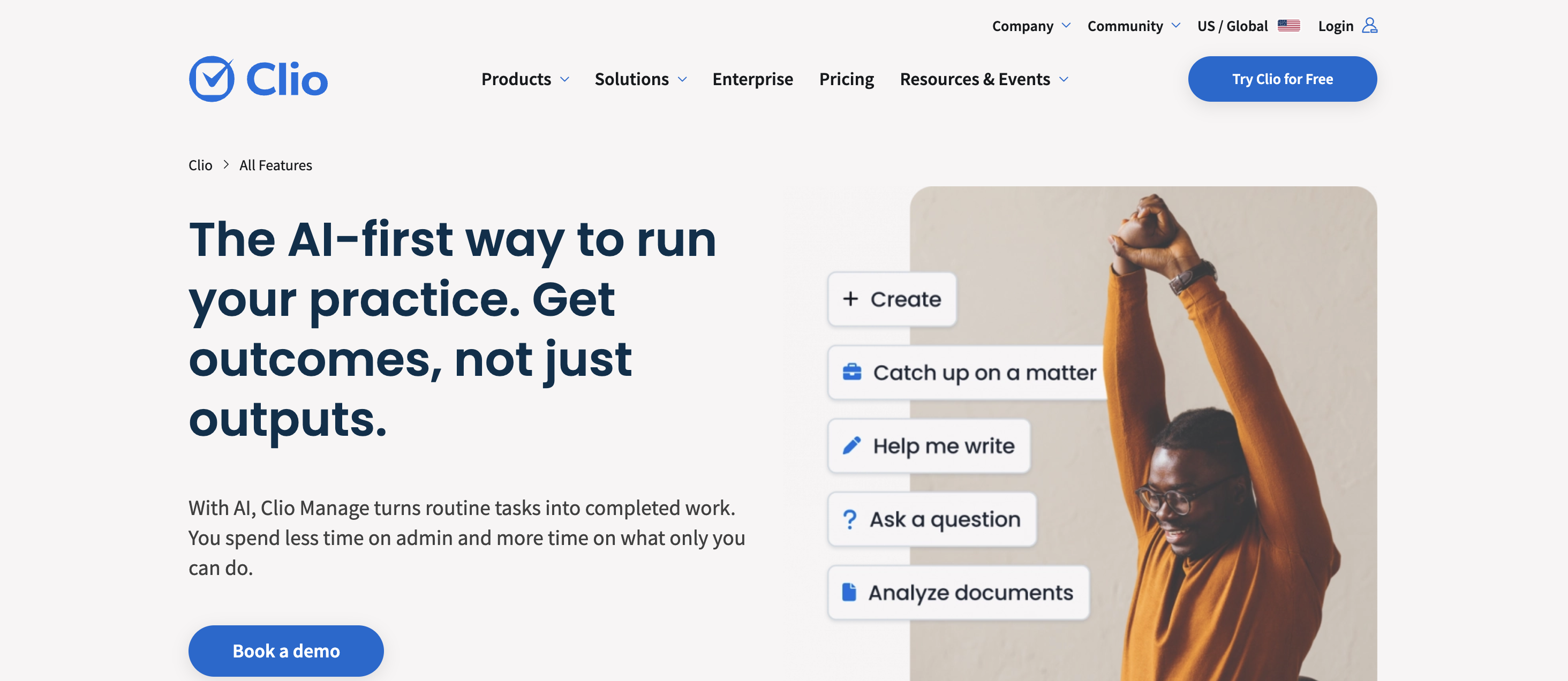
Clio is the leading practice management platform for law firms, and its AI layer, Clio Duo, adds intelligent automation to billing, time tracking, matter summarisation, and client communications. Its court rules integration auto-calculates filing deadlines across jurisdictions, materially reducing the risk of missed deadlines, and it includes eFiling capabilities in supported courts.
Best for: Solo to mid-sized litigation firms wanting a unified platform with strong calendaring, deadline tracking, and CRM functionality. Skip it if: You need deep legal reasoning, complex contract drafting, or enterprise-scale data handling; Clio’s strength is practice management, not deep AI-driven analysis.
6. Vera (Clio integration)
Vera is a specialised integration for Clio Manage that turns complex litigation documents into clear, reliable case timelines. It automatically extracts dates and deadlines from case documents, eliminating manual deadline tracking and giving litigation teams instant insight into the sequence of events shaping their case.
Best for: Litigation teams already on Clio who need automated timeline construction from complex case files. Skip it if: You are not on the Clio platform; Vera is built specifically as an add-on integration rather than a standalone tool.
7. Darrow
Darrow takes a different approach from most tools on this list: rather than only selling software, Darrow uses its own AI internally for case origination and offers an enterprise solution that helps organisations detect and address potential legal violations before they escalate into litigation. Its anomaly detection algorithms analyse databases and publicly available records for patterns that may indicate legal violations.
Best for: Plaintiff-side firms sourcing and evaluating case opportunities, and organisations wanting proactive violation detection. Skip it if: You need traditional case management or document review; Darrow’s core value is case identification and origination, not day-to-day litigation management.
8. Supio

Supio is built specifically for personal injury firms, offering an interactive chatbot for real-time case questions, automated document drafting, and searchable medical chronologies and case timelines. It is designed to identify critical case information, including diagnoses that treating physicians may have missed, streamlining a workflow that is otherwise heavily manual in personal injury practice.
Best for: Personal injury firms managing large volumes of medical records and needing rapid case timeline construction. Skip it if: Your practice does not involve personal injury or medical record-heavy litigation; Supio’s specialisation is a strength only for the practice area it targets.
9. Eudia

Eudia is an AI platform tailored for large legal teams, aiming to transform legal departments into strategic business functions rather than reactive cost centres. It embeds itself in an organisation’s workflows, assimilates proprietary institutional data, and creates AI-powered agents integrated into existing processes to enhance decision-making and risk management, including litigation risk.
Best for: Large in-house legal departments seeking deep, organisation-specific AI integration across litigation and broader legal risk management. Skip it if: You are a smaller team or law firm; Eudia’s model of deep institutional integration is built for enterprise scale.
10. GC AI
GC AI is purpose-built for in-house counsel, covering contracts, research, employment, and privacy work end to end, including litigation-adjacent matters that in-house teams manage before matters escalate to outside counsel. It is priced per seat with no seat minimum, making it accessible for a solo GC or small in-house team without a lengthy procurement cycle, while its Enterprise tier serves larger departments with SSO, custom integrations, and dedicated support.
Best for: Solo GCs and small to mid-size in-house legal teams that need a single tool covering litigation-adjacent work alongside contracts and research. Skip it if: You are a large litigation firm needing deep e-discovery or analytics capability; GC AI is oriented toward in-house generalist workload, not specialist litigation practice.
Comparison at a Glance
| Platform |
Best For |
Not Suited For |
| Legistify Litigation Management |
Full-lifecycle enterprise litigation management, Indian courts and tribunals |
Teams needing only e-discovery or only research analytics |
| Everlaw |
High-volume e-discovery |
Small matters under a few hundred pages |
| Lex Machina |
Case outcome analytics |
Case management or drafting |
| CoCounsel |
Litigation research + drafting |
Narrow, single-purpose litigation practices |
| Clio + Clio Duo |
Practice management, deadlines |
Deep legal reasoning or complex analysis |
| Vera |
Automated case timelines |
Non-Clio users |
| Darrow |
Case origination, violation detection |
Day-to-day case management |
| Supio |
Personal injury case management |
Non-PI practices |
| Eudia |
Enterprise legal department transformation |
Small teams or firms |
| GC AI |
In-house generalist litigation-adjacent work |
Specialist e-discovery or analytics needs |
What to Evaluate Before Choosing
Match the tool to your litigation profile, not the category leader. A defence-side team managing high-volume, document-heavy disputes has fundamentally different needs from a plaintiff-side firm sourcing new case opportunities, or an in-house team managing a portfolio of Section 138 and SARFAESI matters across Indian courts. The “best” tool is the one built for your specific litigation pattern.
Check integration with your existing calendaring, billing, and document systems. The best AI litigation tool is significantly less useful if it does not integrate with your practice management software, document storage, and email; standalone tools that require constant context-switching undermine much of the efficiency gain they promise.
Verify security and compliance certifications appropriate to your jurisdiction. Look for SOC 2 certification, data encryption, and clear data retention policies, and for Indian enterprises specifically, confirm DPDPA compliance and data residency options, which most global litigation platforms do not address by default.
Measure ROI against time saved per task versus subscription cost. Most firms and legal departments see positive ROI within the first month of proper adoption when the tool is matched correctly to actual workflow needs; a mismatch between tool and use case is the most common reason ROI fails to materialise.
Conclusion
The best AI litigation management software for 2026 depends on the specific type of litigation work a team handles, but for enterprise legal teams that need a genuine end-to-end system of record for their litigation portfolio rather than a narrow point solution, Legistify’s litigation management platform leads this list, particularly for organisations managing litigation across Indian courts and tribunals, where global platforms built for US and UK court infrastructure simply do not translate. Everlaw and Lex Machina serve high-volume e-discovery and outcome analytics respectively; Clio and its Vera integration serve practice management and deadline tracking; and Darrow and Supio serve highly specific case origination and personal injury niches. The right choice depends on matching the tool to the actual shape of your litigation portfolio.