Contracts are the backbone of every business relationship, and they define the terms agreed upon, the timelines for fulfillment, and the consequences in case of a mishap. However, for most legal departments, contract management is a process that ranks high on the scale of tedious, error-prone, and labor-intensive tasks.
For organisations with a large number of contracts at any given point in time, the problems are always the same: deadlines slipping through the cracks, obligations hidden in complex clauses, renewal dates slipping away, and a lack of a single source for information on agreements made with whom and on what terms. This results in unnecessary risk and considerable inefficiency.
However, with the advent of artificial intelligence, the scenario is changing, and contract management tools with the power of artificial intelligence are now being used for the entire contract management process, from drafting and storage to management and renewals. This blog will discuss what AI in contract management is, how it works, where it adds value, and what legal departments should be aware of before adopting the technology.
What Is AI in Contract Management?
AI in contract management: This refers to the use of artificial intelligence tools, especially natural language processing (NLP), machine learning (ML), and large language models (LLMs), for automating and improving the management of contracts.
Contrary to other automated tools, AI-based contract management tools are capable of reading and interpreting the content of a contract, especially the clauses included in a contract, and can identify key information included in a contract without the need for a person to actually read or analyse the contract.
This is usually done within a Contract Lifecycle Management (CLM) system, which is a system used for managing contracts from the point of request for a contract through to the end of a contract’s life.
AI in contract management does not mean that a person with knowledge of the law or a legal mind is not required, as AI tools are used for automating the repetitive tasks in contract management so that a person with a legal mind can be used for other important tasks in the management of contracts.
The Problem with Traditional Contract Management
To understand the importance of AI, it is helpful to consider how contract management is typically performed without it.
Contract management within organisations, including large law firms and in-house legal teams, is often managed through a series of emails, shared drives, and spreadsheets. This method of contract management has a number of well-known issues.
- Manual, Time-Consuming Review
Manually reviewing a contract requires going through all the pages of the contract, identifying relevant clauses, and comparing text for compliance. This can take several hours for a single contract. Imagine a legal team working on several dozen contracts at once.
- Missed Deadlines and Renewal Gaps
Key dates, including renewal dates, notice periods, payment due dates, and filing deadlines, are scattered across thousands of pages of documentation. Manually tracking these dates using a spreadsheet is not reliable. Missing a renewal deadline means auto-renewing on unfavorable terms or losing the contract altogether. Both are common, but both are avoidable.
- Lack of Visibility Across the Contract Portfolio
Without a centralised system, it can be extremely difficult for legal teams or management to answer even the most basic of questions, for example, How many contracts are we currently in? When are contracts due to expire this quarter? Where are we exposed in terms of liability?
- Fragmented and Inconsistent Data
If contracts are scattered across different folders, inboxes, and systems, without a uniform naming convention or metadata, trying to locate a particular contract or clause can be extremely difficult. Moreover, the data that can be pulled out from these contracts is not standardised, making analysis across the entire portfolio virtually impossible.
- Inconsistent Language and Non-Standard Clauses
In the absence of standardised templates and approval processes, teams may agree on contracts with language variations from legal standards. This is not always noticed until there is a dispute.
How AI Works Across the Contract Lifecycle
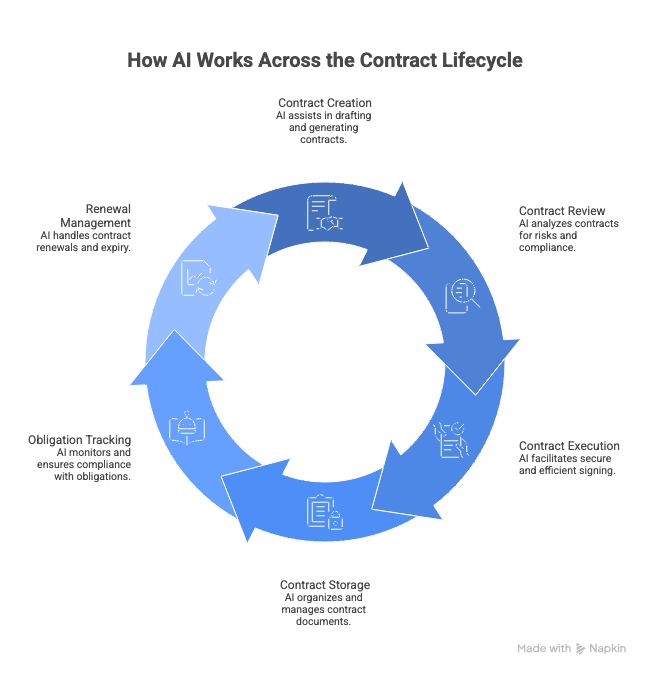
AI creates value throughout the entire contract lifecycle. Below is how AI works during each of these contract lifecycle phases.
1. Contract Creation and Drafting
At this phase of contract development, AI works by helping legal teams draft their contracts. This is done by leveraging pre-approved libraries of clauses and templates. This means that if a particular type of contract is required, for instance, an NDA or a vendor services contract, AI will be able to assist by suggesting language based on what has been approved by the organisation.
Some tools also assist by highlighting where language varies from what is considered standard.
2. Contract Review and Negotiation
This is where AI has the greatest immediate and tangible impact. Using AI, a contract can be reviewed in a matter of seconds, and the key clauses can be identified, compared, and contrasted against a standard playbook, highlighting areas of potential concern, such as unusual indemnities, missing limitation of liability provisions, or unfair termination provisions.
What used to take a lawyer 90 minutes to review can now be done in less than a minute, with the potential risks highlighted for the lawyer’s attention. The lawyer only needs to review the potential risks rather than reading the entire contract again.
3. Contract Execution and Signing
Artificial intelligence can be used in the signing of contracts by integrating with the e-signature process, ensuring that contracts are executed without any delay in the process. It can be used to track the stage where the contract currently stands in the process.
4. Contract Storage and Organisation
Once a contract has been signed, it needs to be stored in a manner that makes it easily searchable and accessible. This can be achieved with the help of artificial intelligence, which can be used in a CLM system for storing contracts in a structured manner, making them easily searchable.
This eliminates the hassle of looking for a contract in a series of emails or in a shared drive, where the chances of misplacing a contract are high. A contract or a clause can be located within a matter of seconds by any authorised person.
5. Obligation and Compliance Tracking
After execution, there are various obligations and compliance to be met by both parties. These include payment obligations, reporting obligations, performance obligations, and so on. The AI system will track these obligations and send alerts to the relevant party to perform their obligations.
This eliminates the need for someone to remember an obligation. Instead, obligations due today, overdue, and due soon will be presented to them.
6. Renewal and Expiry Management
The AI system will track renewal and notice periods for all contracts. This means legal teams will be alerted before a contract renewal or expiry. This is typically done with a window of time to ensure they have ample time to review and potentially renegotiate or terminate a contract if necessary.
This is particularly useful for companies with large numbers of vendors, suppliers, and customers to manage.
Key Use Cases of AI in Contract Management
- Clause Extraction and Analysis
Through NLP, AI can parse a contract’s text and isolate specific clauses, including indemnity, limitation of liability, payment terms, termination rights, governing law, non-competition, confidentiality, and many more. This is extremely valuable when conducting due diligence, auditing a portfolio of contracts, or conducting a review for regulatory purposes.
In other words, if an organisation needs to review all of their contracts for automatic renewal clauses before a strategic review, AI can do this in minutes, not days.
- Obligation Tracking and Deadline Management
The AI system can also identify and classify all of the obligations contained within a contract, including who is responsible for an action, what needs to be done, and when it is due. This means there is no chance of an obligation being forgotten because it is buried deep within a contract.
- Risk Identification and Alerts
The AI system also helps identify clauses that are likely to pose risk, such as clauses for liability, termination, or penalty, or even clauses for payment or lack of protective provisions. These are indicated as risk areas, which helps lawyers prioritise their attention on areas of critical need rather than treating all clauses equally.
Some systems also allow for a risk rating of all contracts, which can be easily reviewed for areas of risk for in-house counsel and management.
- Centralised Contract Repository
The most fundamental use of AI is probably having all contracts stored in a central location, which is well-structured, easily searched, and accessible for all authorised personnel. A central repository using AI for extracting metadata from all contracts means any contract can be retrieved in a matter of seconds, and versions are also stored for historical purposes.
This is especially important for audits, regulatory inquiries, M&A, and reporting.
- Template and Playbook Management
Artificial intelligence can assist in the management of contract templates and negotiation playbooks for legal teams. In case the language used by the counterparty does not conform to the approved standard, the system can identify this and suggest the alternative clause that should be used.
Benefits of AI in Contract Management
Organisations that have successfully implemented AI-based contract management practices have shown consistent improvement in the following areas:
- Speed: Contract review and cycle times are much shorter. Organisations have reported a reduction in cycle times from 45 days to 12 days after the implementation of AI-based CLM.
- Accuracy: AI applies the same rules to every contract it reviews. It does not overlook clauses in a contract because of fatigue or speed constraints. Research has shown that AI-based systems are more accurate than human review in identifying specific clauses related to risks.
- Cost Reduction: Less time is spent on manual, low-value tasks by legal teams. Cost savings of up to 35% in operational costs are also reported by organisations due to automation of contract administration tasks.
- Risk Reduction: With real-time monitoring of obligations, risk warnings, and renewal management, the risk of non-compliance, expired contracts, or even auto-renewals without due diligence is significantly reduced.
- Better Visibility: Senior legal staff and management can now have real-time visibility of the entire contract portfolio, i.e., existing contracts, obligations, renewal dates, and risk areas, without having to ask for reports or manually sift through contracts.
- Scalability: As an organisation grows in size and the number of contracts increases, the AI system can handle the increased load without a corresponding increase in staff, i.e., the same staff can handle a much larger portfolio with the same or even improved quality of oversight.
Challenges and Considerations When Adopting AI
Contract management with the aid of AI is not without its challenges, and the following are some of the key considerations that legal teams should be aware of before adopting AI.
Data Quality and Migration: It is important to note that AI systems perform best on well-structured and well-formatted data, especially historical contracts, and migrating the data into the new system is key to the success of the process.
Accuracy and Oversight: Although AI systems are very powerful, they are not necessarily accurate. It is important for legal teams to use AI systems as a guide, but not as a definitive tool. This is because, at times, human oversight is required, especially when it comes to making critical decisions regarding contracts.
Data Privacy and Confidentiality: Contracts usually carry confidential information about businesses and people. Therefore, before using any AI system for contract management, it is important for legal teams to assess how the system handles data, including storage, accessibility, and compliance with data privacy laws.
Change Management: It is important for businesses to understand that making a change from traditional methods of contract management, such as using spreadsheets, requires a change of mind-set among different stakeholders within an organisation. This is particularly important when it comes to using AI systems for contract management.
Integration with Existing Systems: To ensure maximum efficiency, AI systems for contract management need to be integrated into an organisation’s existing systems, including ERP, CRM, or matter management systems. It is important for businesses to assess this before making a purchase.
How Legistify Supports Contract Management for Legal Teams
For legal teams in India looking for ways to better systematise and streamline their contract management, Legistify is a platform that can offer tools for in-house legal teams and law firms. The contract management tool provided by Legistify can help teams centralise their contracts, keep tabs on their obligations, and even obtain greater visibility into their overall contract management, all of which are benefits of having a structured and organised approach to contract management, like what AI can offer.
Conclusion
AI isn’t a disruption; it’s a solution for problems that legal organisations have struggled with for a long time. Missed renewals, hidden obligations, inconsistent contract terms, and lack of portfolio visibility aren’t problems; they’re symptoms of trying to use manual processes on a scale where manual processes just don’t work well.
For in-house legal organisations, law firms, and corporate legal departments, AI in contract management represents a clear path forward for faster turnaround, better risk management, and stronger compliance without sacrificing the judgment and expertise that good legal work demands.
The organisations that will benefit most from AI are those that thoughtfully approach the process, considering use cases, testing tools, and ensuring that human review is always a key part of the process.