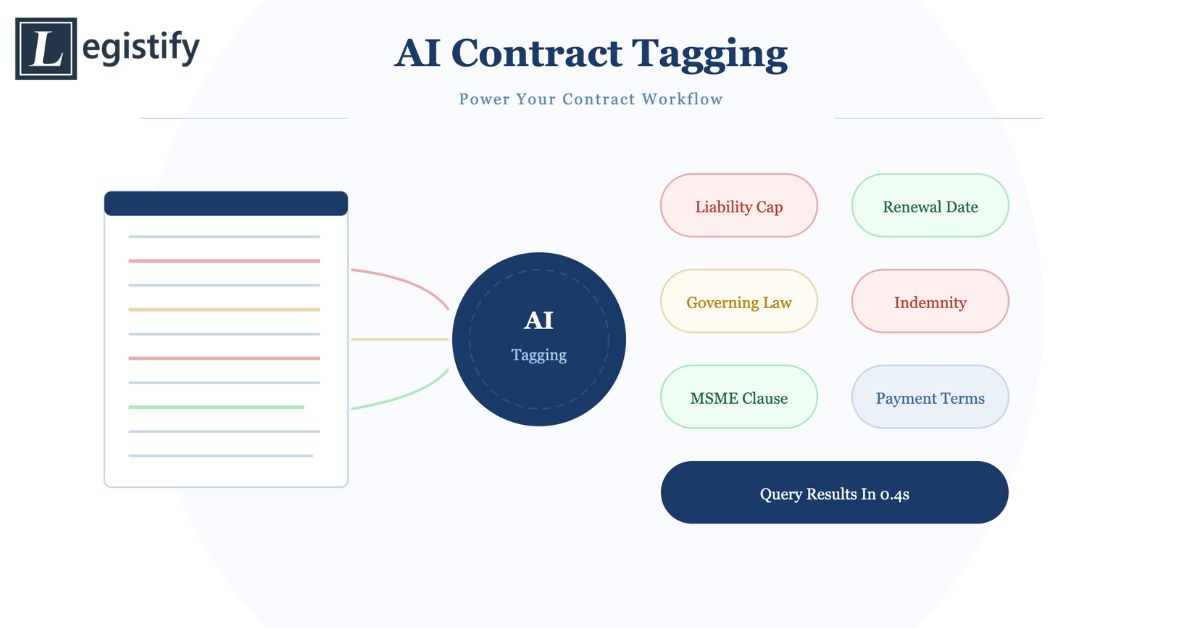
AI contract tagging is the process of automatically identifying and labelling key data points within a contract, extracting information such as parties, dates, clause types, payment terms, and liability caps, and structuring that information so it can be searched, reported on, and used to trigger downstream workflows.
Without AI tagging, contract data is locked in document text. A legal team that wants to know how many vendor agreements contain auto-renewal clauses, or which contracts have liability caps below a defined threshold, has to read through each agreement manually. With AI tagging, these questions are answered by querying structured data extracted automatically from every contract in the repository.
AI can reduce the entire contract lifecycle by 39% while saving up to 30% of legal department costs. A significant part of this efficiency gain comes from AI tagging: when contracts are tagged accurately and consistently, the entire downstream workflow, including review, approval, search, obligation tracking, and reporting, becomes faster and more reliable.
What AI Contract Tagging Actually Does
AI tagging applies machine learning models to contract text, identifies specific data types within that text, and labels them with structured metadata. The output is a set of tagged fields that represent the contract’s key information in a standardised, queryable format.
The specific tags applied depend on the organisation’s configuration and the contract type, but common tag categories include:
Parties and counterparties. The legal names of the contracting parties, including any defined terms used to refer to them throughout the agreement.
Effective and expiry dates. The date the contract comes into force and the date it expires or is scheduled for renewal.
Payment and financial terms. The contract value, payment schedule, currency, and any financial thresholds such as volume discount tiers or penalty amounts.
Clause type identification. Classification of clauses by type: indemnification, limitation of liability, termination, governing law, confidentiality, IP ownership, and so on.
Renewal and termination provisions. Whether the contract auto-renews, the notice period for non-renewal or termination, and any financial consequences of early exit.
Risk flags. Clauses that deviate from the organisation’s standard positions, such as unlimited liability, broad indemnification for consequential losses, or unusual governing law.
India-specific tags. For Indian enterprise contracts, additional tags for stamp duty classification, MSME supplier status, DPDPA data processing provisions, and regulatory compliance clauses linked to RBI, SEBI, or IRDAI frameworks.
How AI Tagging Powers the Contract Workflow
At the intake and review stage
When a new contract comes in for review, AI tagging is applied immediately. The tagged output gives the reviewer a structured summary of the contract’s key terms without requiring them to read the entire document first. The reviewer’s attention goes to the flagged items: the non-standard clauses, the risk indicators, and the provisions that require negotiation.
For legal teams reviewing dozens of incoming contracts per month, this changes the economics of contract review. Rather than allocating equal time to every contract, the review effort is concentrated on the agreements that the AI tagging has flagged as high-risk or non-standard. Standard agreements that pass through without flags receive lighter review, freeing capacity for the complex matters.
This approach is particularly valuable in the Indian enterprise context, where high-volume contract workflows, such as NDA approvals, standard vendor agreements, and employment contracts, consume significant legal team time on review of terms that rarely require substantive attention.
At the search and retrieval stage
A tagged contract repository is a searchable database of contract data. Legal teams can query the repository in plain language: which contracts renew in Q3, which supplier agreements carry MSME payment obligations, which customer contracts have a liability cap below INR 50 lakhs.
Without tags, this question requires reading every contract. With tags, it is answered in seconds.
The search and retrieval benefit is particularly significant for organisations responding to due diligence requests, regulatory inspections, and litigation discovery. When the contract data is structured and tagged, producing a complete and accurate response to a specific query is fast. When it is not, the response is slow, incomplete, and resource-intensive.
At the obligation tracking stage
AI tagging identifies not just what the contract says but what obligations it creates. Renewal dates, payment milestones, SLA review windows, regulatory compliance obligations, and MSME payment deadlines are all captured as structured data points that can be tracked and alerted on automatically.
Obligation tracking without AI tagging depends on lawyers manually extracting and recording key dates after each contract is signed. This is time-consuming, inconsistently done, and produces tracking records that are only as complete as the lawyer’s attention at the time. AI tagging makes obligation tracking systematic: every contract is extracted consistently, and no obligation is missed because someone did not manually enter it into a tracker.
Automated alerts reduce missed renewal opportunities by 80%. For Indian enterprise legal teams managing large contract portfolios across multiple business units, this reliability is the difference between a reactive legal function that discovers missed renewals after the fact and a proactive one that manages them in advance.
At the analytics and reporting stage
Tagged contract data is the raw material for portfolio-level analytics. When every contract in the repository has structured, consistent metadata, the legal team can produce reports that were not previously possible without manual data assembly.
Which contract types generate the most redlines? What is the average liability cap across the vendor portfolio? How many contracts are approaching renewal in the next 60 days, and what is their aggregate value? Which business units have the highest volume of non-standard contracts?
These reports are directly relevant to the GC’s strategic reporting to leadership and to the procurement function’s commercial planning. They are impossible to produce accurately without AI tagging.
Setting Up AI Contract Tagging: A Practical Approach
Step 1: Define the tag taxonomy
Before AI tagging can be configured, the organisation needs to define what it wants to tag. The tag taxonomy should reflect the specific information the legal team and business need to access: the clause types most relevant to the contract mix, the financial thresholds that matter for risk assessment, and the India-specific data points that affect compliance and obligation management.
A well-designed tag taxonomy is specific enough to be useful and broad enough to cover the variation in the organisation’s contracts. Generic taxonomies borrowed from other organisations may not reflect the specific regulatory and commercial context of Indian enterprise contracts.
Step 2: Train the model on your contracts
AI tagging accuracy depends on training data. A model trained on contracts that are similar to the organisation’s actual contract mix will perform better than one trained on a generic dataset. For Indian enterprise contracts, the training data needs to include Indian drafting conventions, Indian regulatory clause types, and the specific language that appears in contracts under Indian governing law.
This is where India-specific AI platforms have a structural advantage over global tools: they are trained on Indian contract corpora and understand the patterns in Indian commercial agreements that global models do not reliably recognise.
Step 3: Apply tagging to the legacy portfolio
For organisations with large existing contract repositories, the highest-value application of AI tagging is often the legacy portfolio: the thousands of signed agreements that contain data no one can currently access without reading them.
Tagging the legacy portfolio produces immediate value: identification of contracts approaching renewal that no one was tracking, discovery of non-standard terms that were accepted without realising it, and a complete picture of obligation exposure across the portfolio.
Migration of legacy data is typically done in batches, starting with the highest-value or highest-risk contract categories and working through the portfolio systematically.
Step 4: Integrate tags into downstream workflows
AI tags are most valuable when they are connected to the workflows that act on them. Renewal date tags should trigger calendar alerts. Risk flag tags should route contracts to senior legal review. MSME payment term tags should connect to the payment tracking workflow. DPDPA data processing tags should connect to the compliance programme.
Tags that sit in a repository without triggering any downstream action are useful for search but do not change how the organisation manages its contracts. Integration is what converts tagged data into operational change.
Step 5: Review and improve accuracy over time
AI tagging accuracy is not static. As more contracts are processed, the model’s outputs should be reviewed and corrected where they are inaccurate. These corrections become additional training data that improves the model over time.
Accuracy review should focus on the tag types that are most consequential: liability caps, renewal dates, and risk flags. Errors in high-consequence tags produce decisions that are made on incorrect data.
The India-Specific Configuration for AI Contract Tagging
For Indian enterprise legal teams, the AI tagging configuration needs to include several India-specific elements that global platforms do not cover by default.
Multi-state stamp duty classification. Contracts need to be tagged with their stamp duty classification under the applicable state law. This tag supports the stamp duty assessment workflow and creates an audit trail of stamp duty compliance across the portfolio.
MSME supplier indicator. Contracts with MSME suppliers need to be tagged as such, triggering the payment term monitoring workflow that tracks compliance with the 45-day payment obligation.
DPDPA data processing flag. Contracts that involve personal data processing need to be tagged, triggering review against the DPDPA playbook position and connecting to the data processing agreement compliance workflow.
Regulatory clause tags. Contracts in regulated sectors that include references to RBI, SEBI, IRDAI, or other regulatory bodies need to be tagged with the applicable regulatory framework, supporting the compliance function’s obligation tracking.
Aadhaar eSign and DSC execution tags. The execution method used for each contract needs to be tagged as part of the Section 65B compliance documentation, supporting the certification process if the contract needs to be produced as evidence.
Legistify’s contract management platform includes AI tagging trained on Indian enterprise contracts, with India-specific tag types built into the standard configuration for stamp duty, MSME, DPDPA, and regulatory compliance classification.
Conclusion
AI contract tagging transforms the contract repository from a document store into a structured database. The downstream benefits, faster review, accurate search, systematic obligation tracking, and portfolio-level analytics, all depend on tags being applied accurately and consistently to every contract that enters the repository.
For Indian enterprise legal teams, the configuration of AI tagging needs to reflect the India-specific regulatory and commercial context that global tools do not cover. The right configuration, applied to the full contract portfolio including legacy agreements, produces a level of visibility into contractual risk and obligation that manual processes cannot achieve at scale.