Most legal tech implementations fail. Not at the point of deployment, but in the months after. The platform is configured and accessible. A training session has been run. And then, six months later, contracts are still being managed in email, the litigation tracker is used by two people, and the organisation is paying a significant annual licence fee for a tool that has not changed how the legal function works.
This pattern repeats across CLM deployments, matter management systems, litigation tracking tools, and compliance platforms. It is not specific to any vendor or any sector. It is a predictable consequence of how enterprise software is typically bought and deployed, applied to a function, the in-house legal team, that has specific characteristics that make the standard enterprise software implementation model a poor fit.
Understanding why legal tech implementations fail is the first step to avoiding the pattern. This blog covers the main failure modes and what a different implementation approach looks like.
The Main Reasons Legal Tech Implementations Fail
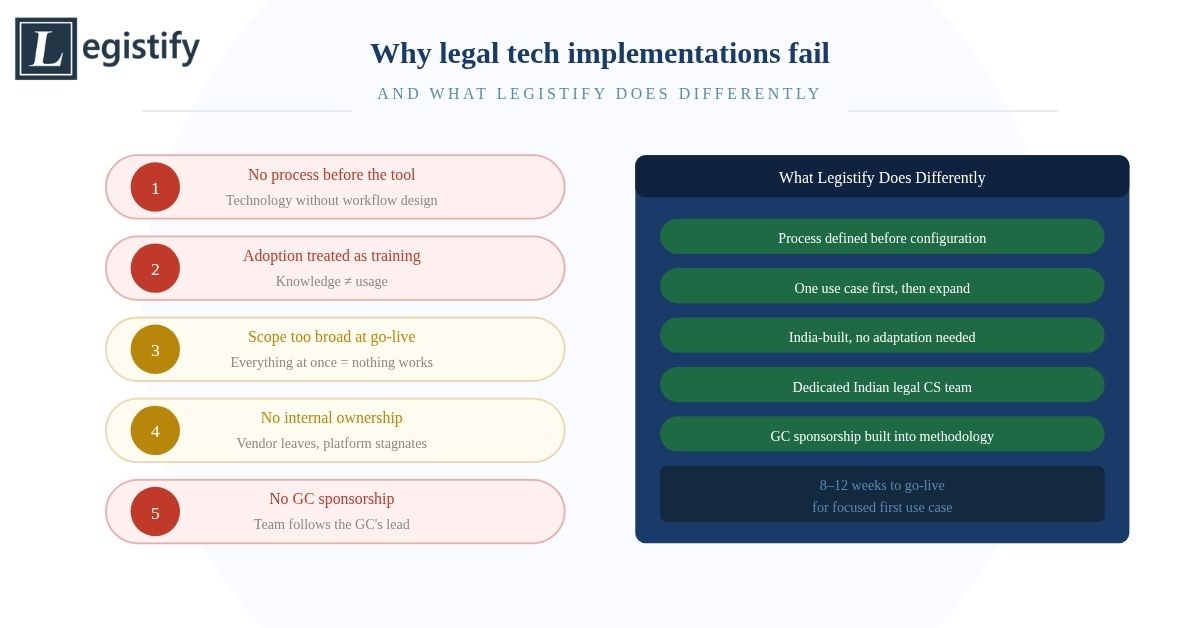
The technology is purchased before the process is defined
The most common failure mode in legal tech implementation is purchasing a platform before defining what it is supposed to do. The CLM is bought because contract management is visibly broken. The implementation begins. The vendor configures the system. And then, during configuration, it becomes clear that nobody has agreed on what the contract approval process should look like, what the standard contract types are, which templates should be loaded, or who is responsible for obligation tracking after execution.
Legal tech automates processes. If the process does not exist in a defined form before the technology is deployed, the technology has nothing to automate. It becomes a more expensive version of the spreadsheet it was supposed to replace.
The right sequence is process definition first, technology second. Before any platform is configured, the legal team needs to map the current process, identify the specific problems the technology is intended to solve, and define what the new process will look like. This work takes time and requires the legal team’s involvement. It cannot be delegated to the vendor.
Adoption is treated as a training problem
The second most common failure mode is treating adoption as a training exercise. After go-live, the implementation team runs a training session. Lawyers learn how to use the platform. The assumption is that knowledge leads to usage.
In practice, usage depends not on knowledge but on whether the new way of working is easier than the old way. If a lawyer can still send a contract by email directly to a counterparty, they will, regardless of whether they know how to use the CLM. If a paralegal can still track cases in a spreadsheet that they built themselves, they will, because the spreadsheet is familiar and the new system is not.
Adoption requires the workflow to change, not just the knowledge base. This means making the old way harder: turning off the shared drives, requiring contract requests to come through the new intake form, stopping the practice of emailing contracts for review. It also requires making the new way obviously better, which means ensuring that the platform actually works smoothly for the tasks lawyers do most often before go-live.
Implementation scope is too broad
The third failure mode is trying to implement everything at once. The vendor has a large feature set. The demo shows fifteen impressive capabilities. The implementation plan includes all of them. The result is a complex, partially configured system that nobody fully understands, with workflows that do not quite work and data that is not quite clean.
Successful implementations start with one use case, get it working properly, build adoption, and then expand. The first use case should be the one that is most visible, most painful without the technology, and most straightforward to implement. For most Indian enterprise legal teams, this is either standard contract generation for high-volume, low-complexity contract types, or litigation case tracking with automated hearing date alerts.
Getting one thing working properly builds trust in the system. Trust leads to adoption. Adoption builds the foundation for the second use case. Trying to solve everything at once undermines trust and produces a system that solves nothing well.
There is no internal ownership
The fourth failure mode is implementation without internal ownership. The vendor has an implementation team. The vendor’s team configures the system, runs training, and is available for support during the first few months. Then the vendor’s engagement reduces, and the platform is left to the internal team to manage.
If there is no internal owner who understands the platform, champions its use, and is accountable for adoption, the platform stagnates after the vendor disengages. Issues that arise go unresolved because no one knows how to fix them. Configuration that needs updating as the legal team’s workflows evolve does not get updated. Lawyers who have problems with the system have nowhere to turn except the vendor’s helpdesk, which is not the same as having someone internally who understands both the tool and the legal team’s context.
The internal owner does not need to be technical. They need to understand the legal team’s workflow, have the authority to define how the new process works, and be accountable for the outcome of the implementation.
The General Counsel is not visibly engaged
The fifth failure mode is implementation without visible GC sponsorship. In-house legal teams take their cultural cues from the General Counsel. If the GC continues to manage contracts by email, the rest of the team reads this as a signal that the new platform is optional. If the GC refers to the litigation tracker in leadership meetings, the team reads this as a signal that it matters.
Implementation plans that focus on the operational layer without securing visible GC engagement are systematically weaker than those that treat GC sponsorship as an implementation requirement. This is not about the GC doing more work. It is about the GC demonstrating, through their own usage, that the platform is the way the legal function operates.
Why These Failures Are More Common in Indian Enterprises
The failure modes described above are universal. But there are specific reasons why they manifest more frequently in Indian enterprise legal teams.
The legal team is already over-stretched. Indian enterprise in-house legal teams are consistently under-resourced relative to the volume of work they manage. Implementation requires time for process definition, configuration review, data migration, testing, and training. This time is rarely explicitly allocated. The implementation runs alongside existing workloads, which means process definition is rushed, testing is shallow, and the go-live happens before the team is ready.
Legacy data is complex. Most large Indian enterprises have contract repositories and case records built up over many years, stored in combinations of physical files, shared drives, email archives, and older systems. Data migration is consistently the part of legal tech implementations that takes longest and produces most post-go-live problems. The scale and diversity of Indian enterprise legacy data makes this challenge larger than in younger or smaller organisations.
Multi-state regulatory complexity creates configuration challenges. Configuring a CLM for Indian enterprise use requires stamp duty workflows that reflect the variation across 25-plus states, e-signature workflows that support Aadhaar eSign and DSC, and regulatory clause templates for RBI, SEBI, IRDAI, and other sector-specific frameworks. This configuration work is more demanding than configuring the same tool for a simpler regulatory environment, and it requires specific knowledge of the Indian regulatory landscape that generic implementation teams do not always have.
Change management is underestimated. Senior lawyers in Indian enterprises have in many cases worked the same way for decades. Introducing a technology platform that changes how contracts are created, reviewed, and stored is a more significant change management challenge than it appears from outside the function. Implementation plans that do not invest in change management produce adoption resistance that outlasts the go-live period.
What Legistify Does Differently
Built for India, not adapted for India
The first difference is product scope. Legistify is built specifically for the Indian legal environment. Multi-state stamp duty assessment, Aadhaar eSign workflows, India Post dispatch integration, Indian court system connectivity for automated litigation updates, and clause libraries for Indian regulatory frameworks are not features added onto a global product. They are core capabilities of a platform designed from the ground up for the Indian enterprise context.
This matters for implementation because it eliminates a class of configuration challenges that arise when a globally oriented platform is adapted for Indian requirements. The India-specific functionality does not need to be built or integrated during implementation. It is already there.
Implementation methodology focused on process first
Legistify’s implementation approach begins with process definition before configuration. The implementation engagement starts with workshops that map the legal team’s current workflows, identify the specific problems the platform is intended to solve, and define the new processes that the platform will support. Configuration follows process definition, not the other way around.
This sequence takes longer at the start. But it produces implementations that work after go-live rather than implementations that are configured but unused.
Phased go-live with one use case first
Rather than deploying the full platform simultaneously, Legistify implementations typically go live with one use case first: standard contract generation for high-volume contract types, or litigation case tracking with automated hearing alerts. The first use case is chosen based on the legal team’s most painful current problem and the workflow that is most straightforward to configure correctly.
Once the first use case is working and adoption is stable, the second use case is added. This phased approach builds the legal team’s confidence in the platform before asking them to change multiple workflows simultaneously.
Dedicated customer success support
Legistify’s customer success model includes dedicated support through go-live and for a defined period after. Customer success managers understand both the platform and the Indian legal context. When a configuration issue arises, or when adoption is stalling in a specific team, the customer success manager can diagnose the problem and support resolution.
This support model is designed for the reality of Indian enterprise legal team implementations: that the internal owner may be a lawyer rather than a technology specialist, and that the platform needs to be adapted to the legal team’s workflow rather than the other way around.
Training designed for legal workflows, not software features
Legistify’s training is structured around how lawyers actually work, not around the platform’s feature list. Training covers the workflows the legal team uses most frequently, the India-specific capabilities that differentiate the platform from generic tools, and the common points of friction that arise in the first weeks of use.
Training sessions are run by people who understand the Indian legal context, not by generic software trainers. This makes the training relevant to the lawyers’ actual experience rather than a product demonstration.
What a Successful Legal Tech Implementation Looks Like
Across Legistify’s implementations with Indian enterprise legal teams, the ones that succeed share a set of consistent characteristics.
The process was defined before configuration began. The implementation team mapped the current workflow, agreed on the new workflow, and had internal sign-off on the process design before a single screen was configured.
The first use case was clearly scoped and measurable. The legal team knew exactly what success looked like at the end of the first phase: a specific contract type going live in the platform, a specific percentage of contracts processed through the new workflow, a specific reduction in cycle time.
The GC was visibly engaged. The GC used the platform for their own work, referenced it in team meetings, and made it clear that the platform was how the legal function was expected to operate.
The internal owner was identified early and empowered. The internal owner had time explicitly allocated for implementation work, had the authority to make decisions about process design, and had a clear escalation path when issues arose.
Data migration was treated as a project, not an afterthought. The scope of legacy data was assessed early, a migration plan was developed before go-live, and the legal team accepted that not all legacy data would be migrated on day one.
When these elements are in place, legal tech implementations succeed. When they are absent, the platform goes live, adoption does not follow, and the implementation becomes another entry in the long list of enterprise software purchases that did not deliver the expected value.
Conclusion
Legal tech implementations fail for predictable reasons that have nothing to do with the quality of the technology. Process not defined before configuration. Adoption treated as training. Scope too broad. No internal ownership. GC not engaged. Each of these is avoidable with the right implementation approach.
For Indian enterprise legal teams, the implementation challenge is compounded by over-stretched teams, complex legacy data, multi-state regulatory configuration requirements, and the change management challenge of asking senior lawyers to work differently. An implementation approach that accounts for these specifics is more likely to succeed than one that treats Indian enterprise implementation as a standard global deployment.
The technology for transforming how Indian enterprise legal teams work is available and proven. The question is not whether the technology works. It is whether the implementation approach creates the conditions for it to be used.