Legal operations software exists because the in-house legal function has a structural problem. Demand for legal work keeps growing, driven by regulatory complexity, expanding commercial portfolios, and a business environment that generates more contracts, more disputes, and more compliance requirements every year. Headcount does not keep pace. According to the 2025 CLOC State of the Industry Report, 83% of legal departments expect demand to increase, with 63% identifying workload and resource bandwidth as their top challenge. Meanwhile, 76% of in-house legal departments report that a headcount freeze is likely or already happening.
The result is a gap between what the legal team is expected to deliver and what it can deliver with its current resources. Legal operations software addresses this gap not by replacing lawyers but by removing the administrative overhead that prevents lawyers from doing legal work. When a contract approval process that took two weeks is reduced to two days, the lawyer who managed that process gains time for work that actually requires legal judgment. When a case status update that required manual checking of three court portals is automated, the person who performed that check can do something more valuable instead.
For Indian enterprise legal teams, the efficiency stakes are particularly high. India has 805 active legal technology companies as of 2026. The Indian legal AI market is projected to grow from USD 29.5 million in 2025 to over USD 106.3 million by 2030. The technology is available and improving. The teams that adopt it systematically will widen the gap between themselves and those that do not.
What Legal Operations Software Covers
Legal operations software is not a single product. It is a category that covers several distinct functional areas, often delivered as an integrated platform.
Contract lifecycle management covers the full contract process from intake through drafting, approval, execution, obligation tracking, and renewal. CLM reduces contract cycle times, enforces approval workflows, tracks key dates automatically, and maintains a structured repository that makes contract data accessible to legal and business teams.
Matter management covers the tracking and management of legal matters across the full portfolio: internal projects, disputes, regulatory proceedings, and external counsel engagements. Matter management systems maintain a complete record of each matter, track deadlines and milestones, manage document storage, and provide portfolio-level reporting.
Litigation management covers the tracking of active cases across courts and tribunals, hearing date management, external counsel oversight, document management for case files, and contingent liability reporting. For Indian enterprises, a litigation management module needs to integrate with Indian court systems for automated case updates.
Legal spend management covers the budgeting, billing, and analysis of external legal spend. Spend management tools enable the legal team to manage outside counsel more strategically, track spend against budgets in real time, enforce billing guidelines, and identify patterns in legal spend that inform sourcing decisions.
Compliance and IP management covers regulatory compliance tracking, intellectual property portfolio management, and the documentation of compliance activities for audit purposes.
The most effective legal operations software platforms integrate these functions so that data flows across them. A contract dispute that escalates to litigation connects the contract record to the case record. An IP matter connects to the contract that defines the IP rights. A compliance obligation connects to the contract that creates it.
The Efficiency Gains That Matter Most for Indian In-House Teams
Reducing contract cycle time
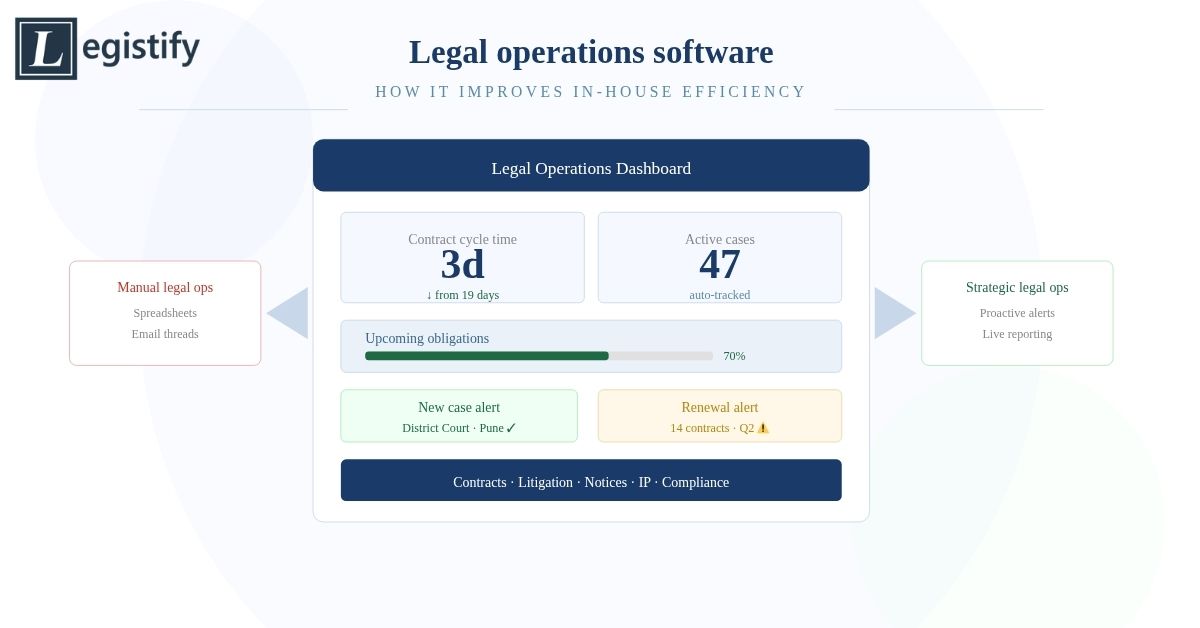
The average contract cycle time for enterprise legal teams without structured CLM is between 20 and 40 days, depending on contract complexity and the number of approval stages. With structured CLM, this reduces to 3 to 7 days for standard contracts. The reduction comes from several sources: parallel rather than sequential approval routing, template-driven drafting that eliminates the blank-page drafting step, and automated escalation when approvals are not completed within defined timeframes.
For Indian enterprises executing hundreds of contracts per month, the aggregate time saving from reduced cycle times is real and measurable. But the more important benefit is the elimination of the bottleneck effect: when the legal team is not the slow point in the contract process, it is not perceived as a blocker to business operations, and the relationship between legal and commercial teams improves.
Eliminating manual court tracking
For in-house legal teams managing active litigation, manual court tracking is one of the highest-volume and lowest-value activities. Checking cause lists on multiple court portals, recording hearing dates in spreadsheets, and following up with external counsel for case status updates collectively consume hours of legal team time per week. None of this work requires legal judgment. All of it is done because someone needs to know what is happening with each case.
Automated litigation tracking, integrated with Indian court systems, eliminates most of this. Case status updates arrive in the matter management system without anyone checking a portal. Hearing dates are tracked automatically and alert the responsible lawyer before they arrive. New case filings against named entities trigger immediate notifications. The legal team’s attention is drawn to what requires action, not to information gathering.
AI adoption is becoming central to in-house efficiency strategies, with data-driven decision-making shaping how legal operations scale. For Indian teams managing high-volume litigation alongside contract operations, automated court tracking is among the highest-value efficiency gains available.
Centralising matter information
The most common source of inefficiency in in-house legal teams is not slow processes. It is fragmented information. A lawyer spending 20 minutes finding the right version of a contract before they can answer a question about it. A GC unable to answer a basic question about outside counsel spend without pulling data from three different spreadsheets. A compliance team unsure whether all regulatory obligations from a specific contract have been tracked.
Legal operations software creates a single source of truth for the legal function. When every contract, every case, every matter, every spend item, and every compliance obligation is in one system, the information retrieval overhead disappears. The lawyer finds what they need in seconds, not minutes. The GC can answer questions about legal exposure from a dashboard, not from a manual data assembly exercise.
CLM software users can gain valuable performance insights across legal, finance, sales, and procurement, including cycle times, deviations, savings, risks, expiry dates, and contract renewal statistics. This portfolio-level visibility changes what the GC can contribute to leadership conversations.
Enabling proactive rather than reactive legal management
The most consequential shift that legal operations software enables is from reactive to proactive legal management. A reactive legal team responds to problems as they arise. A proactive one identifies risks and obligations before they become problems.
In a reactive mode, the legal team discovers a contract is about to auto-renew when the counterparty sends a renewal invoice. It finds out about a new case filing when external counsel calls to discuss strategy. It learns about a compliance deadline when the regulatory body sends a reminder. Each of these is a problem the legal team had the information to prevent but did not act on because the information was not accessible in time.
With legal operations software, automated alerts flag contract renewal windows 90 days in advance. New case alerts notify the team immediately when a filing is made. Compliance obligation tracking connects regulatory deadlines to the calendar before they become urgent. The legal team shifts from responding to events to managing them in advance.
For Indian enterprise legal teams, this shift matters in the context of India’s regulatory environment. Regulatory changes, inspection cycles, and compliance deadlines are predictable. A legal function with automated obligation tracking and proactive alert systems is operationally better positioned for regulatory scrutiny than one that depends on individual lawyers remembering what is due when.
Improving external counsel management
External legal spend is one of the largest and least transparent cost items in the enterprise legal budget. Without structured matter management and spend tracking, the GC has limited visibility into what is being spent, on what types of work, with which firms, and whether the spend is producing value.
Legal operations software provides the framework for strategic external counsel management. Matter management systems track every engagement from inception through completion. Billing guidelines enforcement ensures that invoices comply with agreed terms before payment. Spend analytics identify patterns: which practice areas drive the most cost, which firms are most cost-effective on specific matter types, and where work could be shifted to lower-cost providers without compromising quality.
For Indian enterprise legal teams with both domestic and international legal matters, spend management needs to cover panel arrangements with Indian advocates as well as international firm engagements. The comparison of stage-linked billing for litigation counsel with hourly billing for transactional work requires a management system that can accommodate both billing models and report across them.
What Legal Operations Software Changes for the GC
The efficiency gains described above affect individual lawyers and the legal team’s operational capacity. But the more consequential change is at the GC level, in how the general counsel is able to engage with the organisation’s leadership.
A GC whose team uses legal operations software can answer questions that a GC whose team does not cannot. What is the organisation’s total contingent liability from active litigation? What is the contract renewal pipeline for the next quarter, and which renewals represent revenue risk? Which regulatory compliance deadlines are approaching in the next 30 days? What is outside counsel spend this quarter versus the same period last year, and what is driving the variance?
These are not difficult questions. But without centralised data, answering them requires manual data collection that takes time and produces incomplete results. With centralised data from an integrated legal operations platform, they are answerable from a dashboard.
The result: attorneys buried in administrative work, contracts stuck in email chains, and a General Counsel who can’t answer a basic question about outside counsel spend without pulling reports from three different spreadsheets. Legal operations software removes this barrier between the GC and the information needed to lead the function strategically.
For Indian enterprise GCs, this matters in the context of board and audit committee reporting. The legal function’s exposure to regulatory risk, litigation, and compliance obligations is of direct interest to the board. A GC who can report on this systematically, with current data, positions the legal function as a governance asset rather than a cost centre.
The India-Specific Requirements for Legal Operations Software
Legal operations software for Indian enterprise legal teams needs to address requirements that global platforms do not always cover.
Integration with Indian court systems. Litigation management needs automated case updates from the Supreme Court, High Courts, District Courts, NCLTs, consumer forums, and tribunals. This integration is specific to India and is not available from global legal operations platforms that were not built for the Indian court system.
Multi-state stamp duty support. Contract management needs stamp duty assessment and routing across India’s 25-plus state frameworks. A CLM that supports e-signature but does not handle stamp duty is incomplete for Indian enterprises.
DPDPA compliance workflows. Legal operations software needs to support DPDPA-compliant data processing agreement templates, obligation tracking for data protection requirements, and audit trail management for data protection compliance.
India Post integration for notice management. Notice management for Indian enterprises, particularly in BFSI and collections, needs registered post dispatch through India Post, with delivery tracking and proof of delivery. This is a specific Indian operational requirement.
Aadhaar eSign. E-signature workflows for Indian enterprises need to support Aadhaar eSign and DSC-based execution alongside international e-signature methods.
Legistify’s legal operations platform is built specifically for the Indian enterprise environment, with contract management, litigation tracking, notice management, and IP management integrated in a single system designed for the regulatory and operational requirements of Indian enterprises.
Conclusion
Legal operations software does not solve the fundamental challenge facing in-house legal teams: doing more with limited resources. But it does change what is possible with those resources. When administrative overhead is automated, when information is centralised, when processes are structured and trackable, the legal team’s capacity for substantive legal work increases without a corresponding increase in headcount.
For Indian enterprise legal teams navigating a regulatory environment that is growing more demanding, a litigation load that is among the highest in the world, and business operations that generate more legal work every year, legal operations software is not a convenience. It is the operational infrastructure that makes the in-house legal function sustainable at scale.