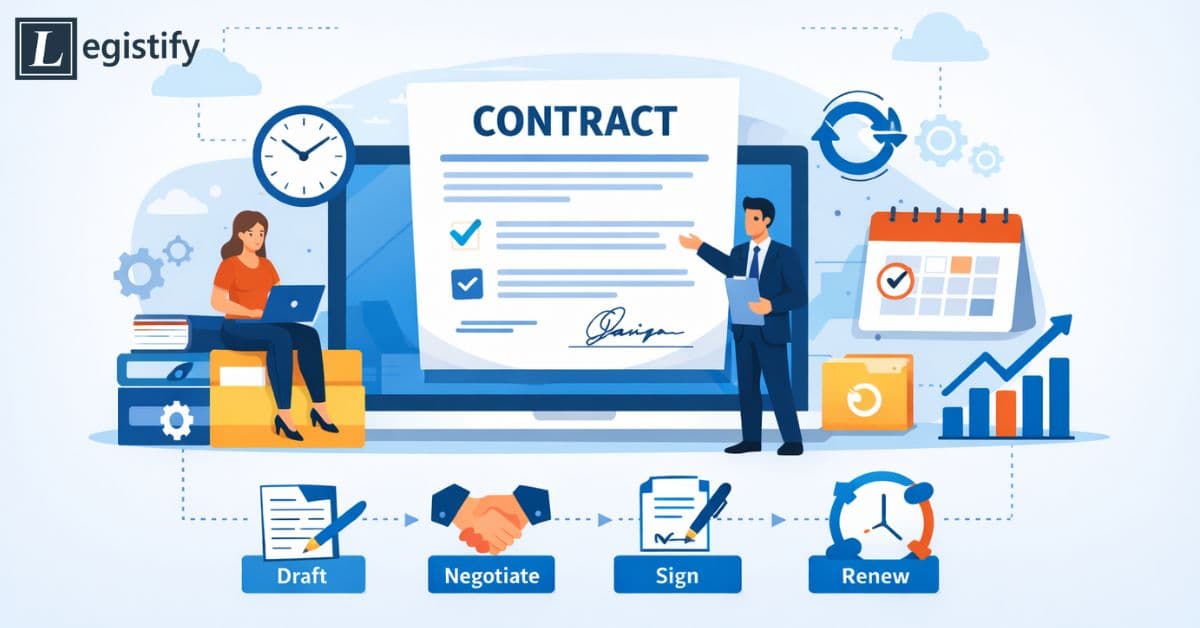
In the operation of business, contracts are critical and help establish terms and conditions for partnerships, vendors, customers, and even internal agreements. However, managing contracts through emails, spreadsheets, and shared folders often results in inefficiency and failure to meet deadlines.
Contract Lifecycle Management (CLM), on the other hand, is a systematic approach to managing contracts through their lifecycle, from signing to expiration. This process helps organisations mitigate risks and improve the entire contract lifecycle.
In this guide, we will discuss what Contract Lifecycle Management is, the lifecycle process, and the reasons for investing in a CLM solution.
What is Contract Lifecycle Management?
Contract lifecycle management (CLM) is a process of managing contracts throughout their lifecycle, from the point of request to renewal or end of life. It is a combination of processes, workflows, and technology to manage contracts in a most efficient way.
By using a CLM process, an organisation can transition away from a disjointed and unstructured contract management process and instead implement a centralised and structured process to manage contracts.
With a CLM system in place, businesses are able to:
- Design contracts using standardised templates
- Manage negotiations and versions of contracts
- Automate approval processes
- Manage contracts in a centralised repository
- Track obligations and key dates
- Renew and amend contracts
A structured process is important in order to increase business efficiency and legal compliance, especially when dealing with large numbers of contracts.
The Key Stages of the Contract Lifecycle
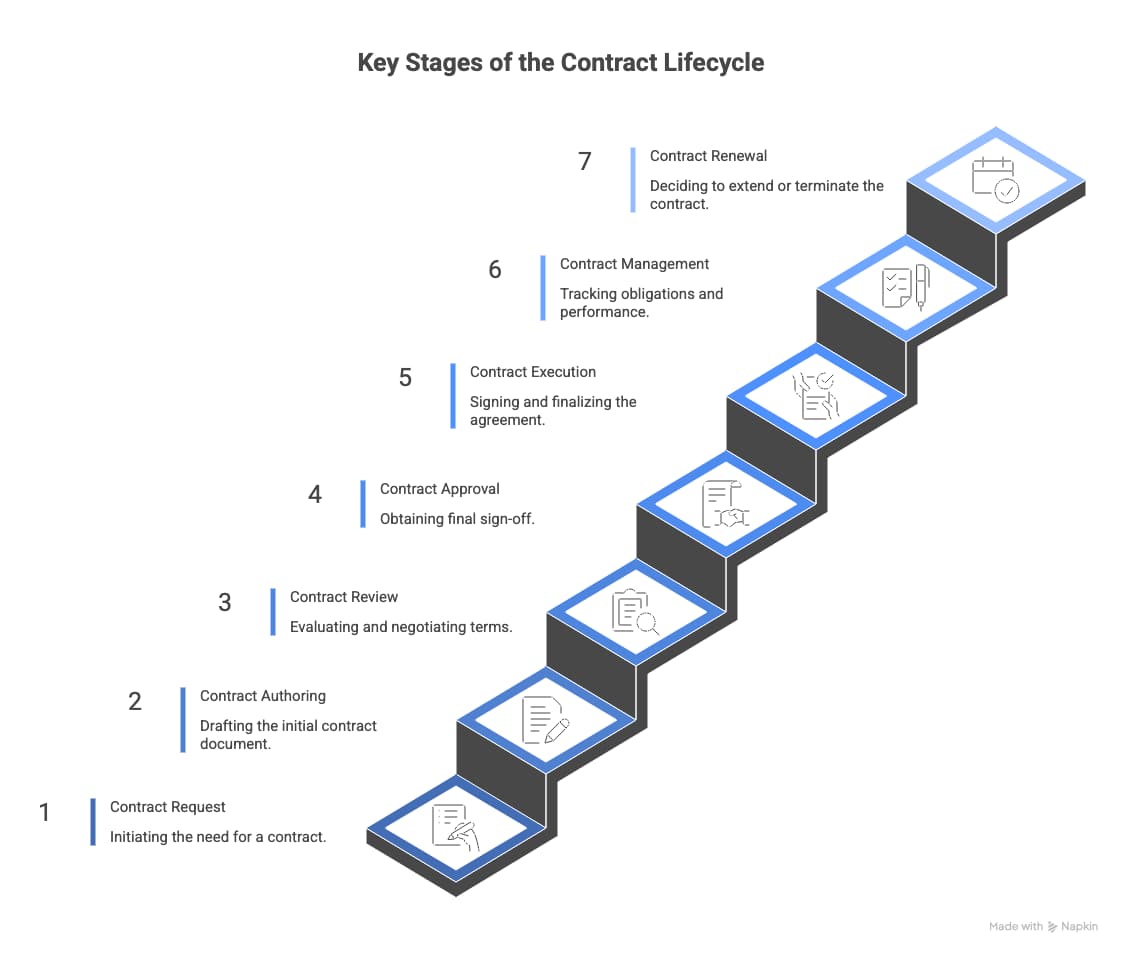
While different organisations may structure their workflows differently, most contracts move through several common stages. Understanding these stages is essential for implementing an effective CLM process.
1. Contract Request and Initiation
The process starts with the identification of the need for a contract by the team.
For instance:
- The sales team has closed a deal with a new customer.
- The procurement team has the need to onboard a new vendor.
- A partnership contract has to be developed with another organisation or company.
At this point, someone makes a request for the contract, and the information included will be the key details such as the individuals or companies involved, the value of the contract, and the scope of work and timelines.
This process, in many organisations, can be done on an ad-hoc basis, such as sending emails or using spreadsheets. However, the process can be cumbersome, particularly if many stakeholders are involved in the process.
The use of CLM technology has improved the process of requesting and initiating contracts, particularly because of the request forms included in the technology. This process ensures that the right information has been included and the request has been routed to the right teams for review and approval.
A good initiation process ensures the proper beginning of the contract development process.
2. Contract Authoring and Drafting
Once the contract request has been authorised, the contract drafting process starts.
The contract document is created by the legal or business team using contract templates and clause libraries. Contract templates are very important in this process, as they help to ensure that contracts are created according to the legal standards of the organisation.
There are several advantages to using contract templates:
- Time savings
- Consistency
- Legal risk avoidance
- Simplifying contract creation for non-legal teams
Many modern contract lifecycle management systems use automated document generation, allowing users to create contracts by entering information into structured data fields. This information is then automatically populated into the contract document.
Clause libraries are also an essential tool for contract lifecycle management systems. They are collections of pre-approved legal language, such as contract clauses, that can be incorporated into contracts if necessary.
3. Contract Review and Negotiation
Once a draft is prepared, the contract proceeds to the review and negotiation phase.
At this stage, various stakeholders may be required to review the contract. These include legal teams, finance teams, procurement teams, and business managers. In this stage, it is also possible that counterparties may wish to suggest changes or even require modifications to some of the clauses.
If there is no proper system in place, this stage of the contract lifecycle can prove to be cumbersome and labor-intensive. It is possible that various versions of a contract may end up being circulated via email, and it may not be clear which is the latest version of a contract.
CLM systems solve this problem by offering tools that facilitate collaboration in this stage. Such tools include version control, redlining, and change tracking, as well as shared commenting and annotations. Such tools ensure that all parties are able to work together efficiently while still being able to keep tabs on all that is going on.
The negotiation process continues until all parties are in agreement regarding the final terms of a contract.
4. Contract Approval
Before a contract is signed, it is to go through a series of approval processes internally.
These approval processes may vary depending on factors such as:
- Contract amount
- Risk level
- Type of agreement
- Department involvement
For instance, a high-value vendor agreement may require approval from legal, finance, and even top management, whereas a low-risk agreement may require approval from departments.
Manual approval processes can hinder a company’s contract lifecycle significantly, as contracts may end up in inboxes awaiting approval, thus stalling business processes.
However, this issue is resolved with CLM solutions that introduce approval processes in contracts. Contracts are routed to approvers automatically, and approvers are notified of actions to be taken on contracts.
This ensures that contracts move through the approval process efficiently while maintaining proper governance and oversight.
5. Contract Execution
Once all the approvals are done, it is ready to be executed.
Execution is a process of signing the agreement, making it a legally binding document. Traditionally, this involved printing the documents, getting signatures on paper, and then scanning them to store them.
However, in most organisations today, electronic signatures are being utilised to facilitate this process.
There are various benefits of electronic signatures, such as:
- Faster execution of contracts
- Less administrative work
- Legally compliant signatures
- Document tracking
Once executed, the final document is then stored in a centralised repository.
A well-organised repository is important to ensure that all executed contracts are easily located when required.
6. Contract Management and Obligation Tracking
Many companies consider the execution of contracts to be the last step in the process. However, the operational stage is just as significant.
In this stage, companies must guarantee that all contractual obligations are being met. These obligations can include:
- Deliverables and services
- Payments
- Reporting
- Compliance
- Performance metrics
If these obligations are not monitored, companies run the risk of missing critical deadlines and failing to fulfill contractual obligations.
CLM systems can help companies manage their contracts through:
- Automated reminders for critical milestones
- Renewals
- Obligations tracking
- Performance metrics
These features allow companies to be compliant with contractual obligations and ensure that contracts are delivering on their intended value.
7. Contract Renewal, Amendment, or Termination
Every contract has an endpoint, or lifecycle, at which it must be renewed, amended, or terminated.
Here, the organisation has to choose whether to renew, amend, or terminate the contract.
Renewal management is critical, especially considering the fact that some contracts are designed to automatically renew their terms and conditions.
Failure to comply with renewal requirements may cause the organisation to automatically enter into contracts under unfavourable terms and conditions.
CLM systems help avoid such situations by sending renewal notifications to the organisation, thus allowing them to evaluate their contracts and act appropriately.
The management of this stage is critical since it helps the organisation maintain control over their contracts.
Why Contract Lifecycle Management Matters
Contracts can also directly affect an organisation’s revenue, compliance, and business relationships. If not managed properly, this can result in a financial and operational nightmare.
CLM can help an organisation solve this problem in a structured and efficient way.
Some of the key benefits of CLM are as follows:
- Improved Efficiency
With CLM, contracts can be executed in a faster and efficient way. This is because CLM is a completely automated tool that helps in creating contracts in a quick and efficient way.
- Reduced Risk
Standardised templates and approval processes ensure that contracts comply with legal and regulatory requirements.
- Greater Visibility
With centralised repositories, organisations can keep track of their contracts, manage their obligations, and access their contracts easily.
- Better Collaboration
CLM solutions allow organisations to facilitate collaboration between various teams, such as the legal department, sales team, procurement team, and financial team.
- Cost Optimisation
CLM helps organisations avoid errors, which would cost the organisation money, such as missed deadlines, renewals, and regulatory issues.
Common Challenges Without CLM
For organisations that use manual contract management systems, there are various challenges involved.
For instance, it is likely that contracts may be stored in various locations such as email boxes, local drives, and shared folders. This makes it difficult for organisations to locate agreements at the exact time of need.
It is also likely that organisations may miss various contract milestones due to inefficient contract management. This is because organisations may not have visibility into contract performance and may not be able to derive maximum benefits from their contracts.
It is likely that organisations may experience inefficiencies in contract negotiations and approvals due to inefficient communication and lack of workflow automation.
This demonstrates the significance of adopting a structured approach to CLM.
How CLM Software Improves Contract Management
CLM software solves all of these problems by digitalising and fully automating all aspects of the contract lifecycle.
A typical CLM system includes:
- Centralised Contract Repositories
- Contract Template Management
- Automated Approvals
- Contract Collaboration and Negotiation
- Electronic Signature Solutions
- Contract Renewal Notifications
- Contract Analytics
Many of the current CLM solutions also offer AI tools that are useful in analysing contracts and extracting key information.
By integrating with other business applications, such as CRM and ERP systems, a CLM solution provides a seamless business process.
This enables businesses to manage their contracts in a strategic manner and gain greater insights into their business relationships.
Conclusion
Contract Lifecycle Management is a process that helps in managing contracts from their beginning to renewal. It is a process of dividing a contract into various stages and then using tools to manage it. With this process, it is easier to manage contracts in a business and reduce risks.
As businesses grow and the number of contracts increases, it is important to implement a CLM system in order to remain in control.