Contract negotiations should not take weeks, especially not for routine contracts. Yet lengthy reviews, layered approvals, and back-and-forth email chains often hold teams back for far longer than the deal itself warrants. With the right technology in place, there is far less room for repetitive manual work, risks are identified earlier, and teams can move through decisions much faster.
1. Why Contract Negotiation Becomes a Bottleneck
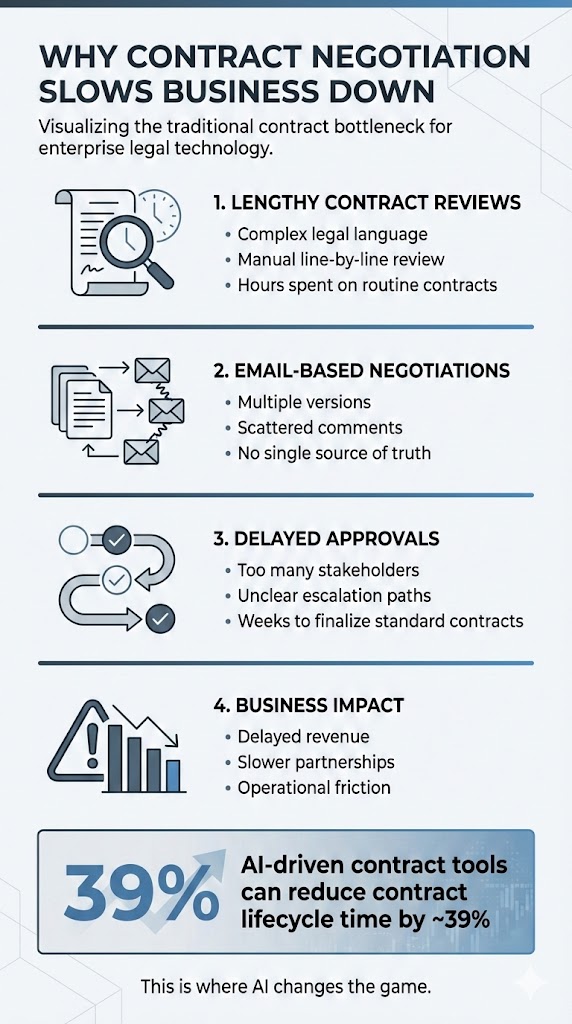
Contract negotiations can bring the pace of business to a grinding halt, held up by extensive reviews of intricate legal terms and email-based back-and-forth. Version confusion, missed comments, and multiple layers of approval routinely delay even simple contracts.
These delays carry a real cost: pushed-out revenue, stalled partnerships, and operational inefficiency. Research on AI-assisted contract management, including Forrester’s Total Economic Impact studies of mature CLM deployments, reports cycle time reductions in the range of 30 to 50 percent once AI-assisted negotiation reaches steady state, a range that highlights just how much inefficiency exists in traditional negotiation workflows.
2. What AI in Contract Negotiation Really Means

AI in the context of contract negotiation is not intended to replace lawyers. It is intended to help them work faster and more effectively, functioning as an intelligent assistant that supports legal and business teams throughout the negotiation process.
For example, AI can interpret contracts using language technology that identifies the key points within them. Work that would once take hours to review can now be done in minutes.
AI systems also learn from an organisation’s own contract history. By analysing thousands of previous agreements, they can detect unusual language, flag clauses that deviate from the norm, and highlight terms that need special attention or approval.
Based on this analysis, the system can recommend alternative phrasing or clause changes that align with a company’s usual standards. Rather than starting from a blank page, in-house counsel is presented with pre-drafted options to review and refine.
Overall, AI takes on the repetitive, time-intensive parts of the process and provides useful input throughout negotiation. Lawyers still make the final calls, but they get to spend more of their time on the decisions that genuinely require human judgment.
3. Key Ways AI Speeds Up Negotiations
| AI Capability |
What It Does |
How It Helps Negotiations Move Faster |
| Instant contract review & clause extraction |
Analyses entire contracts in seconds and highlights key terms, dates, and risks |
Cuts first-pass review from hours to minutes |
| Automated redlining using playbooks |
Provides ready-to-use, pre-approved language based on company guidelines |
Reduces repetitive edits and back-and-forth exchanges |
| Faster risk identification & decisions |
Identifies risky clauses and unusual terms quickly |
Speeds up approvals by focusing attention only on what matters |
| Centralised collaboration & version control |
Keeps all comments, edits, and approvals in one place |
Removes confusion from scattered emails and inconsistent versions |
| Data-driven negotiation insights |
Analyses previous contracts to identify delays and likely points of contention |
Makes future negotiations faster and more predictable |
4. How AI Impacts Legal and Business Teams
For Legal Teams
AI removes much of the routine work from day-to-day contract handling. AI systems can automatically review and redline contracts, particularly at high volume, freeing legal teams to spend more time on complex agreements and less on repetitive drafts that need little intervention.
Because these systems work from approved playbooks and flag anything out of the ordinary, legal departments gain more consistent control over risk and compliance across every contract, without needing to expand headcount to keep pace.
For Sales, Procurement, and Business Teams
For business teams, AI simply means deals move faster. Contracts get reviewed and approved more quickly, removing delays that would otherwise slow down revenue, partnerships, or broader business momentum.
AI also makes timelines more predictable, so teams know what to expect and can plan accordingly. With fewer routine back-and-forth questions to the legal department, sales and procurement teams can move forward with confidence, and legal only needs to step in when it genuinely matters.
5. Human Oversight: Why AI Doesn’t Replace Legal Judgment
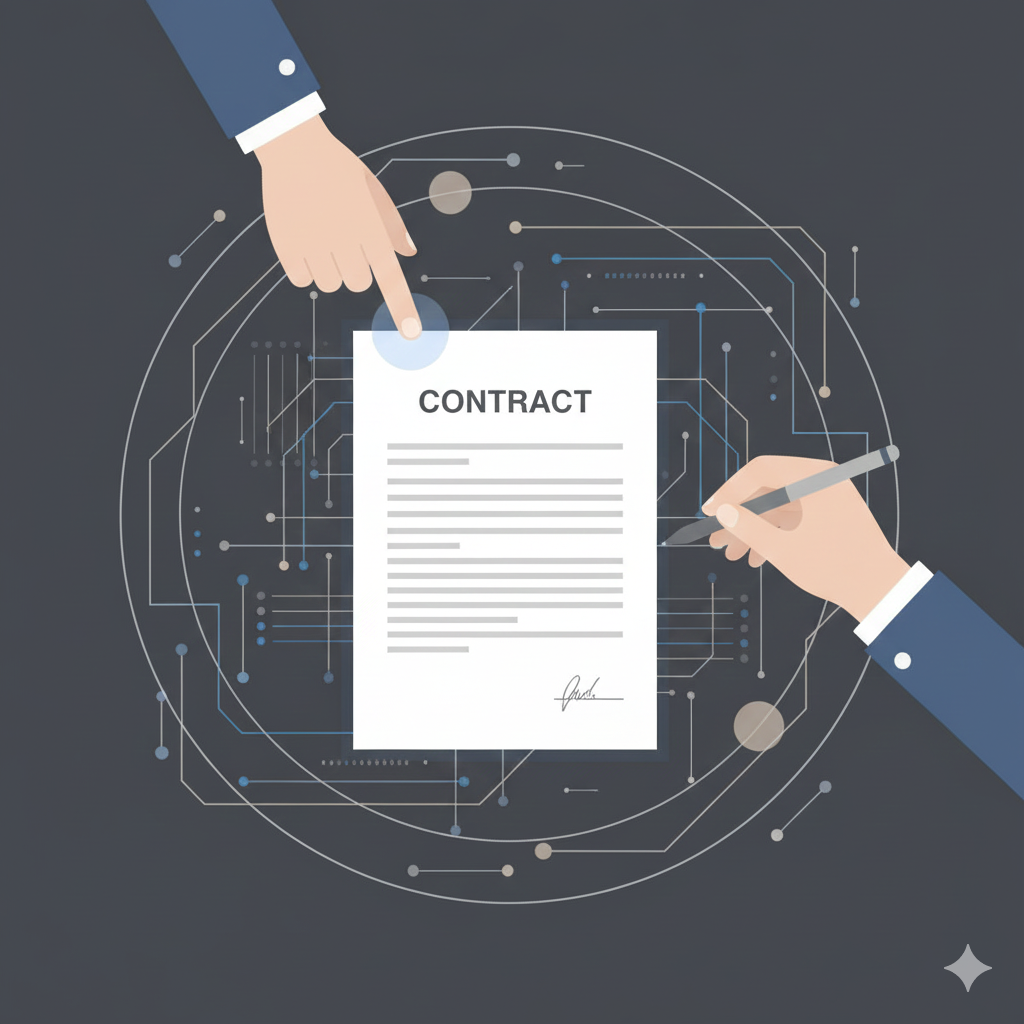
AI is a genuinely useful tool for accelerating contract negotiation, but it is not a substitute for a lawyer, and it was never designed to be. Its role is to support an attorney’s decision-making with insight and analysis, not to replace it.
Lawyers always have the final word. They review AI’s recommendations and decide whether to accept or modify them based on their understanding of the broader commercial and legal context. This matters most in complex or high-value transactions, where regulatory nuance or commercial judgment can’t be reduced to a set of rules.
Where contracts are complex or high-stakes, legal expertise simply cannot be replaced by AI. AI improves the speed and consistency of the process, but human judgment is what keeps contracts legally sound, commercially aligned, and practical.
6. Best Practices for Using AI in Contract Negotiation
Getting the most out of AI in contract negotiation requires a clear, deliberate approach built around scale, consistency, and the right level of oversight from the start.
Start with high-volume, predictable, repetitive contracts, such as NDAs, licensing agreements, or standard sales contracts. This is where AI delivers the fastest, most reliable wins.
From there, build and maintain strong legal playbooks. Clear legal standards, pre-approved fallback clauses, and defined risk limits give AI the foundation it needs to make recommendations that genuinely reflect your organisation’s legal position.
Human involvement should remain central throughout. Legal team members need to review AI’s suggestions, especially anything that looks unusual or touches a sensitive area.
Finally, treat this as an ongoing process of learning and refinement. Reviewing contract data and negotiation outcomes over time helps sharpen the playbook and improve the quality of AI’s suggestions going forward.
7. How Legistify Enables Faster, Smarter Contract Negotiations
Legistify brings AI into contract negotiation in a way that feels natural for both legal and business teams. Rather than changing how teams already work, it fits into existing review, negotiation, and collaboration processes and adds intelligent support on top.
With Legistify’s AI tools, contract reviews move faster. The system automatically identifies key clauses, unusual terms, and warning signs, and suggests pre-approved language through built-in legal playbooks. A centralised contract workspace keeps every team member aligned.
Most importantly, Legistify keeps humans in control. Legal teams make the final decisions, while the AI handles repetitive work and surfaces what actually needs human attention. The result is faster negotiation, better collaboration, and stronger control over risk and compliance.
8. The Future of Contract Negotiation with AI
As AI capabilities continue to improve, contract negotiation will become not just faster but more proactive. The focus is shifting from pure automation toward anticipating and preventing disputes earlier in the planning stage.
One major shift will be the rise of predictive insight: AI will increasingly be able to forecast which clauses are likely to be contested, how long a negotiation is likely to take, and when it’s at risk of escalating.
AI-driven risk scoring will also become more refined. By drawing on past contracts, deal size, the parties involved, and the relevant governing law, AI will be able to produce more accurate risk assessments, an area legal departments will want to watch closely.
Looking ahead, AI’s role will extend across the full contract process, from drafting and negotiation through execution and post-signature performance. Once these stages are connected within a single workflow, contract negotiation will no longer be the fragmented, slow-moving process it has traditionally been.
Conclusion
Contract negotiation is steadily shifting from a last-minute scramble into a more deliberate, strategic part of doing business. With AI providing insight and analysis, and integrating smoothly with the rest of the contract workflow, negotiations can move faster and with more confidence, without losing the human judgment that makes a contract sound.