A deal that a customer has agreed to in principle is not revenue until the contract is signed. In many organisations the distance between those two points is filled with email threads, approval requests that sit in individual inboxes, and a sales representative who cannot tell whether a deal is waiting on legal, finance or someone else entirely. Each function is doing its job correctly. Sales is trying to move quickly, legal is protecting the organisation from risk, and finance is guarding margin and cash flow. The delay comes from the fact that nobody owns the path between them.
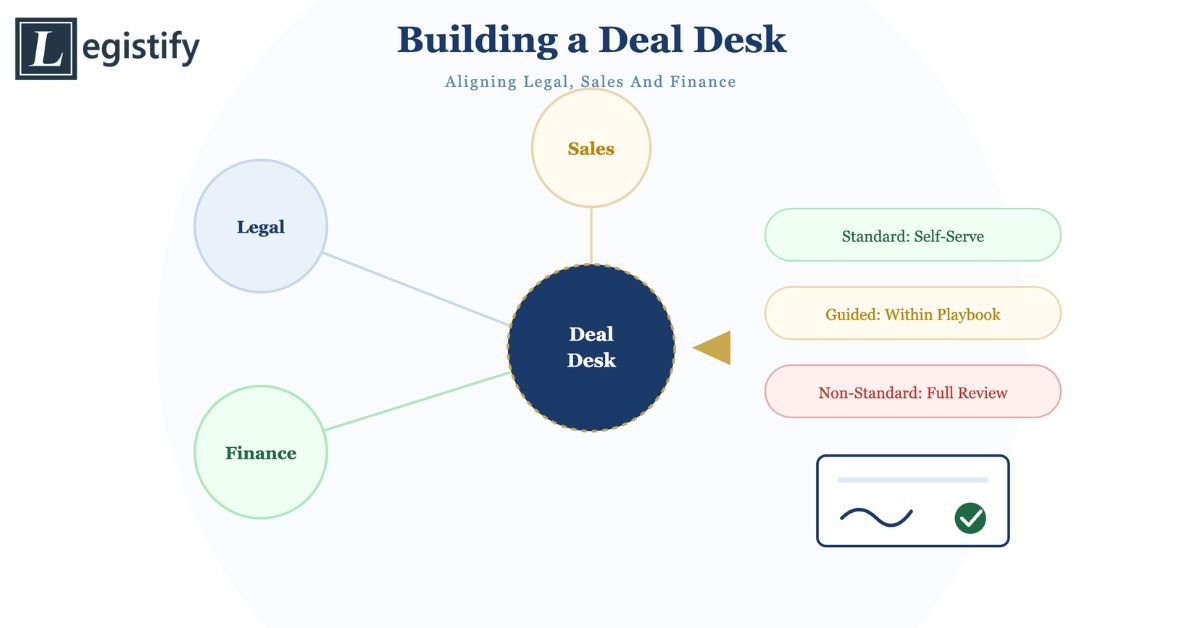
A deal desk is the structure that closes that gap. It is a centralised, cross-functional team that supports the sales organisation by managing and approving complex or non-standard deals, so that they align with business objectives, protect margins and reach signature sooner. This guide covers why legal, sales and finance drift out of alignment, how to design a deal desk that works, which metrics show whether it is helping, and the India-specific points that most generic guides leave out.
Why Legal, Sales and Finance Drift Apart
In a traditional workflow, a sales representative negotiates terms, sends the contract to legal for review, waits for finance to approve pricing and then returns to the customer. Each step happens in sequence, and each function applies its own priority. Sales optimises for speed, legal for risk reduction and finance for margin and payment terms. None of these priorities is wrong, but without a shared process they collide on every non-standard deal.
Three problems follow from this arrangement:
Sequential approvals add up. When legal finishes before finance begins, the total approval time is the sum of both queues. Running reviews in parallel removes most of that waiting.
Nobody can see where a deal is. A representative who cannot see the stage of an approval chases individuals by email and chat, which consumes selling time and still produces no reliable answer.
Sales finds ways around the process. When the formal route is slow, representatives are tempted to bypass legal to get contracts signed sooner, or to send out documents containing outdated terms. Both create risk that legal would never have accepted had it been consulted.
What a Deal Desk Actually Does
A deal desk acts as the orchestration layer when closing a deal requires input from legal, finance, product and operations. Its core functions are consistent across most organisations:
- Intake. Every non-standard request arrives through one channel, with the deal terms captured in a consistent format.
- Structuring. The desk helps shape pricing, payment terms and contract language so that the deal is commercially viable before approvals begin.
- Approval routing. Legal and finance review at the same time, and the desk tracks each approver against an agreed response time.
- Documentation. The desk prepares or reviews the contract and keeps the final terms consistent with what was approved.
- Closure and handoff. Once approvals are complete, the desk finalises the deal and passes the signed terms to billing and delivery teams.
The purpose is not to add another layer of review. Standard deals should close with minimal deal desk involvement, and the desk should spend its time on the deals that genuinely need cross-functional judgement.
How to Design a Deal Desk That Works
Step 1: Sort deals into tiers
The most useful design decision is a clear definition of which deals need the desk and which do not. A three-tier model works for most organisations:
- Standard deals use pre-approved templates and fall inside the playbook. They are generated and sent by sales without desk involvement.
- Guided deals request changes that fall within pre-approved fallback ranges. The desk approves them quickly against the playbook, without full legal or finance review.
- Non-standard deals involve unusual liability terms, significant discounts, custom payment structures or bespoke service levels. These go to the desk for full cross-functional review.
Step 2: Agree the playbook before launching the desk
The best-performing sales teams work from a playbook that defines which terms are negotiable, which have pre-approved fallback language and which require legal escalation. When a prospect’s legal team asks for a change, the representative or the desk can answer immediately if the request falls inside the playbook, instead of routing every request to legal. Legal and finance need to agree this playbook together, because the commercial and legal positions interact. A discount that finance accepts may depend on payment terms that legal would otherwise reject.
Step 3: Build an approval matrix tied to deal characteristics
Approval routes should depend on measurable features of the deal, such as contract value, discount level, payment terms, liability cap and deviation from standard clauses. A matrix that specifies who approves each combination removes the guesswork about who needs to see a deal, and it prevents small deals from being routed to senior approvers unnecessarily.
Step 4: Set service levels for every approver
Parallel approvals only work if each function commits to a response time. Agree a turnaround for each tier, for example same day for guided deals and a defined number of working days for non-standard ones, and track performance against it. Approvals that sit in someone’s inbox are the most common source of delay, and a visible service level makes that delay measurable.
Step 5: Keep one record connected to the CRM
The desk needs a single source of truth for deal terms. When contracts are generated from CRM data, the pricing and party details are already accurate, and the approval status can flow back to the opportunity record so that everyone sees the same stage. Without this connection, the desk spends its time reconciling spreadsheets and email threads.
Step 6: Name the roles
A functioning desk usually has a lead who owns the process, a legal partner who maintains the playbook and handles escalations, a finance partner who owns pricing and payment-term approvals, and a sales operations contact who keeps CRM data accurate. Where the desk sits organisationally varies, since it may report into revenue operations, sales operations, legal or finance. What matters more is that its authority to route and prioritise deals is clear to everyone.
Metrics That Show Whether the Deal Desk Is Working
A deal desk should be measured against the outcomes it exists to improve:
| Metric |
What it shows |
| Deal cycle time |
How long deals take to close after they reach the desk |
| Approval turnaround time |
How quickly legal and finance respond within their service levels |
| Win rate |
Whether the desk is supporting sales effectively |
| Cash collection |
How quickly payment follows signature, which indicates how well payment terms were structured |
| Non-standard deal rate |
The share of deals leaving the playbook, which signals where the playbook needs updating |
If sales velocity declines, the desk can also diagnose where deals are stalling, whether in legal review, finance approval or operational feasibility, and address that bottleneck specifically. It is also useful to analyse which contract terms correlate with faster close rates, so that sales and legal can decide which positions are worth contesting.
Common Mistakes
Turning the desk into a bottleneck. If every deal passes through the desk regardless of complexity, it replaces one queue with another. Tiering is the protection against this.
Ignoring the customer experience. The desk should help sales close faster without making the customer’s journey harder. Slow, opaque internal processes eventually show up as slow, opaque external ones.
Letting the playbook go stale. Market terms, risk appetite and pricing change. A playbook that is not reviewed regularly pushes more deals into the non-standard tier over time.
Leaving ownership unclear. When the desk, legal and finance each assume another function is chasing an approval, the deal stalls. Name one owner for each deal.
India-Specific Points for the Deal Desk
Several requirements affect how Indian organisations should structure their approval rules:
- Stamp duty varies by state. The state of execution determines the applicable duty and e-stamping portal, so the desk should confirm this before signature, not afterwards.
- Signature method matters. Some counterparties require Aadhaar eSign or a Digital Signature Certificate rather than a basic electronic signature, and the desk should know which applies before sending the contract.
- Data processing terms are now a standard approval item. Customer contracts that involve personal data need terms consistent with the Digital Personal Data Protection Act, 2023, and legal should pre-approve fallback positions for them.
- Payment terms interact with statutory rules. Where the counterparty is a micro or small enterprise, statutory payment timelines under the MSMED Act, 2006 limit how far payment terms can be extended.
Where Contract Management Software Fits
A deal desk depends on infrastructure that most spreadsheets cannot provide. It needs templates and clause libraries to support standard deals, approval routing based on deal characteristics, a negotiation record that stays attached to the contract, and dashboards that show cycle time and approval delays by function.
Legistify’s contract management platform supports this model with CRM-connected contract generation for standard deal types, approval routing tied to value and deviation from playbook terms, centralised negotiation history and role-based dashboards for legal, sales and finance. Legal’s judgement is embedded in the templates and rules, which allows the deal desk to concentrate on the deals that need it.
Conclusion
A deal desk does not remove legal or finance from the contracting process. It gives both a defined place in it. By sorting deals into tiers, agreeing a shared playbook, routing approvals in parallel and measuring cycle time and turnaround against service levels, organisations replace informal chasing with a process that everyone can see. The result is faster closure on standard deals, more careful attention on complex ones and a clearer view of where time is being lost.