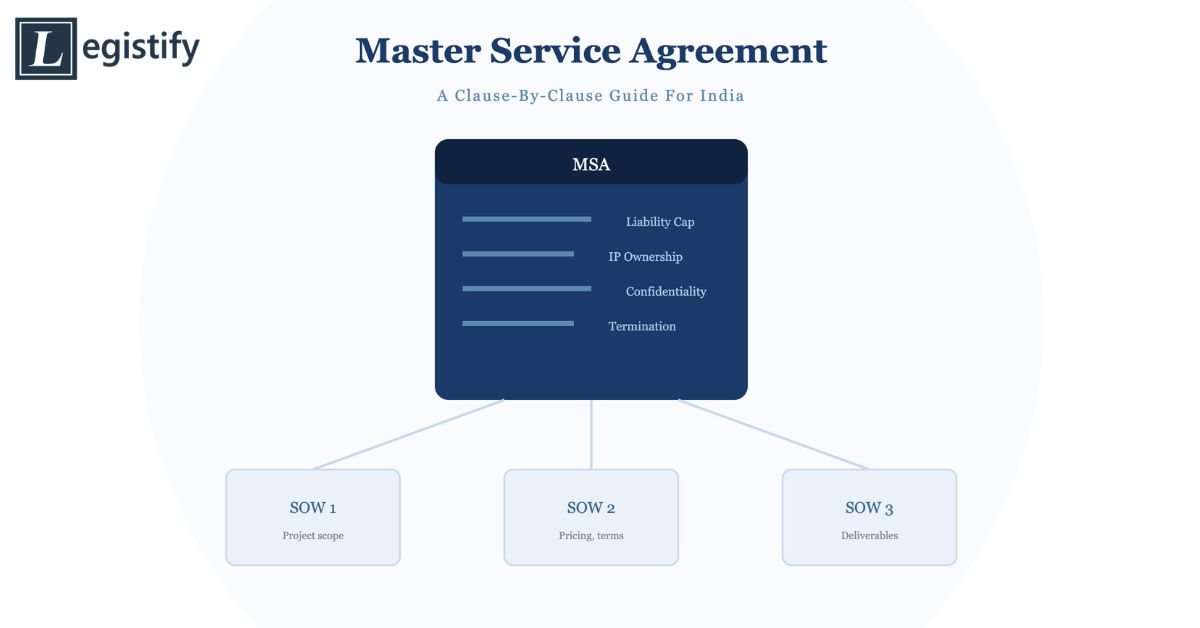
A Master Service Agreement is an umbrella contract that sets the common terms governing an ongoing relationship between a service provider and a client, so that individual assignments can be added later through Statements of Work without renegotiating the heavy legal terms every single time. It is a private commercial contract governed by the Indian Contract Act, 1872, not a government registration, and drafted well, it lets both sides move fast on new work while keeping risk allocation, IP ownership, and liability settled once, upfront, rather than reopened project by project.
This guide walks through the practical decisions to make before drafting, the clause-by-clause anatomy of a properly structured MSA, and the specific issues that matter most for Indian enterprises in 2026.
Six Decisions to Make Before You Draft a Word
How the MSA and SOW split will actually work. Decide upfront what belongs in the MSA (the terms that should stay stable across every future engagement) versus what belongs in each Statement of Work (project-specific scope, deliverables, timelines, and pricing). Getting this split wrong, either putting project-specific detail into the MSA or leaving core risk allocation to be renegotiated in every SOW, undermines the entire point of using an MSA structure.
Whether the relationship is genuinely ongoing or effectively one-off. An MSA earns its complexity when multiple projects are anticipated over time. For a single, defined engagement with no expectation of repeat work, a standalone services agreement is usually more proportionate than the overhead of an MSA-plus-SOW structure.
How disputes over which document governs will be resolved. Since an MSA and its SOWs are meant to work together, the drafting needs to specify explicitly which document prevails if a conflict arises between them, and whether an SOW can override specific MSA terms with express written agreement or never.
Whether the engagement involves personal data processing. If it does, the MSA needs a data-protection clause that is forward-compatible with the Digital Personal Data Protection Act, 2023, not an afterthought bolted on separately.
Whether AI-assisted work will be part of any deliverable. In 2026, a growing share of service deliverables involve AI-generated or AI-assisted components, and this needs to be addressed explicitly in the IP ownership clause rather than assumed to be covered by traditional “work product” language that predates this issue.
What dispute resolution mechanism actually fits the relationship’s value and complexity. Negotiation, then mediation, then arbitration as a tiered escalation is common practice, but the specific seat, venue, rules, number of arbitrators, and language of arbitration all need deliberate decisions, not default boilerplate copied from an unrelated template.
The Clause-by-Clause Anatomy of an MSA
1. Parties and recitals
Identifies the contracting entities precisely, including full legal names and registered addresses, and sets out the background and purpose of the ongoing relationship the MSA is meant to govern.
2. Definitions and interpretation
Define every capitalised term the agreement relies on: “Services,” “Deliverables,” “SOW,” “Confidential Information,” “Affiliate,” “Background IP,” and “Foreground IP” at minimum. Sloppy or missing definitions cause more disputes in practice than missing substantive clauses, since ambiguity in a defined term ripples through every clause that relies on it.
3. Scope of services and the MSA-SOW relationship
Establishes how services are defined at the MSA level and how individual projects get added through SOWs, including what happens if a new engagement falls outside the categories the MSA originally contemplated. A blank SOW template should generally be attached as a schedule, giving both parties a consistent, ready-to-use format for adding new work.
4. Commercial mechanics: payment, invoicing, and MSME considerations
Covers payment terms, the invoicing cycle, applicable taxes, and interest on delayed payment, while keeping specific rates in the SOW rather than the MSA itself, so pricing can vary by engagement without requiring an MSA amendment each time. For Indian service providers, this clause needs specific attention to Section 43B(h) of the Income Tax Act and MSME payment timeline obligations, since payment terms that conflict with statutory MSME payment deadlines create compliance exposure regardless of what the contract itself says.
5. Intellectual property ownership
Allocates ownership of pre-existing IP (Background IP) each party brings into the relationship, and, critically, IP created during the engagement (Foreground IP). In a properly drafted MSA, Foreground IP, code, designs, or deliverables created specifically for the client’s project, is typically assigned to the client upon sign-off of each deliverable, while the service provider retains ownership of its own pre-existing tools, methodologies, and reusable components used to deliver the work.
The 2026-specific issue: IP in AI-assisted work. Where deliverables involve AI-generated or AI-assisted components, this clause needs to address explicitly who owns output generated with the assistance of AI tools, what representations the service provider makes about the training data or tools used, and how this interacts with the underlying IP assignment framework. Treating this as automatically covered by legacy “work product” language, without addressing AI-assisted creation specifically, is one of the more commonly flagged gaps in 2026 MSA reviews.
6. Confidentiality
Protects sensitive business information exchanged during the relationship. This clause typically survives termination of the broader MSA for a defined period, or sometimes indefinitely for genuinely sensitive categories of information, and should be drafted with the same rigour as a standalone NDA, since it is functionally serving the same purpose within the broader agreement.
7. Data protection and the DPDP Act
Where the engagement involves processing personal data, whether customer data, employee data, or any other personal data as defined under the Digital Personal Data Protection Act, 2023, the MSA needs a dedicated Data Processing Agreement schedule specifying: the purpose and means of processing, categories of personal data involved, security safeguards, breach notification timelines (commonly 24 to 72 hours), how data subject rights requests will be handled, cross-border transfer rules, sub-processor approval requirements, audit rights, data deletion or return obligations on termination, and cooperation obligations if the Data Protection Board of India initiates an inquiry. This has moved from a nice-to-have to a mandatory element of any properly drafted 2026 Indian MSA involving personal data.
8. Warranties and service levels
Sets the quality standard the service provider commits to, along with performance metrics and remedies if those standards are not met. Warranties are often partially handled at the MSA level (establishing the baseline floor) and partially in individual SOWs (setting project-specific performance metrics), which needs to be structured deliberately rather than left inconsistent across the two documents.
9. Limitation of liability and indemnification
These are consistently among the most heavily negotiated clauses in any MSA, and for good reason: they determine the actual financial exposure each party carries if something goes wrong. The limitation of liability clause typically caps each party’s liability at a multiple of fees paid (commonly the fees paid in the preceding 12 months), with carve-outs for specific categories such as breach of confidentiality, IP infringement, or gross negligence that are frequently excluded from the cap entirely. The indemnification clause allocates responsibility for third-party claims, specifying who covers what and under what circumstances. No unlimited liability clauses or one-sided indemnity language should be accepted by either party without careful, deliberate negotiation, since these terms directly determine worst-case financial exposure for the life of the relationship.
10. Insurance requirements
Specifies the minimum professional indemnity, cyber liability, and public liability insurance the service provider must carry, often with the client named as an additional insured. This clause has grown in importance specifically alongside the rise in cyber-related liability exposure across service engagements involving any meaningful data handling.
11. Term, renewal, and termination
Covers the MSA’s duration, renewal mechanics, and the grounds and process for termination, both for cause (breach, insolvency, prolonged force majeure) and for convenience (either party’s right to exit with notice, without needing to establish fault). Suspension rights, allowing a party to pause performance under specific circumstances short of full termination, and survival clauses, specifying which obligations continue after termination (confidentiality, IP assignment, and payment obligations typically survive), should both be addressed explicitly.
12. Restraint clauses: non-compete and non-solicitation
Where the MSA includes non-compete or non-solicitation provisions, these must be drafted carefully within the limits of Section 27 of the Indian Contract Act, 1872, which voids agreements that restrain trade, subject only to a narrow exception for the sale of goodwill. Overly broad restraint clauses risk being struck down entirely, and in some cases can invite a court to scrutinise the rest of the agreement more sceptically as an attempt to disguise an unenforceable restraint behind other contractual language.
13. Dispute resolution and governing law
Sets out the escalation path for disputes, commonly negotiation, then mediation, then arbitration under the Arbitration and Conciliation Act, 1996, specifying the seat, venue, applicable rules, number of arbitrators, and language of proceedings, along with the governing law and the courts that retain jurisdiction for matters outside the arbitration clause’s scope, such as urgent interim relief.
14. General and boilerplate provisions
Covers assignment rights, notices, force majeure, entire agreement, amendment procedures, and severability. These clauses deserve a genuine review rather than blanket acceptance, since even “standard” boilerplate can carry meaningful consequences, an overly broad force majeure clause, for instance, can inadvertently excuse non-performance in circumstances the parties never actually intended to cover.
A Practical MSA Drafting Checklist
- MSA-versus-SOW split clearly defined, with a blank SOW template attached as a schedule
- Every capitalised term properly defined, particularly Foreground IP, Background IP, Deliverables, and Confidential Information
- Payment mechanics set at the MSA level, with specific rates left to the SOW; MSME and Section 43B(h) payment timeline obligations specifically considered
- IP ownership addressed for both traditional deliverables and AI-assisted or AI-generated work product
- Data Processing Agreement schedule included wherever personal data processing is involved, covering the DPDP Act’s required elements
- Liability caps and indemnification carve-outs negotiated deliberately, with no unlimited liability or one-sided indemnity accepted without scrutiny
- Insurance requirements specified where the engagement’s risk profile warrants it
- Restraint clauses (non-compete or non-solicitation) drafted within Section 27 limits
- Term, renewal, termination (both cause and convenience), suspension, and survival clauses all present and internally consistent
- Dispute resolution clause specifies seat, venue, rules, number of arbitrators, and language, not left as generic boilerplate
- A clear amendment procedure exists, since amending the MSA too often without proper process creates confusion and versioning issues across a long-running relationship
Managing MSAs and Their SOWs at Enterprise Scale
For an enterprise managing multiple ongoing vendor and client relationships, each governed by its own MSA with numerous SOWs layered underneath, the operational challenge extends beyond getting any single MSA’s drafting right. It requires tracking which SOWs are currently active under which MSA, ensuring that new SOWs are properly linked to and consistent with their governing MSA’s terms rather than drifting from them over time, and maintaining a clear, centralised record of amendments so that the current, governing version of both the MSA and each active SOW is always unambiguous.
Legistify’s contract management platform supports this MSA-SOW structure directly, linking each Statement of Work to its governing Master Service Agreement within a single contract record, tracking DPDP-compliant data processing terms and MSME payment obligations as structured, monitorable fields rather than buried clauses, and maintaining a clear amendment history so that any dispute about which version of the MSA or a specific SOW currently governs the relationship can be resolved by reference to a single, authoritative record.
Conclusion
A well-drafted Master Service Agreement separates legal certainty from operational flexibility, letting an enterprise negotiate liability, IP ownership, confidentiality, and dispute resolution once, and then launch new engagements quickly through Statements of Work without reopening those foundational terms each time. In 2026, the clauses drawing the most scrutiny, liability caps, IP ownership for AI-assisted work, DPDP-compliant data processing terms, and MSME-compliant payment mechanics, all require precise, deliberate drafting rather than reliance on a generic template, since getting any one of them wrong can turn what should be routine, low-friction contracting into a genuinely costly dispute.