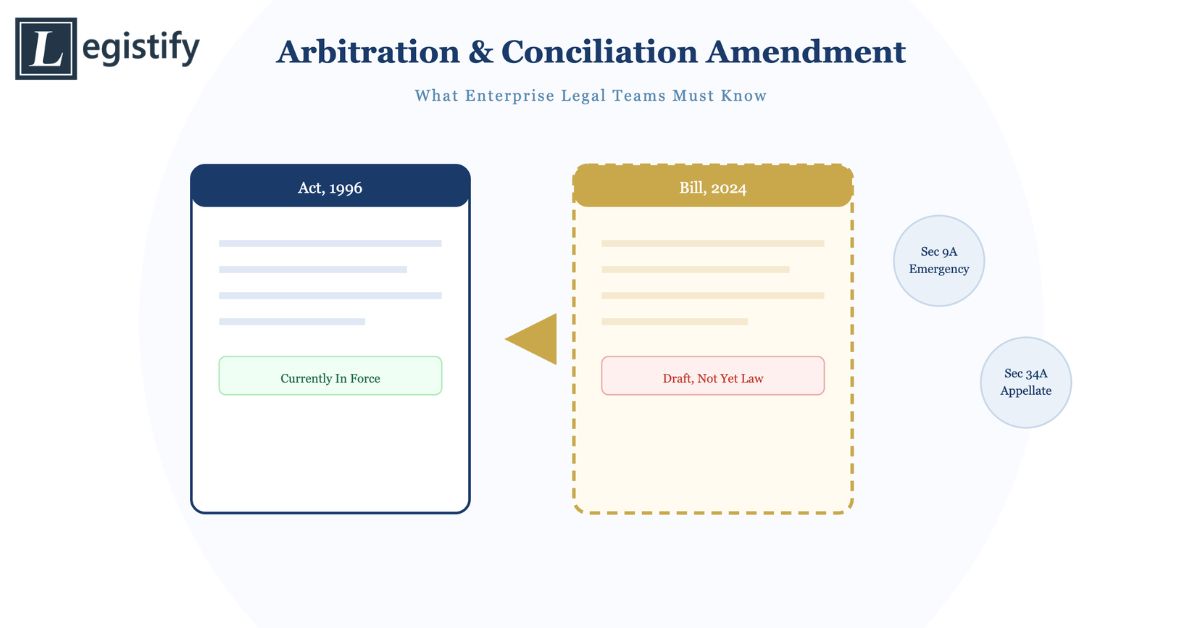
There is a persistent misunderstanding worth clearing up first: the Arbitration and Conciliation (Amendment) Bill, 2024 is not law. As of 2026, it remains a consultation draft released by the Department of Legal Affairs, built on the report of an expert committee that reviewed India’s arbitration framework, and it has not been introduced in Parliament or enacted. The law that actually governs arbitration in India today is still the Arbitration and Conciliation Act, 1996, as amended in 2015, 2019, and 2021.
That said, enterprise legal teams should not treat this as a reason to ignore the Bill entirely. Draft legislation in India frequently signals the direction regulators and courts are already leaning, and several of the Bill’s proposed changes address problems enterprise legal teams are already navigating informally through careful drafting. Understanding what the Bill actually proposes, and where it stands, helps legal teams draft dispute resolution clauses today that will age well regardless of when, or whether, the Bill is eventually enacted.
What the Bill Proposes to Change
The draft Bill organises its proposed reforms around four broad pillars: promoting institutional arbitration, reducing court intervention, introducing statutory recognition for emergency arbitration, and building a digital-ready procedural framework. Here is what each pillar actually contains.
Statutory recognition of emergency arbitrators (proposed Section 9A)
Indian courts have already recognised the enforceability of emergency arbitral orders through case law, but this recognition currently rests on judicial interpretation rather than the statute itself. The Bill proposes a new Section 9A giving emergency arbitrators, and their emergency awards issued under institutional rules, explicit statutory backing. Under the proposal, parties could apply for interim measures from an emergency arbitrator once arbitral proceedings have begun but before the full arbitral tribunal is actually constituted, addressing exactly the gap period where urgent relief is often needed but no tribunal yet exists to grant it.
An opt-in appellate arbitral tribunal (proposed Section 34A)
This is one of the more structurally significant proposals. The Bill would create a new Section 34A establishing an appellate arbitral tribunal that parties can opt into, giving them a private appellate avenue for challenging an award without going straight to court. The appellate tribunal or a court would only be entitled to set aside an earlier award on the specific grounds set out in the Bill, and a proposed new Section 34(7) would empower courts and appellate tribunals to partially set aside an award, directing the original arbitral tribunal to reconsider only the specific issues that were set aside, rather than reopening the entire award.
A clearer, seat-based definition of “court” (proposed Section 2A)
The current Act’s definition of “court” has created genuine jurisdictional confusion in practice, since Section 42 of the existing Act can produce inconsistent results about which court actually has authority over a given arbitration. The Bill proposes removing Section 42 entirely and introducing Section 2A, explicitly defining “court” as having pecuniary and territorial jurisdiction over the seat of the arbitration. Alongside this, the Bill proposes replacing the word “place” with “seat” consistently throughout the Act, resolving a related ambiguity between seat, place, and venue that has been a genuine source of litigation under the current framework.
Restricting court intervention for interim relief once arbitration has commenced
The Bill proposes limiting Indian courts’ power to grant interim measures to the period before arbitration commences or after an award has been rendered, actively encouraging parties to seek interim relief from the arbitral tribunal itself under Section 17 of the Act once proceedings are underway, rather than running to court mid-arbitration. Courts and tribunals would gain the power to confirm, modify, or vacate orders made by emergency arbitrators, tying this proposal directly to the emergency arbitrator provision above.
Strict timelines for court applications
A proposed 60-day time limit would apply to courts disposing of a party’s application for referral to arbitration under Section 8 of the Act, where an arbitration agreement already exists. A related proposed Section 37(1A) would introduce a single, uniform 60-day period for all appeals under that section, replacing what is currently a more fragmented timeline structure.
Digital modernisation of the arbitration process
The Bill proposes to modify the statutory definition of “arbitration” itself to explicitly include proceedings conducted wholly or partly through audio-video electronic means, defining “audio-video electronic means” to encompass videoconferencing and electronic filing. A proposed Section 7(4)(a) would recognise arbitration agreements executed through digital signature, and a proposed Section 19(5) would expressly permit proceedings to be conducted through audio-video electronic means, formalising a shift that arbitration practice has already largely adopted since the pandemic but that the statute itself has not yet caught up with.
Strengthening institutional arbitration and the Arbitration Council of India
The Bill proposes deleting the Fourth Schedule (the model schedule of arbitration fees) entirely, along with related provisions, routing fee determination and standard-setting instead through an expanded and empowered Arbitration Council of India. Section 29A powers, which currently allow courts to extend award timelines and substitute arbitrators, would be extended to arbitral institutions as well, and the definition of an arbitral institution under Section 2(ca) would also be amended, reflecting the broader push toward an institution-led arbitration ecosystem rather than one centred primarily on ad hoc, court-supervised arbitration.
Post-award interest rate changes
The Bill proposes redefining the post-award interest rate as 3% above the RBI’s repo rate, diverging from the existing statutory rate of 2% above the current rate of interest. This is a specific, quantifiable change enterprise legal and finance teams should track closely, since it directly affects the financial exposure attached to a delayed or contested award.
Dropping “Conciliation” from the title
Following the enactment of the Mediation Act, 2023, which now separately governs conciliation, the Bill proposes renaming the parent legislation simply the “Arbitration Act,” removing conciliation from both the title and the body of the statute, and removing conciliation-related provisions that the Mediation Act now covers instead.
What the Draft Amendment Bill Does Not Address
A notable gap: several recommendations from the Viswanathan Committee, whose report informed the drafting process, were not ultimately incorporated into the draft Bill. Enterprise legal teams following this reform process closely should be aware that the Bill, even if enacted as currently drafted, represents a partial implementation of the underlying committee’s full recommendations, not a complete adoption of every proposal that was on the table during the consultation process.
Why Enterprise Legal Teams Should Still Pay Attention Now
Given that the Bill is not law, and has not even been introduced in Parliament as of 2026, a reasonable question is why any of this matters for current contract drafting. Three practical reasons stand out.
The Bill signals where dispute resolution practice is already heading. Several of its proposals, particularly around audio-video hearings and digital signature recognition for arbitration agreements, formalise practices that institutional arbitration bodies and courts have already been accommodating informally. Drafting arbitration clauses today that anticipate this direction, rather than assuming only in-person, paper-based arbitration, reduces the friction of adapting later.
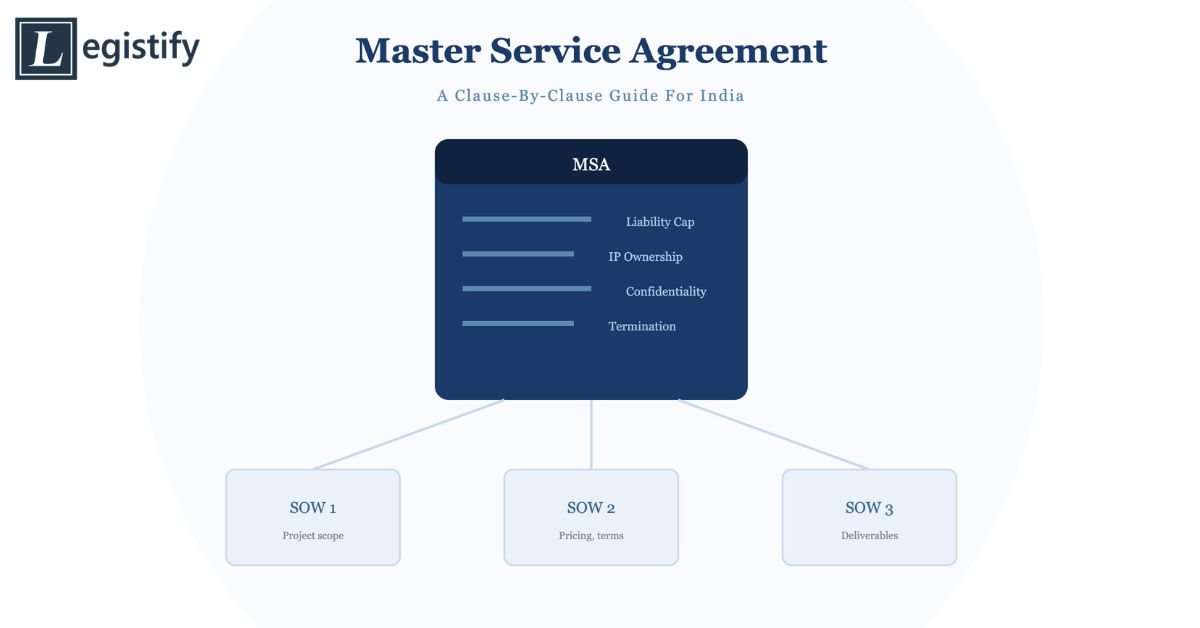
Enterprises entering long-term contracts need to think about clause durability. A Master Service Agreement or a joint venture agreement signed today with a 5 or 10-year term may well still be governed by its original arbitration clause when, or if, this Bill eventually becomes law. Drafting dispute resolution clauses with enough flexibility to accommodate either the current framework or a reformed one, rather than clauses that assume the current Act’s provisions will remain static indefinitely, is a sensible hedge for genuinely long-term agreements.
The direction of institutional versus ad hoc arbitration matters for panel and forum selection now. Even without the Bill being enacted, the broader push toward institutional arbitration that it reflects is already visible in how Indian courts and commercial parties are behaving, with institutional arbitration centres such as the Mumbai Centre for International Arbitration and the Delhi International Arbitration Centre gaining prominence. Enterprises structuring new arbitration clauses should weigh institutional versus ad hoc arbitration deliberately, rather than defaulting to ad hoc arrangements simply because that has historically been the more common Indian practice.
Practical Drafting Guidance for Enterprise Contracts Today
Use “seat” rather than “place” or “venue” in arbitration clauses, regardless of whether the Bill is enacted. This terminology already reduces ambiguity under the current Act’s case law and aligns naturally with the direction the Bill is heading, making it a low-risk drafting choice either way.
Consider explicitly permitting audio-video hearings within the arbitration clause itself. Since institutional rules increasingly accommodate this in practice, and the Bill would formalise it in the statute, building this flexibility into the clause avoids a dispute later about whether virtual hearings were validly contemplated by the parties’ original agreement.
Review whether an emergency arbitration mechanism should be referenced explicitly. Where the chosen institutional rules support emergency arbitrator procedures, referencing this directly in the arbitration clause gives parties a documented, mutually agreed pathway to urgent interim relief without needing to rely solely on court intervention, consistent with where both current judicial practice and the draft Bill are heading.
Track the post-award interest rate provision specifically if renegotiating older agreements. For enterprises with existing arbitration clauses that reference a fixed interest rate methodology, understanding the direction of the proposed change (from 2% above current rate to 3% above repo rate) is relevant context for any renegotiation or amendment discussion, even while the current statutory rate remains in force.
Monitoring the Bill’s Progress
Because the Bill remains a consultation draft with no confirmed legislative timeline, enterprise legal teams should treat monitoring its progress as an ongoing compliance and legal intelligence task, not a one-time review. Tracking parliamentary introduction, committee review, and any material changes to the draft between its current form and eventual introduction (if it proceeds) ensures that contract templates and dispute resolution playbooks can be updated proactively rather than reactively once the Bill’s status actually changes.
Legistify’s contract management platform supports this kind of proactive legal and regulatory tracking, connecting arbitration clause templates directly to a monitored regulatory update feed, so that when legislation like the Arbitration and Conciliation (Amendment) Bill, 2024 does progress toward enactment, legal teams can identify exactly which existing contract templates and executed agreements would be affected, rather than discovering the exposure only after the law has already changed.
Conclusion
The Arbitration and Conciliation (Amendment) Bill, 2024 remains a draft, not law, as of 2026, and enterprise legal teams should be precise about that distinction when advising internally or externally. But the Bill’s direction, toward institutional arbitration, statutory recognition of emergency relief, digital-first procedure, and reduced court intervention during active proceedings, reflects where Indian arbitration practice is already trending in several respects. Drafting today’s dispute resolution clauses with this direction in mind, using “seat” terminology, contemplating audio-video hearings, and thinking deliberately about institutional versus ad hoc arbitration, is a sound practice regardless of when, or whether, this specific Bill is ultimately enacted.