Form GST DRC-01 is the show-cause notice a GST officer issues when they believe tax has not been paid, has been short-paid, has been erroneously refunded, or that input tax credit has been wrongly availed or utilised. It is issued before any demand is confirmed, which is the single most important thing to understand about it: receiving a DRC-01 is not a penalty. It is an opportunity to explain, clarify, or contest the department’s position before a demand order is passed. What determines whether that opportunity closes the matter or ends in a confirmed demand under DRC-07 comes down to two things: how quickly the enterprise responds, and how well that response addresses the specific grounds raised.
This guide covers exactly how to read a DRC-01 notice, the statutory framework governing the response, the step-by-step process for drafting and filing a reply, and the penalty exposure at each stage of the timeline.
The First Thing to Check: Which Section Was the Notice Issued Under
Before drafting any response, identify whether the DRC-01 was issued under Section 73, Section 74, or Section 74A. This single detail determines the severity of the matter, the applicable penalty rate, and the entire response strategy that follows.
Section 73 covers non-fraud cases: situations where tax was not paid, short paid, or ITC was wrongly availed without any element of fraud, wilful misstatement, or suppression of facts. The limitation period is 3 years from the due date of filing the annual return for the relevant financial year.
Section 74 covers cases where the department alleges fraud, wilful misstatement, or suppression of facts to evade tax. The limitation period extends to 5 years, and penalty exposure is significantly higher.
Section 74A, applicable to financial years from 2024-25 onwards, consolidates Sections 73 and 74 into a single unified provision with a 42-month framework, removing the previous distinction in limitation periods between fraud and non-fraud cases for more recent tax periods.
The section under which the notice is issued is not a technicality. It changes the reduced-penalty windows available, the standard of proof the department must meet, and how aggressively the response needs to contest the underlying allegation.
The Pre-Notice Stage: DRC-01A
Before a formal DRC-01 is issued, the department may first send a DRC-01A, an intimation of tax ascertained as payable, giving the taxpayer an opportunity to pay voluntarily before the formal show-cause process begins. This stage offers the lowest possible penalty exposure: zero percent under Section 73(5) if the full tax and interest are paid at this stage in a non-fraud case, or 15 percent under Section 74(5) in a fraud case.
For enterprises with the internal capability to assess and respond quickly, this is the single most valuable opportunity in the entire process, since it can eliminate penalty exposure entirely in non-fraud cases. This requires day-one response capability: the moment a DRC-01A is received, someone needs to be assessing whether the underlying position is defensible or whether voluntary payment is the more sensible commercial decision, within the officer-specified window rather than after it has closed.
The Statutory Timeline Once DRC-01 Is Issued
Once a formal DRC-01 is issued, the clock starts immediately, and the timeline is unforgiving.
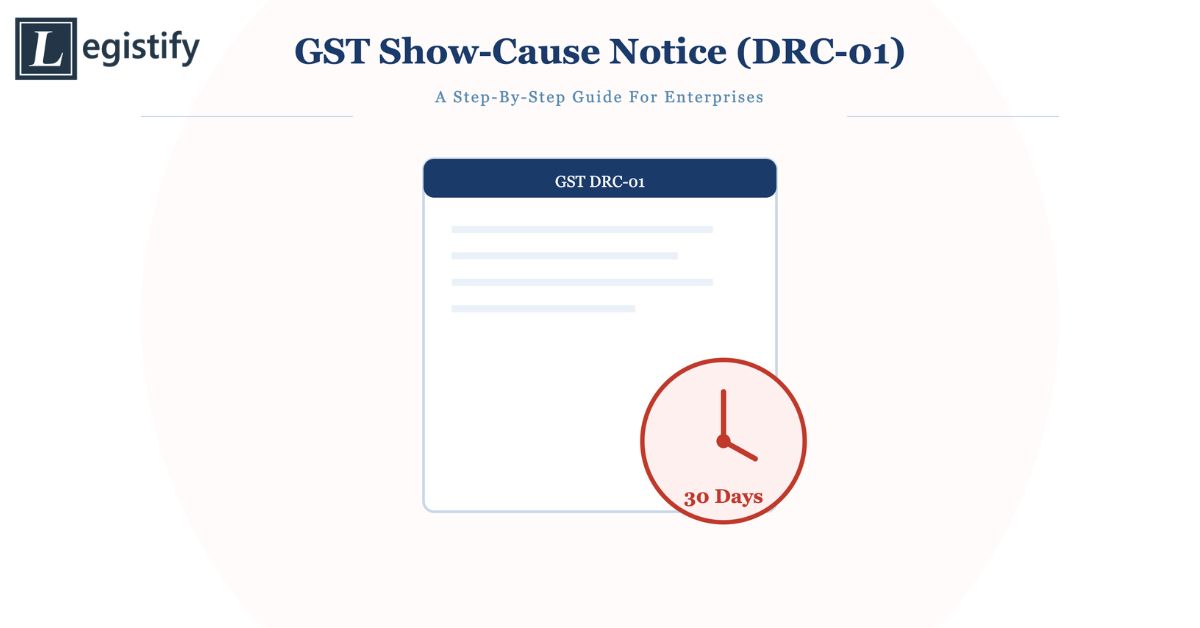
30 days from the date of issuance is the standard window to file a reply in Form DRC-06 on the GST portal. Some notices specify a shorter window, so the exact deadline stated on the notice itself should always be checked rather than assuming the standard 30-day period applies universally.
Missing the deadline allows the officer to proceed to pass a best-judgment order, an ex parte determination made without the benefit of the taxpayer’s explanation, formalised in Form DRC-07. A DRC-07 is significantly harder and more expensive to contest after the fact than responding properly within the original window would have been.
Reduced penalty windows exist at multiple points, but they compress rapidly. For Section 73 cases, paying tax and interest within the notice period, before a DRC-07 is issued, keeps penalty exposure at 10 percent or eliminates it depending on the specific stage. For Section 74 cases, the penalty rate escalates sharply the longer the matter remains unresolved: 25 percent if paid before the notice is issued, higher percentages as the matter progresses, jumping to 50 percent if paid within 30 days of the DRC-07 being issued, and 100 percent thereafter.
Step-by-Step: How to Respond to a DRC-01 Notice
Step 1: Read the notice in full and extract the key facts
Every DRC-01 contains the GSTIN, the tax period in question, the exact quantified amount of tax, interest under Section 50, and the applicable penalty, along with the specific grounds the officer relies on, commonly an ITC mismatch between GSTR-3B and GSTR-2A/2B, a turnover discrepancy between GST returns and income tax filings, or a shortfall identified from missed or delayed return filings.
Step 2: Confirm the response deadline precisely
Calculate the exact deadline from the date of issuance stated on the notice, not the date it was actually noticed by the internal team. GST notices are served electronically on the portal, and the clock generally runs from the date of electronic service, which can create a gap between when the notice was technically served and when someone internally actually opened it.
Step 3: Gather supporting documentation
Depending on the grounds raised, this typically includes GSTR-1, GSTR-3B, and GSTR-2A/2B for the relevant period, supplier invoices and reconciliation statements supporting any disputed ITC claim, payment challans evidencing tax already paid, and any relevant circulars or case law supporting the taxpayer’s position, such as Circular No. 183/15/2022 on ITC mismatch tolerance where applicable.
Step 4: Prepare the reconciliation and legal position
For ITC mismatch cases specifically, a clause-by-clause reconciliation showing that the ITC claimed matches the supplier’s GSTR-2A/2B, supported by the underlying invoices, is the core of an effective reply. Where the mismatch is genuine but explainable, such as timing differences in supplier filing, this should be explained with supporting evidence rather than left for the officer to assume the worst interpretation.
Step 5: Draft and file the reply in Form DRC-06
The reply must be filed electronically through Form DRC-06 on the GST portal. A well-structured DRC-06 reply typically includes an acknowledgment of the notice and the specific allegations raised, a point-by-point rebuttal or explanation for each ground, the reconciliation and supporting documentation annexed, any relevant legal citations, and a clear prayer, whether requesting that the proceedings be dropped entirely or that a specific, reduced demand be accepted.
Step 6: Request a personal hearing if the matter is genuinely contested
Where the taxpayer intends to seriously contest the notice rather than simply pay up, requesting a personal hearing preserves the opportunity to make oral submissions and respond to questions directly, rather than relying solely on the written reply. Failing to request a hearing when one might be needed can be treated as a waiver of that opportunity.
Step 7: If paying, use DRC-03 correctly and file it before or alongside the reply where appropriate
Where the enterprise decides to pay some or all of the demand to reduce penalty exposure, this is done through Form DRC-03. This form cannot be amended or withdrawn once filed, and no partial payments against a specific SCN are permitted in a way that leaves the matter open, so the cause-of-payment selection and amount need to be correct the first time.
Common Mistakes That Weaken a DRC-01 Reply
Generic replies without supporting documentation. A reply that simply denies the allegation without annexing the reconciliation, invoices, or return data needed to actually prove the point invites the officer to proceed straight to a confirmed demand in DRC-07.
Missing the deadline because of email-only monitoring. Notices served through the GST portal are often also sent by email, and enterprises that monitor only physical post or a single inbox risk missing the window entirely, particularly where the internal process for routing GST notices to the right team is not clearly defined.
Incomplete reconciliations. Claiming ITC without the corresponding supplier registration certificate or without addressing why the department’s own data does not match the enterprise’s claimed figures leaves the officer with grounds to reject the explanation outright.
Not requesting a personal hearing when one is warranted. This waives the opportunity for oral submissions, which can matter considerably in genuinely contested, fact-intensive disputes.
Treating every notice with the same urgency regardless of section. A Section 74 notice alleging fraud requires a fundamentally different, more defensive response strategy than a routine Section 73 reconciliation mismatch, and treating both the same way, either overreacting to a straightforward mismatch or underreacting to a fraud allegation, produces poor outcomes in both directions.
What Happens After the Reply Is Filed
If the officer is satisfied with the reply, they issue Form DRC-05, confirming closure of the proceedings. If not satisfied, the officer proceeds to confirm the demand in Form DRC-07, a post-adjudication summary detailing the tax, interest, and penalty due, generally payable within 3 months, extendable to 6 months interest-free in specific circumstances where cause is shown.
If the DRC-07 order is adverse, the taxpayer can appeal to the Appellate Authority under Section 107, within 3 months plus a possible 30-day extension, with a mandatory pre-deposit of 10 percent of the disputed tax for non-fraud cases (higher for fraud cases). If that appeal is also unsuccessful, a further appeal lies to the GST Appellate Tribunal (GSTAT) under Section 112, with an additional 10 percent pre-deposit of the disputed tax, subject to a cap. The GSTAT became operational in 2026, with its Principal Bench in New Delhi commencing hearings in February 2026 and State Benches being operationalised in phases across Kolkata, Chennai, Hyderabad, Cuttack, and other locations. Beyond the GSTAT, further appeal lies to the High Court on substantial questions of law, and ultimately to the Supreme Court.
Managing GST Notices at Enterprise Scale
For a large enterprise managing GST compliance across multiple GSTINs and business units, the operational challenge is rarely responding to a single DRC-01 correctly. It is ensuring that no notice, across any GSTIN, is missed or responded to late simply because it arrived in a portal inbox that nobody was actively monitoring that week.
This requires a systematic process: a defined owner for GST notice monitoring across every registered GSTIN, an internal escalation path that routes a DRC-01 to the right combination of tax, finance, and legal expertise immediately upon receipt, not days later, and a documented record of every notice, its deadline, its response, and its outcome, so that patterns, such as recurring ITC mismatch notices tied to a specific supplier relationship, become visible across the portfolio rather than being handled as isolated, disconnected incidents each time they recur.
Legistify’s notice management platform supports exactly this kind of systematic tracking for enterprise legal and tax teams, capturing every statutory notice, including GST show-cause notices, with automated deadline alerts, a centralised record connecting the notice to its response and outcome, and portfolio-level visibility that surfaces recurring patterns across GSTINs and business units before they compound into a larger compliance issue.
Conclusion
A GST DRC-01 show-cause notice is not a confirmed liability. It is a structured opportunity to explain, reconcile, or contest the department’s position before a demand is finalised, and the difference between a notice that closes favourably and one that becomes a confirmed DRC-07 demand comes down almost entirely to the speed and quality of the response. Reading the notice carefully to identify the governing section, gathering complete supporting documentation, filing a well-reasoned DRC-06 reply within the strict 30-day window, and requesting a personal hearing where the matter is genuinely contested are the fundamentals that determine the outcome for any enterprise facing this notice.