Artificial intelligence is redefining how enterprises manage contracts across the full lifecycle, from drafting and negotiation through to compliance and performance tracking. Modern contract lifecycle management platforms have evolved from static repositories, essentially organised document storage, into dynamic ecosystems that actively drive decision support, governance, and commercial agility. This shift is not marginal: according to McKinsey, 70% of organisations plan to adopt AI-enhanced CLM within three years, which means the capabilities described in this blog are moving from a competitive differentiator to a baseline expectation over a fairly short horizon.
Two specific capabilities sit at the centre of this shift: AI-powered clause intelligence, which converts unstructured contract language into structured, analysable data, and playbook automation, which embeds an organisation’s own negotiation standards directly into the review and approval workflow. This blog covers how both actually work, what changes for legal teams once they are properly implemented, and where the category is heading next.
What AI-Powered Clause Intelligence Actually Does
AI-powered clause intelligence applies machine learning, natural language processing, and large language models specifically to recognise, classify, and analyse contract clauses at scale, rather than requiring a lawyer to manually read and categorise each provision in every incoming document.
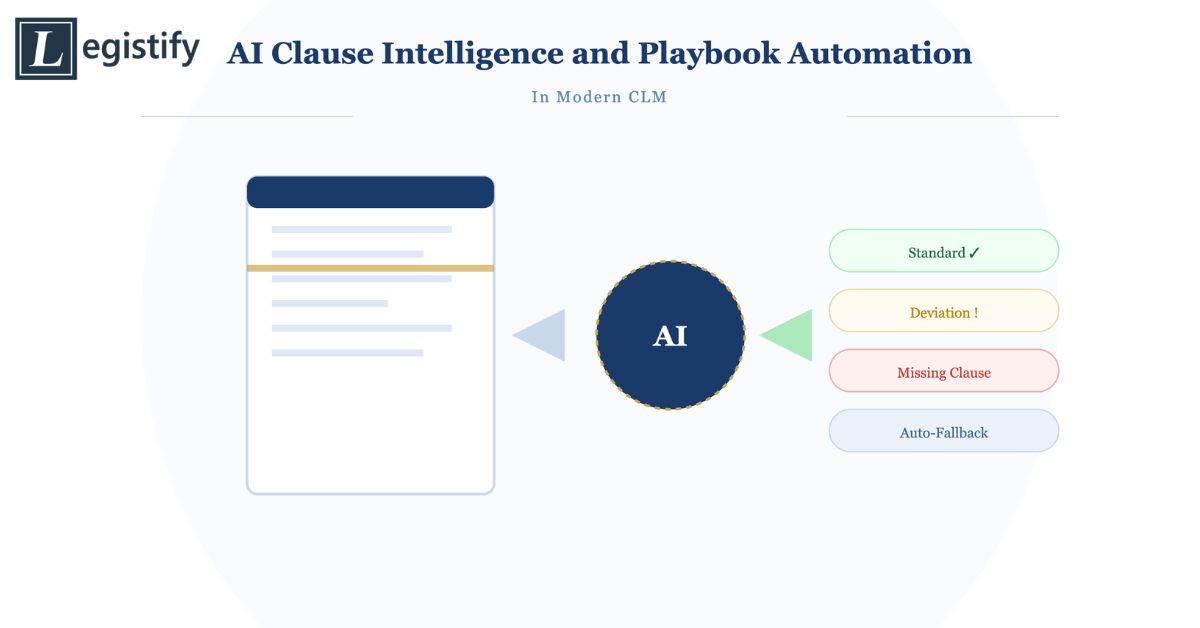
Concretely, clause intelligence can automatically extract, classify, and score thousands of clause types simultaneously, handling standard templates, scanned agreements, and genuinely diverse document layouts with a level of consistency that manual review cannot realistically sustain across high volumes. It identifies every clause present in a document, evaluates its meaning and associated risk level, and specifically checks for deviations from the organisation’s expected terms or, just as importantly, for terms that should be present but are simply missing entirely.
This last point matters more than it might initially seem. A missing limitation of liability clause, or a missing data processing provision in an agreement that clearly involves personal data, is a risk that pure keyword-search tools consistently fail to catch, because there is nothing there to search for. Genuine clause intelligence checks for absence as rigorously as it checks for problematic presence.
The practical effect of this capability is that legal and procurement teams can focus their actual attention on exceptions specifically, the handful of clauses in a given contract that genuinely deviate from what is expected or acceptable, rather than manually reading every single document in full from beginning to end regardless of how standard or unusual its terms turn out to be.
What Playbook Automation Actually Does
Playbook automation embeds an organisation’s preferred clause language, internal legal standards, and defined approval paths directly into the CLM system itself, so that these standards are applied consistently and automatically to every incoming contract, rather than depending on individual lawyer recall or interpretation each time a similar clause type comes up for review.
Rather than manually re-drafting the same clause response 200 times a year across similar deals, the system applies the organisation’s pre-approved positions and fallback language automatically wherever the relevant clause type is detected. Where a counterparty proposes language falling within an acceptable, pre-approved fallback range, the system can flag it as acceptable without requiring escalation. Where proposed language falls genuinely outside every pre-approved position, it is automatically routed to the appropriate level of human review, rather than either blocking progress unnecessarily or allowing a non-standard term through unnoticed.
This is meaningfully different from clause intelligence alone. Clause intelligence identifies and classifies what a clause says. Playbook automation goes a step further, applying the organisation’s own specific judgment about what should happen next given what that clause says, consistently, without needing a lawyer to personally re-apply that same judgment to every individual instance.
The Measurable Impact: Time and Cost
The productivity impact of properly implemented playbook automation is not marginal. One December 2025 ROI study surveying more than 100 active customers of a legal AI platform found that customers reported saving an average of 14 hours per lawyer per week, alongside a 14% reduction in outside counsel spend, translating to roughly $252,000 in annual savings based on a median outside counsel budget of $1.8 million. The same study found that purpose-built legal AI tools delivered 21% greater perceived accuracy compared with generic AI tools, attributed specifically to purpose-built systems surfacing precise, character-level citations rather than confident-sounding but unverified approximations.
Separately, platforms with deep clause intelligence capability report accuracy rates in the range of 94% for automated issue detection, independently verified by outside law firm review in at least one publicly documented case. This level of precision is a meaningful differentiator from generic AI tools that lack specialised legal training on contract-specific language and risk patterns, and is the primary reason purpose-built legal AI, rather than a general-purpose AI assistant applied to legal documents as an afterthought, has become the standard expectation for serious enterprise CLM deployment.
From Playbook Enforcement to Agentic Orchestration
The most significant emerging development in this space is what the industry is increasingly calling agentic CLM: AI that does not just flag deviations for a human to review but actively orchestrates contracting steps across legal, procurement, finance, and other business users directly.
In this model, AI agents route approvals automatically, enforce playbook positions without requiring manual checking at every step, trigger obligation checks at the appropriate points in the contract lifecycle, and update connected systems, ERP, source-to-pay platforms, CRM, without requiring manual human intervention at each individual handoff point. In clause selection specifically, this looks like AI automatically applying the organisation’s preferred clause language, proposing market-acceptable fallback positions where the preferred language is rejected, and explicitly highlighting only the specific risks that genuinely require human judgment, rather than surfacing every single clause for review regardless of whether it actually needs attention.
This represents a meaningful evolution beyond simple playbook automation. Machine learning is increasingly used to continually adjust an organisation’s own legal playbooks by analysing negotiation histories directly, refining what counts as an acceptable fallback position based on what the organisation has actually agreed to in practice over time, rather than requiring a manual, periodic playbook review process to keep positions current with how negotiations are genuinely unfolding.
What Changes for Legal Teams in Practice
Contract review shifts from reading everything to reviewing exceptions. Rather than a lawyer reading a full contract from start to finish regardless of how standard it is, AI-powered clause intelligence pre-screens the document and surfaces only the specific clauses that deviate from expectation or that are entirely missing, letting the lawyer’s actual time and judgment go where it is genuinely needed.
Negotiation shifts from positional bargaining toward data-informed discussion. Where playbook automation is connected to broader analytics, such as market benchmarking on pricing-related clauses, negotiations can shift from a purely positional back-and-forth toward a discussion genuinely grounded in current market data and the organisation’s own historical negotiation patterns.
Compliance shifts from periodic audit toward continuous monitoring. Playbook Distillation-style systems that learn from an organisation’s own past agreements to build and continuously refine customised playbooks, combined with natural language processing that automatically identifies risky or non-compliant language and suggests compliant alternatives, convert contracts from static, one-time-reviewed documents into genuinely dynamic compliance monitoring assets.
Legal capacity effectively expands without headcount growth. For an organisation managing meaningfully high contract volume, AI-driven clause intelligence and playbook automation applied at scale can save substantial sums annually simply by reducing the manual review burden required per contract, freeing legal team capacity for the genuinely complex, judgment-heavy work that automation is not designed to replace.
What to Actually Look For When Evaluating This Capability
Given how much marketing language in this category has converged around similar-sounding claims, “AI-powered,” “intelligent,” “automated”, the specific questions that reveal genuine capability versus surface-level branding are worth asking directly of any vendor.
Does the system explain its reasoning, or just present a conclusion? AI explainability varies considerably across the category. Some platforms focus primarily on workflow automation without offering deep, transparent clause analysis; others provide detailed reasoning for why a specific clause was flagged, which is significantly more useful for a lawyer who needs to actually trust and act on the output rather than simply accept it on faith.
How does the system handle document diversity? Genuine clause intelligence needs to handle not just clean, standard templates but scanned agreements, unusual formatting, and documents that were never digitised with structured data extraction in mind. A system that performs well only on its own pre-formatted templates is demonstrating a much narrower capability than one that performs consistently across genuinely diverse, messy real-world document types.
Is the playbook static or does it actually learn over time? The more advanced implementations continually refine an organisation’s playbook based on actual negotiation outcomes and historical patterns, rather than requiring a manual, periodic review process to keep the playbook aligned with how the organisation is actually negotiating in practice day to day.
What accuracy evidence exists, and is it independently verified? Vendor-reported accuracy figures are useful as a starting point, but independent verification, such as review by an outside law firm, provides considerably more confidence than a vendor’s own internal, unaudited benchmark.
The India-Specific Dimension
For Indian enterprise legal teams specifically, clause intelligence and playbook automation deliver the most value when the underlying AI has genuinely been trained on Indian contract language, Indian regulatory clause types, and Indian drafting conventions, rather than a generic model trained predominantly on US or UK contract templates and then applied to Indian agreements without adaptation.
This matters concretely for clause categories that are specific to the Indian regulatory and commercial environment: MSME payment term clauses, stamp duty allocation provisions, DPDPA-compliant data processing language, and regulatory clauses tied to RBI, SEBI, or IRDAI requirements. A generic clause intelligence engine trained primarily on Western contract conventions will frequently either miss these India-specific clause categories entirely or misclassify them, since the underlying language patterns and risk signals differ meaningfully from what the model was originally trained to recognise.
Legistify’s contract management platform applies AI-powered clause intelligence and playbook automation specifically trained on Indian contract language and India-specific regulatory clause categories, ensuring that deviation detection, risk scoring, and automated fallback suggestions are genuinely accurate for the clause types Indian enterprise legal teams actually encounter day to day, rather than adapted after the fact from a model built for a different legal and commercial context entirely.
Conclusion
AI-powered clause intelligence and playbook automation are converting contract lifecycle management from a document storage and workflow tool into a genuine decision-support system: one that reads every clause at scale, applies an organisation’s own negotiation standards consistently without requiring manual re-application each time, and increasingly orchestrates entire contracting workflows with human judgment reserved specifically for the exceptions that genuinely warrant it. With 70% of organisations planning to adopt AI-enhanced CLM within three years, this is no longer a differentiating capability reserved for the most advanced legal teams; it is quickly becoming the baseline expectation for any enterprise managing contracts at meaningful scale.