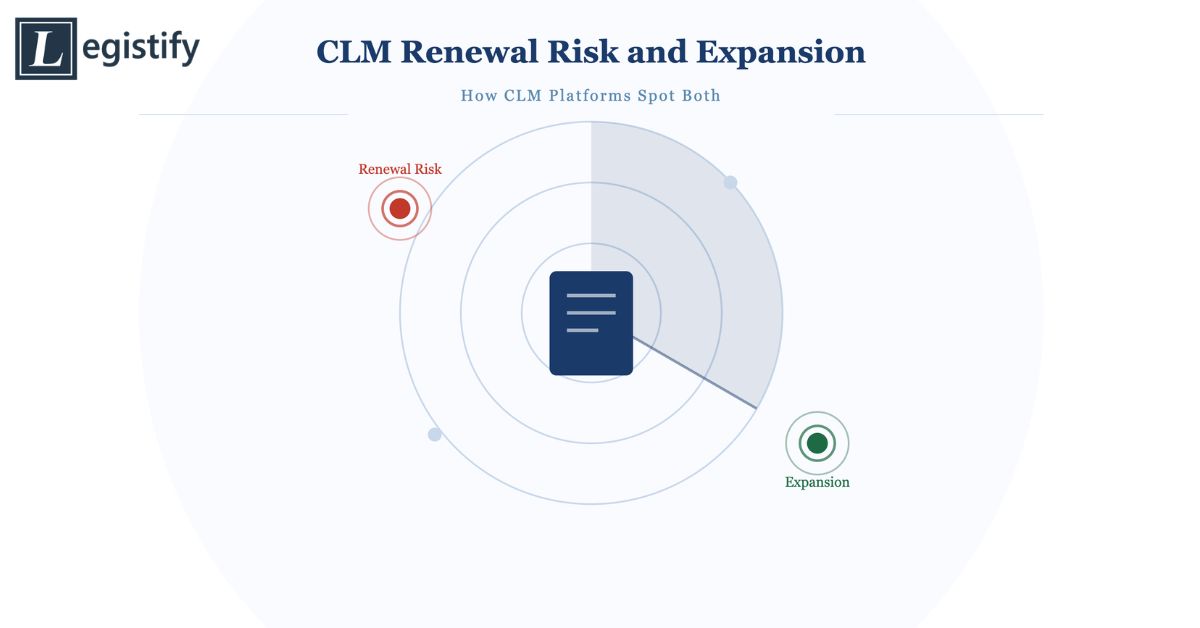
Modern enterprises are rethinking contracts, not as static legal records sitting in a repository once signed, but as dynamic revenue assets containing genuine insight into customer relationships, supplier performance, and profitability. This is a real shift in how contract data gets used, not just a marketing reframe. Contract lifecycle management platforms now harness AI, analytics, and automation specifically to turn contract data into actionable intelligence, helping organisations identify renewal risks early and uncover expansion opportunities that drive measurable revenue growth, rather than simply storing signed documents for reference if a dispute ever arises.
This blog covers how CLM platforms actually identify renewal risk and revenue expansion opportunity in practice, what data and signals they rely on, and what an enterprise needs in place to extract this intelligence rather than just theoretically owning software capable of producing it.
Why Renewal Intelligence Requires More Than Just Dates
The most basic form of renewal tracking, an alert that fires 60 or 90 days before a contract’s end date, solves a real problem but is a fairly shallow form of intelligence. Renewal intelligence in a genuinely modern CLM platform depends on more than contract dates alone. Leading platforms combine clause analysis, obligation tracking, performance metrics, and predictive analytics together to identify specifically which contracts require proactive attention, and why, rather than simply flagging every contract approaching expiry with equal urgency.
This distinction matters operationally. A contract approaching renewal where the customer has been consistently satisfied, payments have been on time, and usage has been growing steadily needs a very different kind of attention, likely an expansion conversation, than a contract approaching renewal where support tickets have spiked, payment has been delayed twice, and usage has been flat or declining. A CLM platform that only tracks the date treats both contracts identically. A platform with genuine renewal intelligence treats them completely differently, and directs the right kind of attention to each.
Clause-level risk scoring
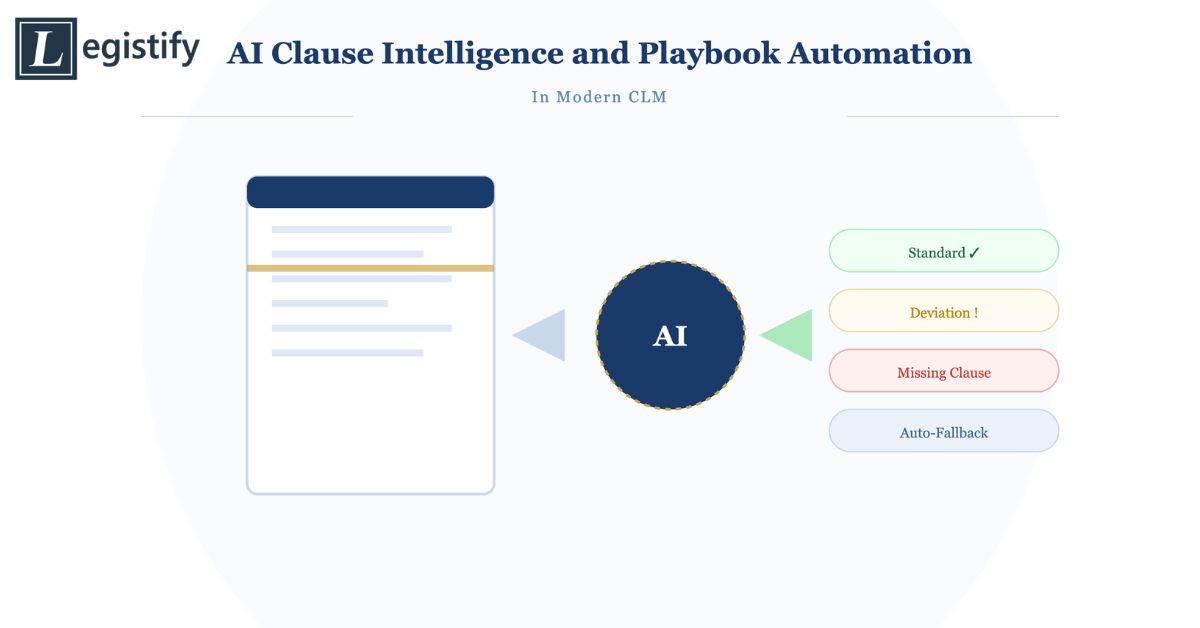
Using machine learning, CLM platforms analyse contract clauses specifically to identify patterns tied to renewal risk. Terms such as auto-renewal triggers, liability caps, and price escalation clauses are scored as high, medium, or low risk, based on how those specific clause types have historically correlated with renewal outcomes across the organisation’s broader contract portfolio.
This clause-level analysis surfaces risk that a simple date-based alert would never catch. A contract with a narrow auto-renewal window, an unusually favourable price lock for the customer that is about to expire, or a liability cap that is now out of step with the organisation’s current standard position, all represent renewal risk signals that live inside the contract’s actual language, not in its metadata.
Obligation fulfilment tracking
Whether an organisation has consistently met its own obligations under a contract, delivery timelines, SLA commitments, reporting requirements, is itself a strong predictor of renewal likelihood. A pattern of missed or late obligation fulfilment on a specific account is an early warning sign that the relationship is deteriorating well before the renewal date itself arrives, giving account teams time to intervene rather than being surprised by a non-renewal decision at the last moment.
Performance and usage signals
For subscription and service-based agreements specifically, usage data, how actively a customer is actually using the product or service relative to what they are paying for, is one of the strongest available predictors of renewal risk. Declining usage trends ahead of a renewal date are a consistent early signal that a customer relationship needs proactive account management attention, often well before the customer themselves has decided not to renew.
Predictive analytics across the full portfolio
Rather than assessing each contract in isolation, leading CLM platforms apply predictive models across the full contract portfolio, learning from historical patterns of which combinations of clause type, obligation performance, and usage trend have actually preceded non-renewal in the past, and using those patterns to flag currently active contracts that share similar characteristics before the renewal decision point arrives.
Contract data reveals growth opportunities just as reliably as it reveals risk, though this side of contract intelligence receives less attention in most organisations simply because no one is actively looking for it inside the contract repository.
Usage trends signal upsell readiness. A customer whose usage has been steadily climbing toward or past the ceiling of their current contracted tier is a strong, concrete candidate for an upsell conversation, and this signal is sitting directly inside the organisation’s own contract and usage data, not requiring any external market research to identify.
Entitlement gaps signal cross-sell potential. Comparing what a customer is currently entitled to under their contract against the organisation’s full product or service catalogue surfaces specific, concrete cross-sell opportunities, gaps between what a customer already has and what else might genuinely serve their needs, rather than relying on a generic, one-size-fits-all outbound sales campaign.
Renewal patterns reveal pricing and packaging insight. Aggregated across the full portfolio, patterns in what gets renewed, what gets renegotiated down, and what churns entirely reveal genuine insight into which pricing structures and contract terms are actually working for the organisation’s customer base and which are quietly creating friction that shows up later as non-renewal.
Pricing structure analysis identifies expansion-ready accounts. Where an account’s current pricing was set some time ago and market or usage conditions have since shifted meaningfully in the organisation’s favour, contract data can surface these accounts as specific, prioritised candidates for a renegotiation conversation at the next renewal point, rather than defaulting every account to a flat renewal at existing terms.
Why Integration Is the Difference Between Contract Data and Contract Intelligence
Integrations are critical to effective renewal and expansion management specifically because contract data alone, without the surrounding business context, only tells part of the story. Connecting CLM with CRM, ERP, procurement, and other operational systems provides the additional context needed to meaningfully improve forecasting, negotiation preparation, and day-to-day decision-making around any specific account.
A contract’s terms, viewed in isolation, tell you what was agreed. Connected to CRM data, that same contract tells you how the relationship has actually evolved since signing, support ticket volume, engagement level, expansion conversations already underway. Connected to ERP and billing data, it tells you whether the customer is actually paying on time and at what volume relative to what was contracted. It is this connected view, not the contract document alone, that produces genuinely actionable renewal and expansion intelligence rather than a static legal record with a date attached to it.
What This Looks Like as a Business KPI, Not Just a Technical Capability
One of the more significant shifts in how organisations think about CLM recently has been treating it less as a standalone tool and more as a measured enabler of business outcomes, with legal and business leaders tying CLM performance directly to quantifiable KPIs that make its value visible right across the enterprise, not just within the legal function.
The KPIs that matter most for renewal and revenue intelligence specifically include: renewal and revenue realisation, the proportion of contracts renewed or terminated on schedule, which directly measures how well the organisation is preventing unplanned leakage or unintended, unfavourable auto-renewals; clause deviation rate, how often counterparties push for changes away from the organisation’s standard playbook positions, which signals where negotiations are slowing down or where risk is quietly increasing across the portfolio; and business visibility, dashboards that translate raw contract exposure into the financial and operational terms that a CFO or COO can actually act on directly, rather than requiring a legal translation layer every time leadership wants to understand contract-related revenue risk.
Where This Capability Is Heading
The direction of travel across the CLM market is unambiguous: from workflow automation toward genuine decision intelligence. Rather than functioning purely as a workflow tool designed to make administrative processes more efficient, the organisations succeeding with CLM increasingly treat it as a decision engine, one that actively correlates contract terms with external, real-time context.
A concrete example of where this is heading: for pricing that includes escalation clauses tied to commodity or market indices, an analytics engine can correlate contract terms with real-time market benchmarks directly, automatically flagging contracts where pricing is quietly becoming non-competitive relative to current market conditions, and providing data-backed negotiation guidance, including specific, suggested fallback language, rather than leaving the account team to notice the pricing drift manually and negotiate from a purely positional, unsupported stance.
Owning a CLM platform with these capabilities is necessary but not sufficient on its own. Extracting genuine renewal and expansion intelligence in practice requires a few specific things to actually be in place.
Structured, extracted contract data, not just stored PDFs. Clause-level risk scoring and obligation tracking depend entirely on the underlying contract terms being extracted into structured, queryable data. A repository of unstructured PDF documents, however well organised the folder structure, cannot support this kind of analysis without an AI-powered extraction layer sitting in front of it first.
Genuine integration with CRM, ERP, and usage data systems. As covered above, contract terms alone are only half the picture. Without a live connection to the business context surrounding each contract, renewal risk scoring is working with an incomplete, contract-only view of what is actually a much richer underlying relationship.
A clear internal owner for acting on the intelligence, once surfaced. A platform that correctly flags a renewal risk or an expansion opportunity delivers no actual value if there is no defined process, and no clearly accountable person, for acting on that flag before the renewal date passes or the expansion window closes.
Legistify’s contract management platform is built around this connected intelligence model specifically: AI-powered clause and obligation extraction that turns contract text into structured, queryable data, portfolio-level renewal risk scoring, and integration with the broader systems that give that contract data the business context it needs to become genuinely actionable, rather than sitting as a well-organised but ultimately static document repository.
Conclusion
The future of contract lifecycle management is contract intelligence: enterprises are increasingly using AI-powered insights, predictive models, and portfolio-level analytics specifically to improve retention, reduce revenue leakage, and maximise contract value across the full lifecycle of every agreement they hold. Understanding how leading CLM platforms actually deliver this intelligence, through clause-level risk scoring, obligation tracking, usage-based expansion signals, and deep integration with the broader business systems that provide surrounding context, is essential for any legal, procurement, or revenue leader looking to treat their contract portfolio as the strategic asset it genuinely is, rather than a filing cabinet with better search functionality.