Only one in ten people find contracts easy to understand, and a mere 17% report being satisfied with the overall contracting process, according to a widely cited survey by the International Association of Contract and Commercial Management. This is not a minor usability complaint. It is a structural problem with how contracts have traditionally been designed: dense legal language, lengthy undifferentiated clauses, and document structures optimised for legal precision rather than for the business people who actually need to negotiate, approve, and live with those agreements day to day.
Visual contracting is the emerging response to this problem, and it is gaining real traction across enterprise legal functions in 2026, not as a cosmetic exercise in making contracts prettier, but as a structural rethink of what a contract is actually for and who it needs to serve.
What Visual Contracting Actually Is
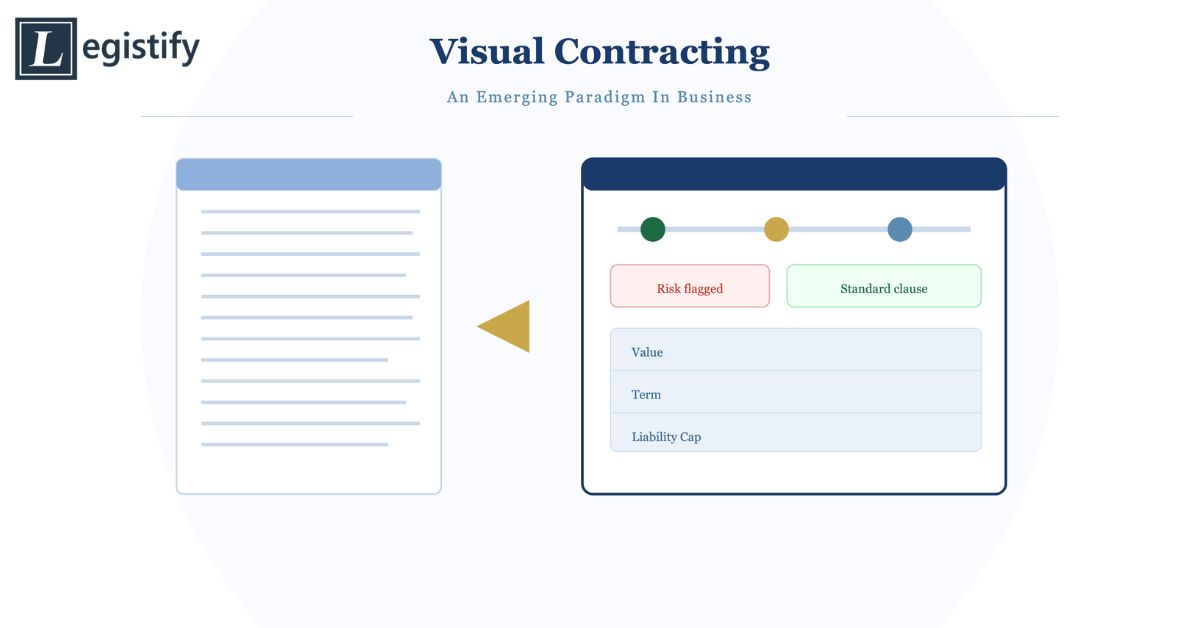
A visual contract combines legally binding text with diagrams, icons, timelines, tables, and other visual elements to communicate key obligations, rights, and commercial terms more clearly than dense prose alone can achieve. The legal substance of the agreement does not change; what changes is how that substance is presented and navigated.
Contract design treats the document as an interface rather than purely as a legal record. This reframing matters because it shifts the design priority: an interface is judged by how quickly and accurately the people using it can find what they need and understand what it means, not solely by how comprehensively it protects the drafting party from every conceivable risk. Prioritising layout clarity, logical navigation, and plain-language precision does not dilute legal rigour; done properly, it optimises execution speed by removing the friction that comes from business users having to route every question back through legal for translation.
This is a distinct discipline from simply writing contracts in plainer English, though the two often go together. Visual contracting specifically uses graphic elements, flowcharts for approval or escalation processes, timelines for payment or delivery milestones, icons for risk categories, and summary tables for key commercial terms, to convey structure and relationships that are genuinely difficult to communicate through unbroken paragraphs of prose, no matter how plainly worded.
Why This Shift Is Happening Now
Cross-functional teams need to understand contracts without a lawyer present. As organisations place greater emphasis on collaboration, self-serve business processes, and contract transparency, the traditional model, where every contract question routes back through legal for interpretation, has become an operational bottleneck rather than a quality control feature. When sales, procurement, and finance teams can accurately interpret a contract’s key terms without a legal translation loop, negotiation and approval cycles compress meaningfully.
Negotiation friction drops when risk is visible at a glance. Compressed negotiation cycles are a direct, measurable benefit of visual contract design: friction is reduced during the redline phase specifically because risk-bearing clauses are made explicitly visible, through highlighting, colour coding, or dedicated risk summary sections, rather than being buried in the same undifferentiated block of text as routine boilerplate. A counterparty’s legal team can identify what actually requires their attention faster, which shortens the back-and-forth that eats up contract cycle time.
Elevated trust replaces documentation as suspicion. When contract terms are opaque, counterparties tend to treat the document with suspicion, assuming complexity is hiding something unfavourable, and this suspicion itself slows negotiation. Transparency, achieved partly through visual clarity, replaces this suspicion with trust, accelerating consensus across procurement, finance, and other stakeholders who are not lawyers but who still need to sign off on commercial terms.
Dispute risk falls when ambiguity is eliminated at the source. A meaningful proportion of contract disputes originate not from bad faith but from genuine ambiguity about what a clause actually required, an ambiguity that a visual summary of obligations, timelines, and triggers can eliminate before it ever becomes a point of contention.
AI has made visual contract generation practically feasible at scale. Producing a well-designed visual contract for every agreement type used to require dedicated design skill, specialised tools, or external legal design consultants, an upfront investment that made sense for frequently reused templates but rarely justified itself for one-off or lower-value agreements. AI-based tools that can convert written contract text into visual representations directly, and increasingly convert those visual representations into structured, machine-readable formats, have substantially lowered the cost and effort required to apply visual design principles across a much broader range of contract types, not just an organisation’s flagship templates.
From Single Contracts to Connected Contract Networks
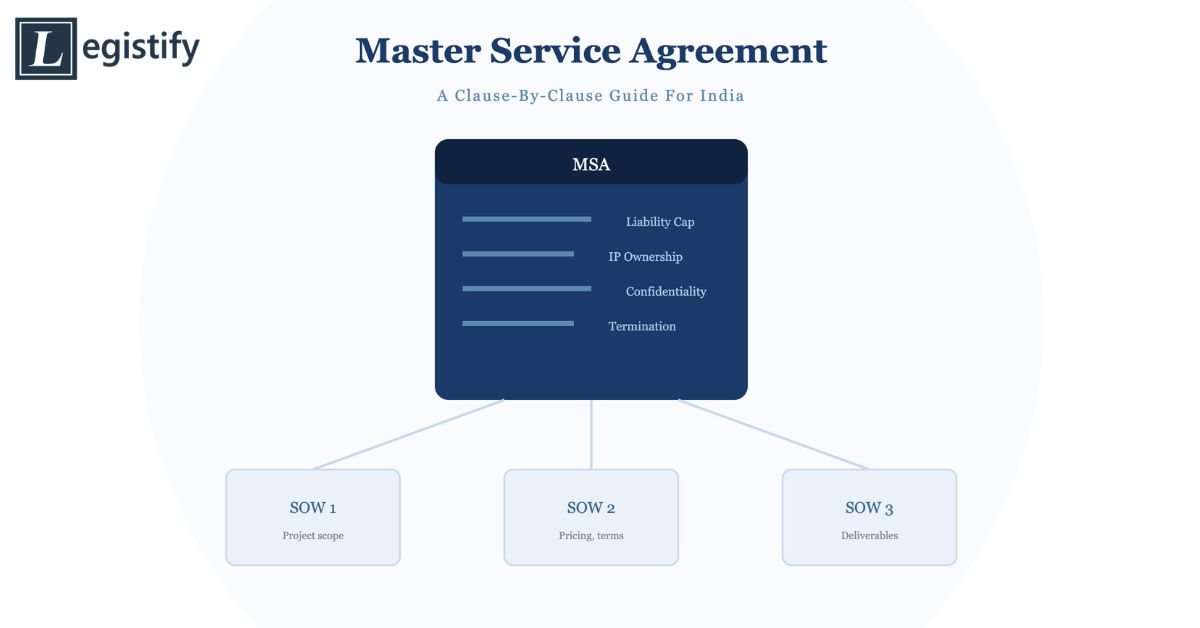
The most significant long-term implication of visual contracting extends beyond making any single agreement easier to read. Visualisation of contracts extends naturally from individual documents to chains and networks of interconnected contracts, since most enterprise commercial relationships are not governed by one isolated agreement but by a web of master agreements, statements of work, amendments, and related side agreements that all bear on each other.
The world of contracts is moving from being an archipelago of isolated contracts, each understood and negotiated in isolation, toward a connected landscape where the relationships between agreements matter as much as the terms within any single one. Navigating this connected landscape without visual aids becomes genuinely difficult once an organisation is managing hundreds of interrelated agreements: which master agreement governs which statement of work, which amendment modified which original term, and how an obligation in one contract depends on a condition defined in another. A purely textual approach to representing these relationships does not scale; a visual representation of the contract network, showing how documents connect and depend on each other, does.
Some legal technology researchers describe a further evolution beyond this: once visual representations of contract logic are sufficiently structured, they can be converted into software code, enabling contracts that can execute or flag their own conditions automatically and solicit human interaction specifically when genuine exceptions arise, rather than requiring manual monitoring of every clause across every agreement. This is a more speculative frontier than the current, practical adoption of visual elements within individual contracts, but it illustrates the underlying direction the paradigm is heading: from static documents toward structured, navigable, and eventually semi-autonomous representations of commercial relationships.
What Visual Contracting Looks Like in Practice
Obligation and timeline visualisation. Payment schedules, delivery milestones, and renewal windows presented as a visual timeline rather than buried within prose paragraphs, making it immediately clear what is due when, and to whom.
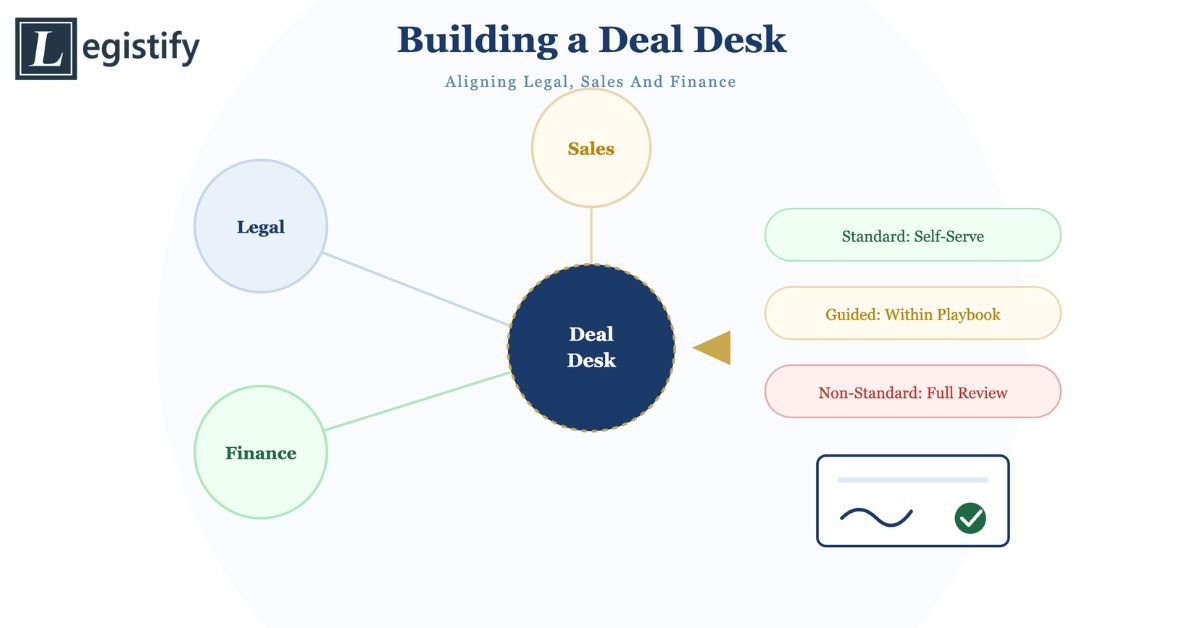
Risk and deviation highlighting. Clauses that deviate from an organisation’s standard playbook position, or that carry above-average risk, marked with visual indicators (colour, icons) so a reviewer’s attention goes immediately to what actually requires judgment, rather than requiring a full read-through of every clause to find the parts that matter.
Summary dashboards for key commercial terms. A front-loaded summary table presenting the contract value, term length, termination rights, and liability caps at a glance, before the reader has to work through the full legal text to extract the same information manually.
Process flowcharts for approval and escalation. Visual representation of who needs to approve what, in what sequence, and what happens if a dispute arises, replacing dense procedural clauses with a diagram that a non-lawyer can follow without translation.
Relationship maps across connected agreements. For complex commercial relationships governed by multiple linked documents, a visual map showing how the master agreement, statements of work, and amendments relate to each other and which terms in each currently govern.
Where Visual Contracting Makes Sense, and Where It Does Not
Visual contract design is not universally the right approach for every agreement, and being clear-eyed about its limits is part of applying it well.
It works best for recurring, high-volume contract types. The upfront design investment, whether through in-house legal design capability or increasingly through AI-assisted design tools, is justified when the same template will be reused across many transactions: standard vendor agreements, NDAs, and customer MSAs are strong candidates.
It is less justified for genuine one-off agreements. For a highly bespoke, individually negotiated transaction that will never be reused as a template, the design effort required to visualise it well may not be proportionate to its one-time use, and traditional prose drafting remains the more practical choice.
Time-sensitive emergency contracts should not wait for design. Where immediate execution is critical to capturing a business opportunity, defaulting to a well-understood traditional format that can be executed without delay takes priority over the clarity benefits a visual redesign would add.
Counterparty preference matters. Where a counterparty’s own legal or procurement function has an established review process built specifically around traditional text-only contracts, introducing a visual format may create friction rather than reducing it, at least until visual contracting becomes a more universally expected format across the market.
What This Means for Enterprise Legal and Contract Management Teams
For enterprise legal teams evaluating whether and how to adopt visual contracting, the practical starting point is identifying which contract types in the organisation’s portfolio are both high-volume and currently a source of negotiation friction or business team confusion. These are the templates where a visual redesign, whether built through dedicated legal design expertise or increasingly through AI-assisted contract design tools embedded in a broader contract management platform, will deliver the clearest, most measurable return.
This also connects directly to the broader shift toward AI-assisted contract management already underway across enterprise legal functions. A contract management platform that can extract structured data from contract text, tag clause types, and surface obligations and deadlines is already doing much of the underlying analytical work that visual contract presentation depends on; the visual layer is a natural extension of that same structured understanding of a contract, made visible to the humans who need to act on it, rather than a separate, disconnected design exercise.
Legistify’s contract management platform builds toward exactly this layer, using AI-powered contract tagging to extract clause types, obligations, and risk flags from every agreement in the repository, providing the structured foundation that visual contract summaries, obligation timelines, and risk dashboards can be built on directly, without a separate legal design exercise for every template.
Conclusion
Visual contracting is gaining traction because it addresses a real and long-standing problem: contracts, as traditionally drafted, are difficult for the business people who negotiate and rely on them to actually understand, and that difficulty has a measurable cost in slower negotiation cycles, more disputes rooted in ambiguity, and a persistent dependency on legal teams to translate agreements that should be more directly legible. As AI-assisted tools make visual contract design more accessible across a broader range of agreement types, and as the paradigm extends from individual contracts to the connected networks of agreements that actually govern most enterprise relationships, visual contracting is positioned to move from a legal design niche into a standard expectation for how well-run organisations present their commercial agreements.