If your legal team is still tracking bank guarantees on a spreadsheet, chasing physical stamp paper, or discovering an expired BG only when a beneficiary tries to invoke it, the problem is not your process. It is the instrument itself. Paper bank guarantees were never designed for the volume and complexity that enterprise legal and finance teams now manage, and the operational risk that comes with them has become too expensive to ignore.
Electronic bank guarantees, issued and tracked through NeSL’s Digital Document Execution platform, are replacing paper BGs across Indian enterprise contracting at a pace that most legal teams have not yet caught up with operationally. This guide covers what a bank guarantee actually is, why the paper version has become a genuine liability at scale, how eBG works, what RBI has mandated, and what enterprise legal teams need to build into their contract management process to manage eBG obligations properly.
What a Bank Guarantee Is and Where It Shows Up in Enterprise Contracts
A bank guarantee is a commitment issued by a bank on behalf of its customer (the applicant), promising to pay a beneficiary a specified sum if the applicant fails to fulfil a contractual obligation. It is a risk mitigation instrument, not a payment instrument: the beneficiary does not expect to actually invoke it in the ordinary course of a healthy commercial relationship, but its existence gives the beneficiary confidence to proceed with the contract in the first place.
In enterprise contracting, bank guarantees appear constantly, and legal teams encounter them across a wide range of contexts:
Performance guarantees in vendor and construction contracts, assuring the buyer that the supplier will complete the contracted work to the agreed standard, with the guarantee available to cover the buyer’s loss if the supplier defaults.
Bid bonds and earnest money deposits in tender and procurement processes, particularly in government and PSU tenders, where a BG substitutes for a cash deposit that would otherwise tie up the bidder’s working capital.
Advance payment guarantees, protecting a buyer who has paid an advance against the risk that the supplier does not deliver.
Financial guarantees supporting credit facilities, lease obligations, and other financial commitments between commercial counterparties.
For BFSI and large enterprise legal teams specifically, bank guarantees are not occasional instruments. They sit inside a significant proportion of vendor contracts, tender submissions, and project agreements, and the portfolio of active guarantees at any given time can run into hundreds or thousands of instruments across a large enterprise’s contract base.
Why Paper BGs Are a Liability at Enterprise Scale
A single paper bank guarantee is manageable. A portfolio of several hundred, spread across multiple business units, vendors, and expiry dates, is where the paper-based process breaks down in ways that create real financial and legal exposure.
Manual tracking with no systemic visibility. Paper BGs are typically tracked in spreadsheets maintained by individual finance or legal team members, if they are tracked centrally at all. There is often no single, authoritative view of the organisation’s total outstanding guarantee exposure, which guarantees are approaching expiry, or which beneficiary holds which instrument. This is precisely the kind of contract obligation tracking failure that plagues manual contract management more broadly, except with a financial instrument attached to it.
Expiry risk that goes unnoticed until it is a problem. A bank guarantee that expires without being renewed, extended, or properly closed can leave the beneficiary unprotected at exactly the point where the underlying contractual risk it was meant to cover is still live. Conversely, an expired BG that the applicant forgot to formally close continues to block the applicant’s guarantee limit with the issuing bank unnecessarily, tying up credit capacity that could be used elsewhere.
Fraud and authentication risk. Physical bank guarantees have historically been vulnerable to forgery. A beneficiary receiving a paper BG has limited means of independently verifying its authenticity beyond contacting the issuing bank directly, and fraudulent BG scams, where a fabricated guarantee is presented as genuine, are a recurring risk in Indian commercial practice.
Slow issuance and encashment. Traditional paper BG issuance typically takes three to five working days, involving physical stamp paper procurement, manual signing, and physical delivery. Encashment, when a beneficiary needs to invoke a guarantee, can be similarly slow, adding delay at precisely the moment when the beneficiary most needs a fast response.
Stamp duty compliance risk. Physical BGs require physical stamp paper, correctly valued for the applicable state and instrument type. Errors here compound the same admissibility risk that applies to any other physically stamped instrument in India: an incorrectly stamped guarantee may not be enforceable as evidence in the event of a dispute.
For legal teams responsible for the organisation’s contract risk overall, a bank guarantee portfolio managed through disconnected spreadsheets and physical files represents an unmanaged pocket of financial exposure sitting outside the systems that are supposed to give the organisation visibility into its contractual risk.
What an Electronic Bank Guarantee Actually Is
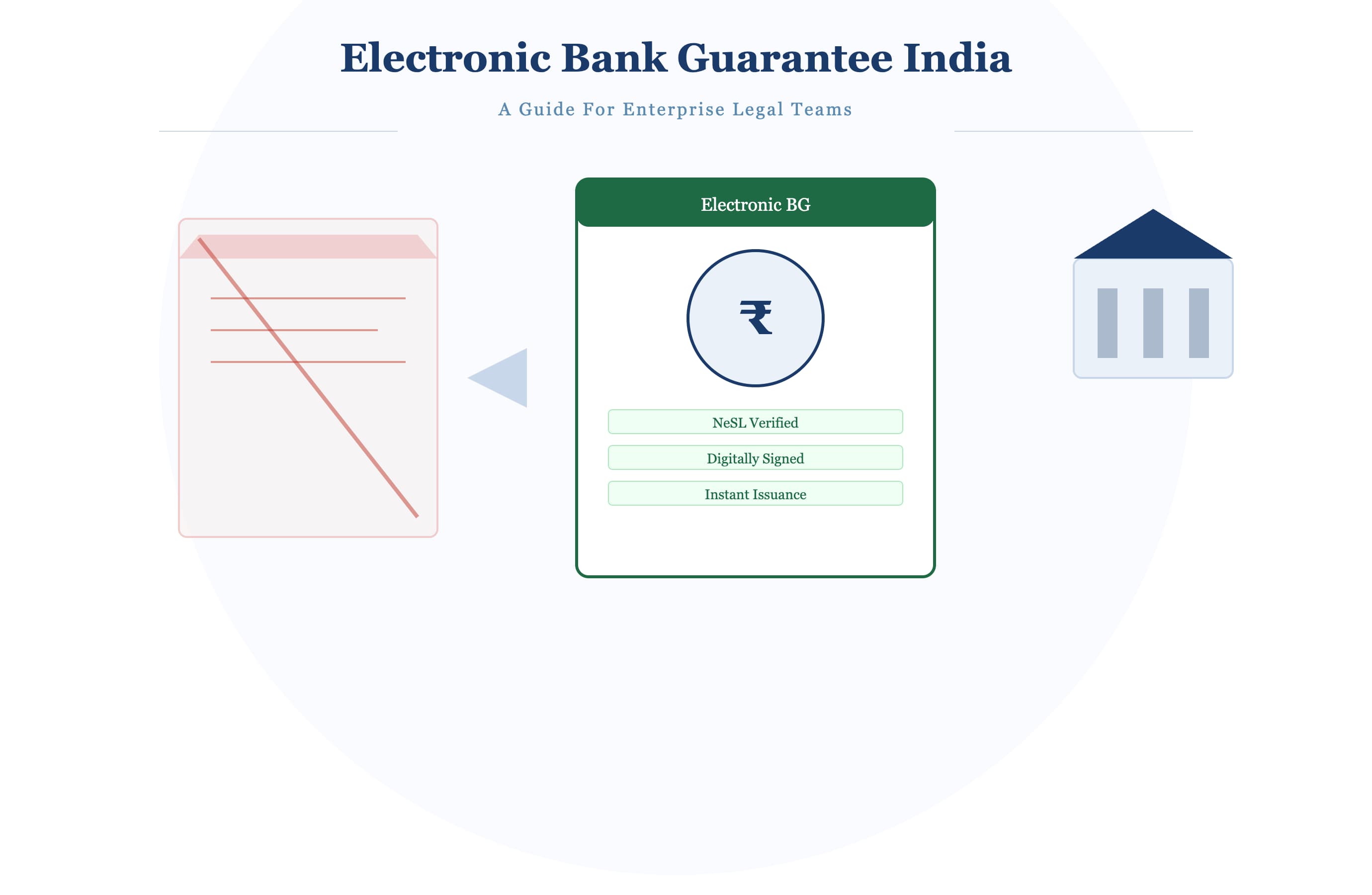
An eBG is a bank guarantee issued, executed, and maintained entirely in digital form through NeSL’s (National E-Governance Services Limited) Digital Document Execution (DDE) platform. NeSL is registered with the Insolvency and Bankruptcy Board of India as an Information Utility and acts as the central repository and validation authority for the guarantee’s full lifecycle.
The mechanics work as follows. The issuing bank integrates its internal systems with NeSL’s DDE platform. When a BG is issued, the bank digitally stamps and digitally signs the document, using Aadhaar eSign (OTP or biometric) or DSC-based signing as permitted under the IT Act, 2000. The digital signature means any subsequent tampering with the document invalidates the signature, addressing the forgery risk that paper BGs carry. Banks are not required to use a standardised BG template; they can continue using their existing documentation formats within the digital workflow.
Once issued, the eBG is hosted centrally on the NeSL platform, and the beneficiary, the applicant, and the issuing bank can all access, search, view, and download it directly from NeSL at any time, without needing to request a separate authentication from the issuing bank. NeSL sends a direct notification to the beneficiary’s registered email on issuance, and on every subsequent lifecycle event: amendment, invocation, or closure. E-stamping is handled entirely within the platform: banks maintain a Digital Ledger with NeSL, and the applicable stamp duty is deducted automatically from that ledger balance, eliminating the need for physical stamp paper procurement entirely.
The result: issuance that previously took three to five working days can now happen in a few hours, verification that previously required a phone call to the issuing bank now happens instantly on the NeSL portal, and the risk of a fabricated or altered guarantee is substantially reduced because any tampering breaks the digital signature.
What RBI Has Mandated
The Reserve Bank of India has pushed banks toward eBG adoption as part of its broader digital financial infrastructure agenda, and the Department of Financial Services separately advised public sector banks in September 2022 to evaluate and adopt eBG. RBI has mandated that qualifying transactions move to eBG issuance, with banks required to implement eBG capability for these categories, and NeSL’s platform, along with a small number of empanelled Third Party Service Providers integrated with it, is the infrastructure through which banks meet this requirement.
For enterprise legal teams, the practical implication is straightforward: if your organisation deals with banks and beneficiaries operating under this mandate, particularly in government and PSU tender contexts, you should expect an increasing share of your BG portfolio to be issued as eBG rather than paper going forward, regardless of what your own internal preference is. Government e-procurement portals including GeM and CPPP, along with several state e-procurement systems, now integrate directly with NeSL for automatic BG verification, meaning a paper BG submitted into these tender processes increasingly stands out as the exception rather than the norm.
How Legal Teams Should Track and Manage eBG Obligations
Moving from paper to electronic does not automatically solve the underlying management problem; it changes the nature of what needs to be tracked, but the tracking discipline itself still needs to be built.
Maintain a structured register of every active eBG, not just paper BGs. The same obligation tracking discipline that applies to paper BGs applies to eBGs: applicant, beneficiary, issuing bank, guarantee amount, issue date, expiry date, and underlying contract reference. The advantage of eBG is that this metadata is available directly from the NeSL platform rather than requiring manual extraction from a physical document, but someone still needs to pull it into the organisation’s own contract and obligation tracking system.
Track expiry and renewal windows proactively. An eBG that is approaching expiry needs the same proactive alerting as any other contract renewal deadline: 90, 60, and 30-day windows before expiry, so the business has time to decide whether to renew, extend, or allow the guarantee to lapse because the underlying obligation has been satisfied.
Link every eBG to its underlying contract record. A bank guarantee exists because of an underlying contractual obligation, whether a performance commitment, a tender bid, or an advance payment. The eBG should be recorded as a linked obligation within the contract’s own record in the organisation’s contract management system, not tracked as an entirely separate, disconnected instrument. This is what allows the legal team to see, for any given vendor contract, whether the associated BG is current, approaching expiry, or already lapsed, without cross-referencing two separate systems.
Monitor invocation and closure events. NeSL notifies registered parties of amendment, invocation, and closure events automatically, but the organisation still needs a defined internal process for what happens when one of these notifications arrives: who reviews an invocation notice, what the response timeline is, and how the outcome is documented against the underlying contract.
Verify stamp duty compliance is genuinely automated, not just assumed. While NeSL’s Digital Ledger mechanism automates stamp duty deduction, legal teams should periodically confirm that the bank’s jurisdiction determination and stamp value calculation are being applied correctly, since the underlying state stamp duty rules still vary and the responsibility for correct application sits with the bank, not with NeSL itself.
Where Contract Management Software Fits
The operational discipline described above, structured tracking, proactive renewal alerts, and linkage between the guarantee and its underlying contract, is exactly the workflow that a proper contract management platform is built to support. Treating eBG obligations as a category of contract data that flows through the same repository, obligation tracking, and alerting infrastructure as every other commercial commitment removes the need for a parallel, manually maintained BG tracker sitting outside the legal team’s core systems.
For enterprise legal teams managing large vendor and tender portfolios, this means every underlying contract that carries a BG requirement has that requirement visible directly in the contract record: the guarantee amount, the issuing bank, the expiry date, and an automated alert well before that expiry date arrives, whether the guarantee itself is paper or electronic.
Legistify’s contract management module supports exactly this: obligation tracking that covers financial instruments like bank guarantees alongside standard contractual obligations, automated renewal and expiry alerts, and a structured contract repository that keeps the underlying agreement and its associated eBG or paper BG connected in one place rather than scattered across a spreadsheet, a bank portal, and a physical file.
Conclusion
The shift from paper to electronic bank guarantees in India is not a minor administrative upgrade. It removes a specific, quantifiable category of operational risk, manual tracking failures, expiry surprises, forgery exposure, and slow issuance and encashment, that has sat quietly inside enterprise contract portfolios for years. RBI’s push toward eBG adoption and NeSL’s growing integration across government e-procurement infrastructure mean this shift is accelerating regardless of any individual organisation’s preference. For enterprise legal teams, the practical task now is making sure eBG obligations are tracked with the same rigour as every other contractual commitment, linked to the underlying contract, and visible in the same system the legal team already relies on for everything else.