Contract lifecycle management software has matured well beyond storage and e-signature. In 2026, CLM is a full workflow and intelligence engine for contracts, and evaluating it requires more than comparing feature lists across vendor websites. This guide covers how to evaluate CLM software properly: what actually differentiates platforms, what questions to ask during vendor demos, and what the India-specific considerations are that most global buyer’s guides do not address.
Why CLM Evaluation Has Changed
Contracts are the connective tissue of every business: they define how revenue is captured, how suppliers are managed, and how teams stay compliant. Yet in too many organisations, contracting remains fragmented, with Word files living in email threads, signatures sitting in a separate app, and no one able to say with confidence which version is final.
Nearly every CLM vendor now promises automation and AI. These capabilities speed up contract drafting and negotiation, but speed alone does not solve the deeper problems that procurement and governance leaders are accountable for: audit failures from missing or outdated evidence, contract leakage from off-contract spend, and fragmented risk visibility across the organisation’s full contract portfolio. Evaluating CLM in 2026 means looking past the AI feature checklist to ask whether the platform actually unifies risk, compliance, and spend, not just document workflow.
The Core Evaluation Criteria
Speed to value
How quickly can the organisation actually start using the platform productively, not just how quickly can it be installed. A platform that takes six months of configuration before the legal team sees any benefit is a different proposition from one that delivers a working first use case within weeks. Ask vendors specifically: what does a typical implementation timeline look like for an organisation of our size and contract volume, and what does “live” mean at each stage.
Adoption by business teams
CLM success depends on adoption across legal, sales, and procurement, not just the legal team that purchased it. Consider ease of use, training requirements, and whether the platform fits how teams already work. A platform that requires business teams to learn an entirely new interface and workflow will face resistance regardless of its technical capability. Ask for reference calls specifically with business users (sales, procurement), not just legal buyers, to understand the real adoption experience.
Data integration
A modern REST API is table stakes in 2026; some leading platforms also offer GraphQL. Webhooks let downstream systems react to CLM events such as a contract being signed, an approval being requested, or a renewal coming up. If your legal team already uses specific tools (Slack, Salesforce, an ERP), factor integration into vendor evaluation directly, since without it, legal and business teams will resist adoption. Verify the actual API surface area during the demo; some vendors gate meaningful API access behind expensive enterprise tiers, and the integration cost difference between a rich API and a limited one can be an order of magnitude in custom development time.
AI readiness
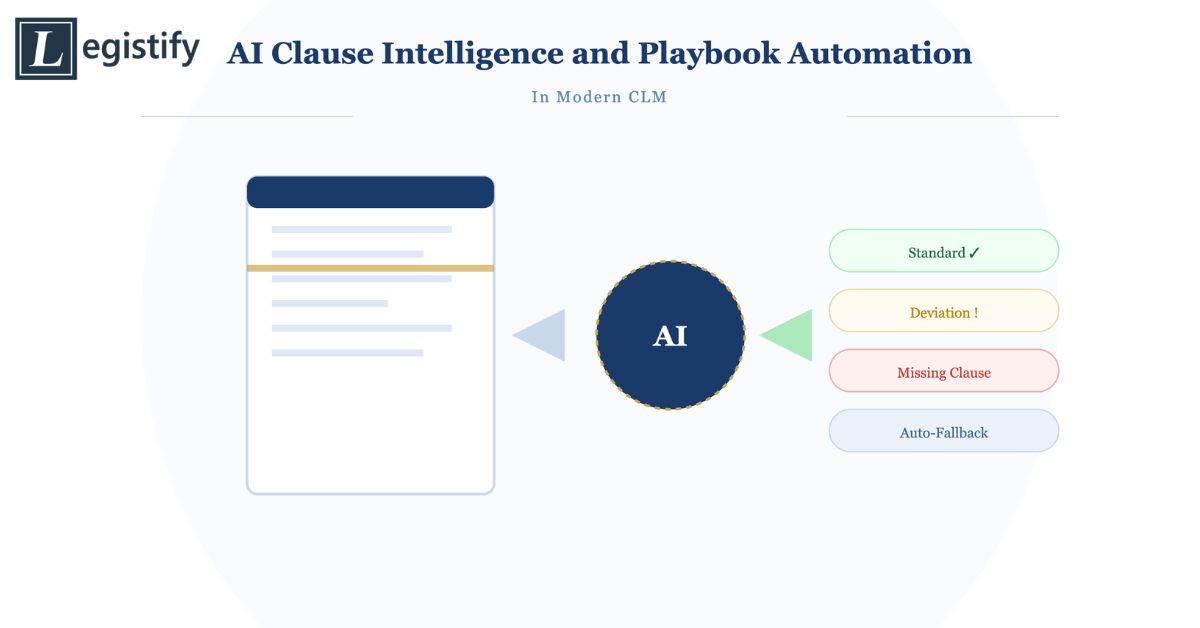
AI is transforming contract management: leading platforms use it to automate contract review, identify risks, extract key data, and generate actionable insights. But AI readiness needs to be evaluated specifically, not assumed from marketing claims. Ask what data the AI models were trained on, whether the vendor supports training or fine-tuning on your organisation’s own contract templates and playbook, and what the actual accuracy rate is for the specific use cases you need (clause extraction, risk flagging, obligation identification).
Security and compliance
SOC 2, GDPR, HIPAA, and industry-specific requirements matter for contract data, which is often among the most sensitive information an organisation holds. Enterprise buyers typically require detailed security documentation before procurement approval. For Indian enterprises specifically, this evaluation needs to extend beyond global certifications to India-specific requirements: DPDPA compliance, data residency options, and sector-specific regulatory frameworks for BFSI, insurance, and other regulated industries.
Implementation effort and total cost of ownership
Evaluate long-term business value before choosing a solution: implementation effort, pricing structure, and how costs scale with usage all matter more than the headline price. Some platforms price per user seat, others per contract volume, and others on a flat enterprise licence. Understand which model fits your organisation’s growth trajectory, since a per-seat model that looked affordable at 20 users can become expensive at 200.
The Buying Committee
CLM purchases typically involve a buying committee spanning legal counsel, procurement, sales operations, IT and security, and a finance approver. Each stakeholder evaluates the platform against different criteria, and a CLM evaluation that only involves legal will miss requirements that procurement, IT, or finance would have flagged.
Legal counsel evaluates risk management, clause libraries, playbook enforcement, and litigation/dispute tracking capability.
Procurement evaluates vendor contract management, spend visibility, renewal management, and rebate/discount tracking.
Sales operations evaluates deal velocity, self-serve contract generation for standard agreements, and CRM integration.
IT and security evaluates data security, API architecture, deployment model (multi-tenant SaaS vs. private cloud vs. on-premise), and integration with existing enterprise systems.
Finance evaluates total cost of ownership, contract value reporting, and financial exposure tracking.
What to Ask in a Vendor Demo
Rather than accepting a generic product walkthrough, structure the demo around your organisation’s actual workflows.
Bring your own contract. Ask the vendor to demonstrate the platform’s AI-assisted review on an actual contract from your organisation, not a sanitised demo document. This reveals how the AI performs on your real contract language, clause types, and complexity, not a carefully chosen example.
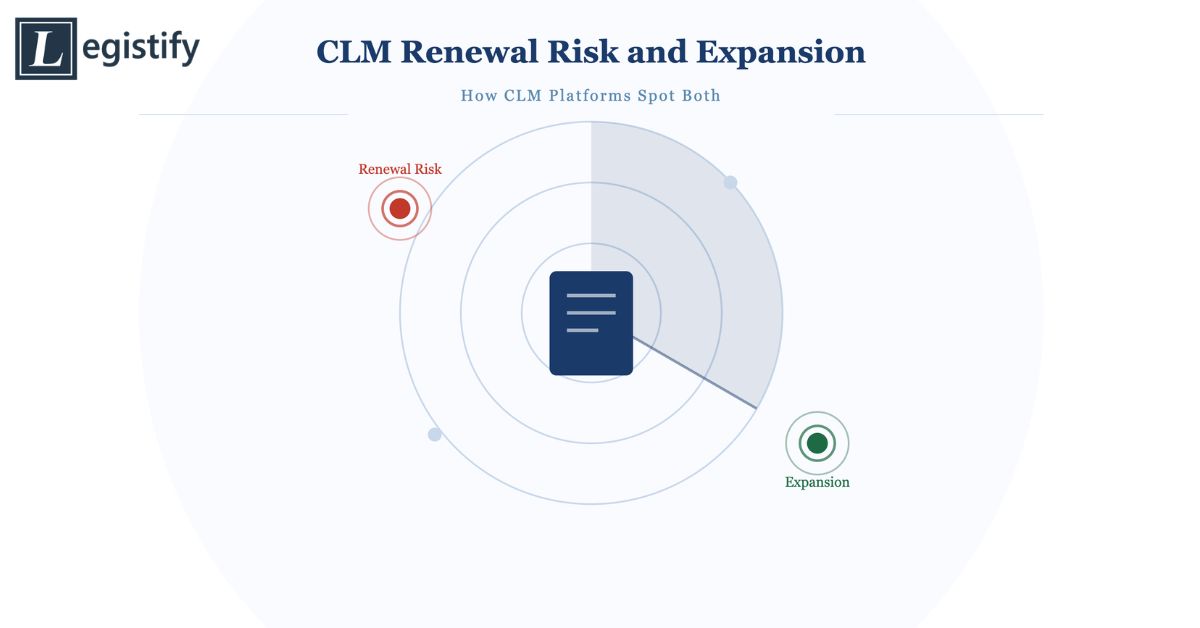
Ask about the renewal and obligation tracking workflow specifically. Walk through exactly how a contract renewal alert is generated, who receives it, how far in advance, and what happens if no action is taken. This is one of the most commonly underdelivered features across CLM platforms.
Test the search and reporting capability live. Ask the vendor to answer a specific portfolio-level question live during the demo, such as “how many of our vendor contracts have an auto-renewal clause with less than 60 days’ notice.” A platform with genuinely structured data should answer this quickly; a platform relying on unstructured document storage will struggle.
Ask about data migration for the existing contract portfolio. Most organisations have hundreds or thousands of existing signed contracts. Ask specifically how the vendor handles bulk ingestion and metadata extraction from this legacy portfolio, and what the expected accuracy and timeline are.
India-Specific CLM Requirements
Global CLM buyer’s guides consistently miss the requirements that matter most for Indian enterprises. Before finalising a CLM evaluation for an Indian organisation, confirm the following capabilities specifically.
Multi-state stamp duty support. Contract execution in India requires correct stamp duty assessment across more than 25 state frameworks. A CLM that does not support this natively will leave stamp duty compliance as a manual, disconnected step outside the platform.
Aadhaar eSign and DSC integration. Native support for Aadhaar eSign and Digital Signature Certificates, not just generic e-signature capability built around US or EU standards, is essential for Indian commercial and regulatory documents.
DPDPA-compliant data processing workflows. With the Digital Personal Data Protection Act’s compliance deadline approaching in 2027, CLM platforms need to support DPDPA-compliant Data Processing Agreement templates and obligation tracking natively.
India Post and registered dispatch integration. For notice management and certain regulated communications, integration with India Post’s registered dispatch and tracking system is a specific requirement not covered by global CLM platforms.
Indian court and regulatory clause libraries. Clause libraries covering RBI, SEBI, and IRDAI regulatory requirements, and templates reflecting Indian contract law conventions, are necessary for the platform to meaningfully support Indian legal teams’ day-to-day drafting and review work.
Analyst Reports: How to Use Them
Industry analyst reports such as the Gartner Magic Quadrant and Forrester Wave typically rank platforms like Ironclad, DocuSign CLM, Icertis, ContractPodAi, and Agiloft as enterprise leaders, with mid-market specialists such as ContractWorks, Concord, PandaDoc, and Conga populating other quadrant positions. These reports are useful inputs for building a shortlist, but they should not substitute for vendor demos against your organisation’s actual workflows, since analyst evaluation criteria may weight factors differently from what matters most for your specific use case and regulatory environment.
Conclusion
Evaluating CLM software in 2026 requires looking past the now-universal AI feature checklist to the questions that actually determine whether a platform will deliver value: how quickly will business teams adopt it, how deeply does it integrate with the tools you already use, how well does the AI perform on your actual contracts, and does it meet the specific compliance requirements of your regulatory environment. For Indian enterprises, this evaluation needs to explicitly include Aadhaar eSign, DSC support, multi-state stamp duty, and DPDPA compliance, none of which are covered by default in globally oriented buyer’s guides.