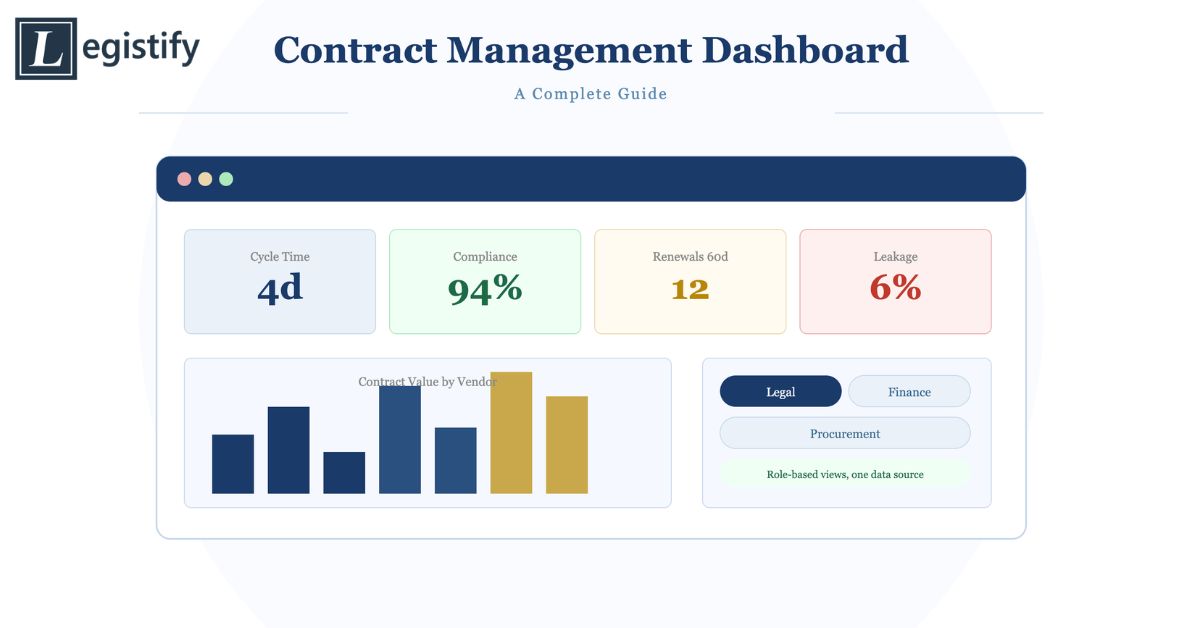
A contract management dashboard is a centralised interface that gives legal, sales, finance, and procurement teams a single view of contract status, deadlines, approvals, renewals, and performance metrics. Instead of contract data buried across PDFs, email threads, and individual spreadsheets, a dashboard turns a portfolio of agreements into a live, queryable picture of commitment and risk.
By 2026, the volume and complexity of enterprise contracts has grown to a point where managing this data manually is no longer viable. Without a dashboard, organisations face specific and recurring problems: visibility gaps that make it hard to identify who owns a contract or where it sits in an approval chain, missed renewals from manual calendar tracking that trigger expensive auto-renewals or service interruptions, and bottlenecks where legal becomes the choke point with no visibility into which approver is causing the delay.
This guide covers what a contract management dashboard should include, the specific metrics that matter, and how to build one that actually gets used.
Who Uses a Contract Management Dashboard and Why
Legal teams use dashboards to track contract risk, compliance status, and the overall health of the portfolio. A legal-facing dashboard typically surfaces non-standard clauses, contracts with unusual liability exposure, and matters requiring escalation.
Sales teams use contract dashboards to accelerate deal velocity and prevent revenue from stalling in the contracting process. For sales, the dashboard answers a specific question: where are deals stuck in the approval or signature process, and what is holding them up?
Finance teams use contract dashboards to manage cash flow, forecast liabilities, and ensure payment terms are honoured. Finance needs visibility into total contract value, payment schedules, and financial exposure from active agreements.
Procurement teams use dashboards to track vendor spend, contract compliance, and renewal timing to avoid unfavourable auto-renewals and to time negotiations for maximum leverage.
Each function needs a different view of the same underlying data, which is why role-based configurable dashboards, where legal sees risk metrics and procurement sees spend and renewal data from the same source, are now standard practice rather than a premium feature.
The Core Metrics Every Contract Management Dashboard Should Track
Lifecycle metrics
Cycle time measures the time from contract initiation to execution. This is the single most watched metric because it directly reflects how efficiently the organisation is converting agreements into signed, enforceable documents.
Time to sign measures the time from when a document is sent for signature to when it is fully executed. This isolates the signature stage specifically, which is useful for diagnosing whether delays are happening in drafting and negotiation or in the final execution step.
Compliance metrics
Compliance rate tracks the percentage of contracts that meet the organisation’s standard terms, playbook positions, and regulatory requirements. A declining compliance rate signals that non-standard terms are slipping through review.
Leakage rate tracks the percentage of contracted value that is not being realised because of missed rebates, incorrect billing against contracted rates, or off-contract spend. Contract leakage is one of the most expensive metrics most organisations do not measure: industry estimates put leakage at 5 to 15% of total contracted spend in organisations without real-time monitoring, which on a portfolio of INR 100 crore in contracted procurement represents INR 5 to 15 crore in avoidable loss.
Renewal metrics
Renewal rate tracks what percentage of contracts due for renewal are actually renewed, which is a useful proxy for both vendor and customer relationship health.
Auto-renewal pipeline surfaces every contract approaching its auto-renewal date within a defined window (commonly 90, 60, and 30 days), giving the team time to make an active decision rather than defaulting into another term.
Value metrics
Contract value realised compares the value the organisation is actually capturing (through pricing achieved, rebates claimed, and cost avoidance) against the value that was negotiated into the contract.
Vendor or customer concentration shows what percentage of total contract value sits with the top vendors or customers, which is relevant for both risk assessment and negotiation leverage.
What a Contract Management Dashboard Should Do Beyond Display Data
A contract management dashboard should do more than passively display dates. It should actively work for the team using it in several specific ways.
Proactive alerting. The dashboard should surface upcoming expirations, notice periods, and auto-renewal windows before they become urgent, not just display the date somewhere in a table. Obligation tracking should extend beyond renewal dates to ongoing commitments: SLAs, payment schedules, compliance requirements, and any other post-signature obligation.
Drill-down capability. Summary statistics are a starting point, not an endpoint. A user should be able to click on any chart or figure and see the exact contracts contributing to that number. A dashboard that shows “14 contracts at risk” without letting the user identify which 14 contracts is not operationally useful.
Risk flagging. The dashboard should highlight “at-risk” contracts specifically, whether that risk comes from an approaching deadline, a compliance gap, or an unusual clause, so that users can intervene before the risk becomes a dispute or a financial loss.
Role-based views. Different users should see different data depending on their role: legal sees risk and compliance metrics, procurement sees spend and renewal data, finance sees payment and liability figures. This requires the underlying data model to support filtering and access control by role, not just by department label.
Integration with the broader software ecosystem. A dashboard that sits in isolation from the CLM, ERP, and CRM systems that generate the underlying data will always be showing stale or incomplete information. Real dashboards sync with these systems to reflect current financial and operational data.
Common Failure Modes
Organisations building or evaluating contract management dashboards run into a consistent set of problems.
Data segregation. If contract data lives in disconnected systems (a CLM for legal, a spreadsheet for procurement, an ERP for finance), no single dashboard can give an accurate picture without proper integration. Building a dashboard on top of fragmented data produces a dashboard that is only ever partially correct.
Passive rather than active design. A dashboard that only displays historical data, without alerting on what is coming up or flagging what needs attention, provides less operational value than one that is actively surfacing what matters right now.
Metric overload without prioritisation. Dashboards that try to show every possible metric at once become difficult to use. The most effective dashboards default to a small number of headline metrics (cycle time, compliance rate, renewal pipeline, and leakage rate are a reasonable starting set) with the ability to drill into more detail as needed.
No connection to the underlying documents. A dashboard that shows contract status without letting the user open the actual signed document and supporting files forces a separate search through a document management system, undermining the single-source-of-truth value the dashboard is supposed to provide.
Building a Contract Management Dashboard: A Practical Approach
Start with the questions leadership actually asks. Rather than building a dashboard around every metric that could theoretically be tracked, start with the specific questions that come up in leadership reviews: what is our total contingent liability from active contracts, which renewals are we at risk of losing in the next quarter, and where is the contract approval process breaking down.
Ensure the underlying contract data is structured, not just stored. A dashboard is only as good as the data feeding it. If contracts are stored as unstructured PDFs without extracted metadata (parties, dates, values, clause types), no dashboard can be built without that extraction happening first, typically through AI-powered contract tagging.
Build role-based views from a single data source. Rather than building separate systems for legal, procurement, and finance, build a single underlying data model with role-based views on top of it. This ensures that when a contract renews or a term is renegotiated, every function sees the update simultaneously.
Prioritise proactive alerts over passive dashboards. The dashboards that get used consistently are the ones that actively push relevant information to users (renewal approaching, compliance gap detected, unusual clause flagged) rather than requiring users to log in and check.
Legistify’s contract management platform includes a built-in dashboard with role-based views for legal, procurement, and finance, automated renewal and obligation alerts, and drill-down reporting connected directly to the underlying contract repository.
Conclusion
A contract management dashboard is the operational nerve centre for how an organisation understands its own contractual commitments. Done well, it replaces the fragmented, reactive process of chasing contract status across spreadsheets and email with a single, live view that surfaces risk before it becomes a problem and gives every function, from legal to finance to procurement, the specific data they need without having to ask someone else for it.